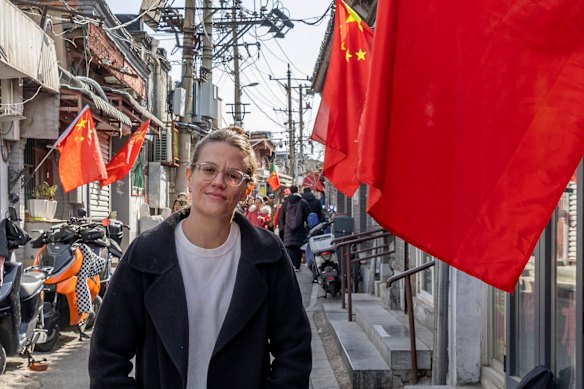

Beijing: When the formidable journalist Margaret Jones landed in Beijing in 1973, she found a city that was “dusty, noisy and endlessly fascinating”.
Her first impression of the Chinese capital has been echoing in my mind since I stepped off the plane at Beijing’s international airport a fortnight ago, at the tail end of the Chinese New Year holiday.
More than 50 years after Jones blazed a trail as The Sydney Morning Herald and The Age’s first China correspondent, I’m following in her footsteps and reopening our news bureau to cover this vast, consequential country at a time of great upheaval in the international system.
Ironically, I landed in Beijing just as a sandstorm was hitting the city, with winds sweeping off Mongolia’s Gobi Desert, throwing grit into the air and greying the skies overhead. Clear-air days have otherwise become more common in this city of 23 million people as authorities have made inroads on Beijing’s air pollution over the past decade.
I also glimpsed Beijing as it rarely is – quiet, its streets almost sleepy. The city had largely emptied for the holiday, save for the omnipresent yellow-clad delivery drivers zipping across town, charging up escalators in food malls to collect orders before racing back to their bikes. The Chinese New Year travel rush is the largest annual human migration on the planet, as millions crisscross the country to be with family in their hometowns – a sign of the enormous people-power China has to leverage.
As for endlessly fascinating, well, that’s guaranteed.
The China that Jones encountered was, of course, vastly different to the one that awaits me, but the ribbon of history runs through them.
“Peking … almost another planet” splashed the headline over one of Jones’ earliest dispatches, where she reflected that every Western value had been overthrown by a society that had “absolute dedication to one single cause”.
The headline is perhaps too anthropological to pass muster these days. Then again, while writing this piece, a robot arrived at my hotel room carrying the coffee I ordered from a nearby cafe using a food delivery app 20 minutes earlier. Flourishes of capitalism – or “socialism with Chinese characteristics”, as the party likes to call it – are everywhere.
If you can get past the enormous human capital and environmental cost of millions of online orders being ferried by poorly paid drivers across the city each day, you’ll be amazed by what can land on your doorstep within the hour.
Jones’ coverage began at the tail end of the Mao Zedong era, in what was then an impoverished and isolated country still unfamiliar to journalists, and in the final throes of the violent Cultural Revolution.
My China posting coincides with another great political epoch – the Xi Jinping era. Xi is China’s most powerful leader since Mao and has reshaped the country to be more authoritarian and nationalistic, and a global superpower.
Today, the US and China are fierce rivals, racing for supremacy in everything from AI and tech to military and economic might.
On Xi’s watch, every goal of the Chinese Communist Party is funnelled through the lens of national security, backed by a formidable apparatus of state surveillance.
The Chinese internet may not be another planet, but it is certainly a wholly different ecosystem, closed off from the outside world by the Great Firewall and heavily censored by the government.
Modern China runs on this internet, from WeChat, the messaging app that everyone uses to communicate, to the payment and delivery apps that have redefined how people dine and shop without leaving home. This ecosystem, though populated with apps from China’s private tech giants, hands the Chinese government enormous control over its 1.4 billion subjects and the flow of information.
Xi’s China contains multitudes. It’s a cashless society, with dazzling technology powered by AI and automation, but underpinned by a multi-speed economy dragged down by a property market crash that refuses to bottom out, oversubsidised industries and heavily indebted local governments. Its high-speed rail system will transport you to most major cities within hours, futuristic electric vehicles are common, online groceries arrive at your doorstep within 30 minutes, while a network of CCTV cameras track your every move.
Some 800 million people have been lifted out of absolute poverty since the Herald first began reporting from inside China, but millions still live on less than $US8.30 ($11.69) a day, according to the World Bank.
My arrival in Beijing marks our papers’ return to China after a six-year hiatus in our decades-long coverage, following the exodus of Australian news outlets in 2020 as the bilateral relationship between Beijing and Canberra plunged into the freezer.
Our return is timely. The coming months and years in China will be world-shaping, making it more important than ever that Australians better understand our country’s closest economic partner, but also our government’s greatest security concern, and deepen our knowledge of the Chinese people, society and culture.
Xi has anointed no successor, has purged his top military brass in sweeping anti-corruption campaigns, and many experts anticipate he will seek an unprecedented fourth term in office in 2027, extending his rule until at least 2032.
In a few weeks, Xi will host Donald Trump in Beijing in what will be the US president’s first state visit to China of his second term. Expect the full pageantry.
The meeting also has the potential to be consequential, against the backdrop of the simmering US-China trade war, questions about the future of Taiwan and Ukraine, and the eagerness of both men to assert their status as leaders of the global system.
The meeting will take place as allies’ confidence in the United States as a security guarantor and reliable partner wanes, and Trump upends the status quo with his “might makes right” approach to international order.
With the Middle East on the brink of escalating conflict, Trump and Xi will be sitting down in the uncertain aftermath of US-Israeli strikes on Iran this week, which killed that country’s Supreme Leader, Ayatollah Ali Khamenei, and wiped out the political leadership of one of China’s closest partners in the region. Iran also supplies about 13 per cent of China’s oil imports.
Before then, Xi will be centre stage at China’s biggest political event of the year later this week, when the National People’s Congress meets to rubber-stamp the party’s 15th five-year plan. It will give China watchers a glimpse of how Xi intends to steer the world’s second-largest economy into his likely fourth term.
It’s not hard to find people in China who have lived with the scars of the Mao era, but who are also concerned about the current economic woes that have halted many people’s climb from poverty to prosperity.
“Thirty years ago, people in both urban and rural areas were starving,” Mr Li, a butcher in Beijing’s old hutong neighbourhood, tells me.
“Today, even peasants at remote corners of the country are free from food and clothing problems.”
‘Our return is timely. The coming months and years in China will be world-shaping.’
Today, his business is flat, and he doesn’t expect things to improve this year, but he is optimistic that China’s trajectory is upwards.
“The economy and general business environment are not good. As long as China doesn’t fight a war, it will go up.”
As was the case with Jones, our paper is again the beneficiary of stabilised political relations between Beijing and Canberra. She was dispatched by the Herald around the time that prime minister Gough Whitlam made his historic trip to China to normalise ties with Beijing in November 1973. A year earlier, US president Richard Nixon had orchestrated his world-shaping pivot to China, aiming to exploit the deepening rift between Beijing and Moscow.
Today, Beijing and Moscow are tighter than ever – a partnership “without limits”, if you take Xi and Russian President Vladimir Putin’s rhetoric at face value.
I’m joining a small squadron of Australian reporters already here, including correspondents from the ABC and The Australian, benefiting from the Albanese government’s lower-volume approach to friction with Beijing, and China’s decision to tone down its wolf-warrior diplomacy.
It’s discomforting as a journalist to have your fate shaped by a political relationship beyond your control, and one that can change on a dime.
All up, hundreds of foreign journalists are working in China, but this figure belies the difficulty many Western outlets encounter reporting here. Surveillance is all but guaranteed, and tales of visa delays and even refusals are not uncommon.
But if Australian journalists were once persona non grata with China, then the messaging from the system – at least for now – is very different.
For the past week, I’ve been manoeuvring through bureaucratic hoops to set up the papers’ official licensing and bureau structure from scratch. I was expecting a Byzantine process that would take weeks, maybe months, and involve shuttling back and forth between Chinese government departments, securing elusive approvals and getting vast numbers of Australian documents translated into Chinese and vice versa.
To my surprise (and delight), my credentials and the office licence were issued together, mere days after I submitted the paperwork. Within hours, I was sitting in a shop run by Mr Jiang, who was authorised by the Foreign Ministry to make the official seals and stamps for our Beijing bureau.
This breakneck speed of approvals is rare, I’m told.
Jones died in 2006. Her successor in Beijing, the equally inimitable late Yvonne Preston, was on the ground when Mao died in 1976, and she reported from a communist China in transition as it opened to the world. They paved the way for decades of Herald and Age reporters to follow, covering China’s rise from a poverty-stricken country to a global superpower.
Today, we resume this tradition.
Get a note directly from our foreign correspondents on what’s making headlines around the world. Sign up for our weekly What in the World newsletter.
 Lisa Visentin is the North Asia correspondent for The Sydney Morning Herald and The Age. She was previously a federal political reporter based in Canberra.Connect via X or email.
From our partners
Disclaimer : This story is auto aggregated by a computer programme and has not been created or edited by DOWNTHENEWS. Publisher: www.smh.com.au