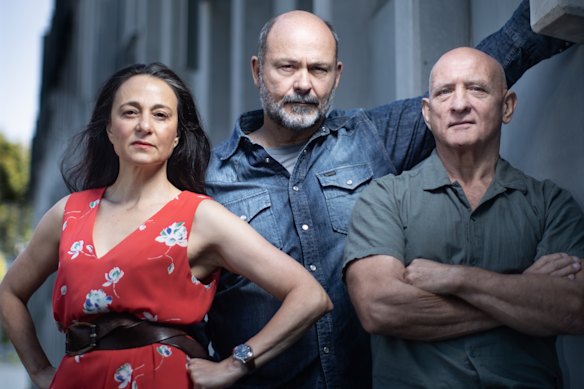
Dennis McIntosh was 11 when Australia’s worst industrial accident killed 35 men. More than 50 years later, his play honours the families left behind.
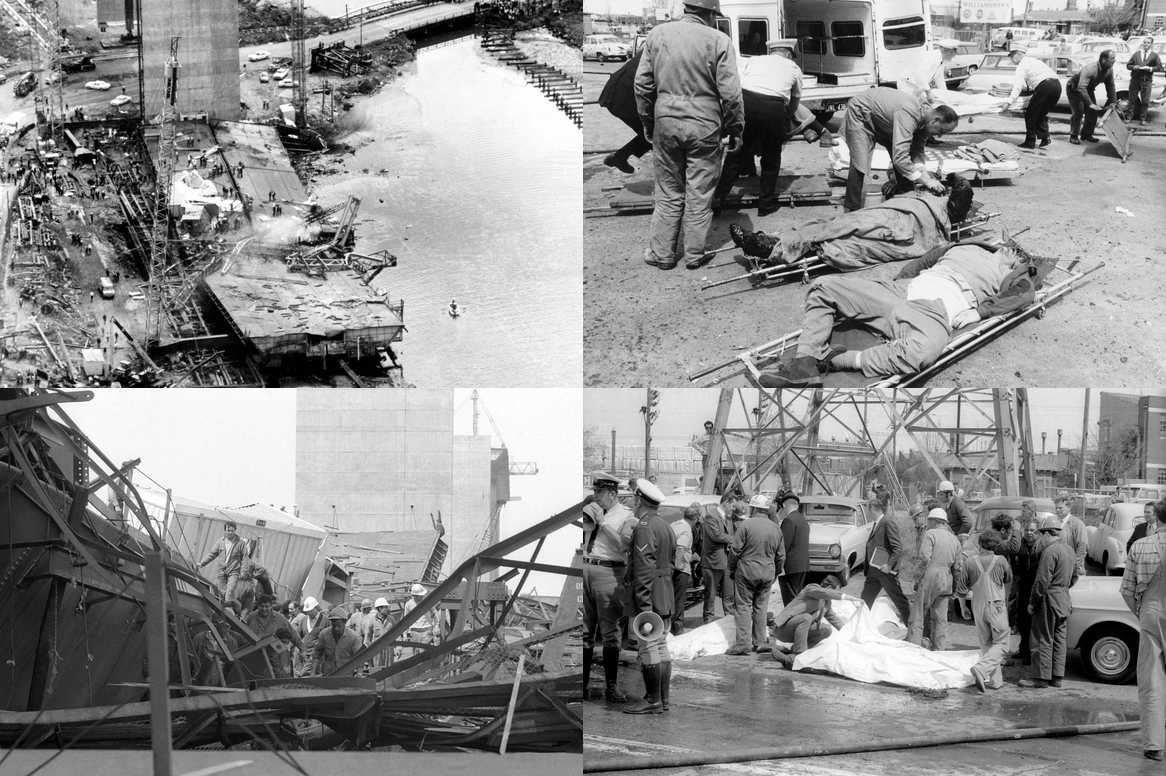
This is the version that most people know. Late in the morning of October 15, 1970, a section of the West Gate Bridge, then under construction, collapsed. Thirty-five men died that day; some were crushed, some fell 50 metres into the water, some burned after tanks of diesel fuel exploded. A further 18 were injured. A subsequent Royal Commission found critical failures in the bridge’s design and construction methods, but no charges were laid. The bridge finally opened to traffic in 1978.
Dennis McIntosh was an 11-year-old student at Newport Primary School and vividly remembers the day it happened. “You felt it and heard it,” he recalls. From the netball courts, he watched smoke rising from the bay. Over the next few days there were many funerals at his church.
He also remembers overhearing talk about problems with the bridge. A similarly designed box girder bridge in Wales had collapsed during construction a few months earlier. Dennis’ father, DF McIntosh, had the same name as one of the resident engineers working on the West Gate. Letters intended for the engineer arrived at the family home. “I remember Dad opening letters, saying, ‘Mum, there’s something wrong with the bridge’.”
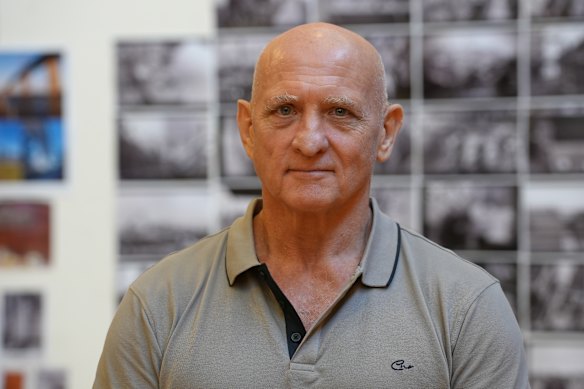
The bridge had been many years in the planning, a 2.5 kilometre span linking the city and established suburbs in the east with the rapidly expanding western suburbs, at that time an industrial and manufacturing hub and home to large numbers of post-war European migrants and blue-collar workers. “It was a big engineering feat. There were 183,000 people living in the west. This [bridge] was a big thing.”
McIntosh has lived a hugely varied life since leaving school in year 9 to milk cows and cart hay; he’s been a shearer, labourer, swimming coach, and language teacher in remote Australia. Jack of all trades doesn’t come close, especially when you add playwright to the list of achievements.
He enrolled in university when he was 40, primarily to gain the skills to write about his daughter, who had developed a brain injury during her infancy and was about to turn 21. He wrote poetry, which was published in The Overland literary journal, two books and completed a PhD.
But somehow, the story of the bridge never left him. He tried to write it as a book, “but every time it was so convoluted, so complex”.
Through a mutual actor friend, McIntosh was introduced to theatre director Iain Sinclair. Not being from Melbourne, Sinclair didn’t know about the disaster. He was shocked to learn that it was the worst industrial accident in Australian history and that it wasn’t in the public consciousness “in the way that it should be”.
“And I was fascinated by the reasons for that.”
Sinclair himself is from a family of coal miners in northern England. His cousins and uncles worked in the pits. His father got a scholarship for athletics, which brought him to Australia.
What attracted Sinclair was that the story of the bridge collapse was being told by someone from the working class.
“I’m acutely aware that quite often working-class stories are seen from the above perspective: Upton Sinclair, John Steinbeck, even Orwell. Middle-class people looking down into the culture.
“But this play, the voice of this play, is working class speaking for itself on its own terms, which I think is admirable for the Melbourne Theatre Company. The state company has chosen to let that story be told from its own value system.”
Among the shocking discoveries Sinclair made was that many of the engineers and managers who worked on the bridge took it off their CVs afterwards, despite being promoted and even winning awards.
There were also backhanded suggestions during the Royal Commission hearings that the militancy of the unionised workers and labour issues were partly to blame.
The bridge’s collapse raised a lot of “intellectual material” — engineering problems, industrial relations, unionism — but it was the human story and McIntosh’s focus on the workers that interested him.
“What really resonated for me was that there was a blind spot in the conversation, and the blind spot was the 35 families.”
Sinclair directed the MTC’s highly acclaimed 2019 production of A View From The Bridge (Age critic Cameron Woodhead gave the “astonishing production” five stars).
He worked with McIntosh from the play’s early stages. “We did decide quite early on to allow this to be epic, and to be poetic as well. Because it’s not really historical revisionism, or a ‘their side, our side’ kind of story. It’s not in that old trade union play tradition.”
One of the challenges for Sinclair is staging an event that hinges around what in a different context would be the explosive climax of a disaster film.
In 2010, Sinclair did a version of Our Town for the Sydney Theatre Company. A prescription of Thornton Wilder’s play is that it takes place on a bare stage with no scenery and minimal props. “You have to create the entire world … From 2010, I’ve been building that theatrical language.
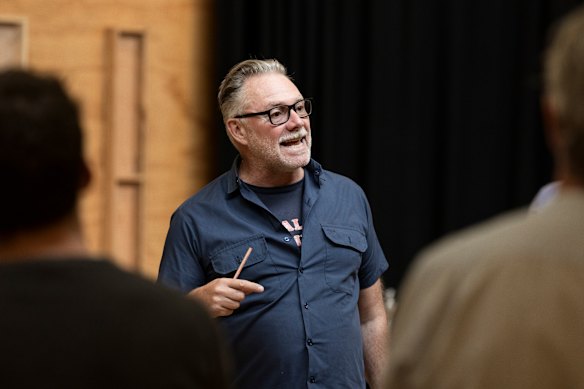
“Arthur Miller makes the point that the great, the best two ages for drama, for theatre, are the Greeks and the Renaissance. Neither of those two times of theatre had sets, or necessarily costume. And there’s something in that. It’s in that negative space that the imagination fills that we’re working and I think there is a tradition in epic, minimalist theatre and the old trade union plays that also have that too. And so I don’t want to give too much away, except to say that that’s the territory that we’re moving in.”
The play was originally called “Those Who Took The Fall” and “that sentiment continues through it,” says Sinclair.
At the centre of West Gate is Victor, an Italian welder with a young family and lofty aspirations, and his widow, Frankie. Many of the details of these characters came after McIntosh met the children of the deceased men and earned their confidence. They gave him insights into the characters, perspectives on what it was like to grow up fatherless and how the tragedy changed the wives’ and mothers’ lives.
Frankie’s real-world counterpart worked two cleaning jobs, but as she hated the bus she learned to drive. “The worst driver in Altona, apparently,” McIntosh jokes. It’s a small detail, but one that adds humour and humanity to the script.
For Steve Bastoni, who plays Victor, and Daniela Farinacci, as Frankie, the play echoes their own experiences as children of post-war Italian migrants. (Bastoni was born in Italy, but came to Australia in 1973 with his Australian mother and Italian father.)
Both actors previously worked with Sinclair on A View From The Bridge.
“I started my professional career at La Mama in ’82 on Tes Lyssiotis’ The Journey, where I was playing a Greek factory worker,” says Bastoni. “So it was wearing a boiler suit, the whole deal, and speaking in Greek, singing in Greek. So there’s a lot of similarities to this. This is actually giving me flashbacks of the very first experience on stage.”
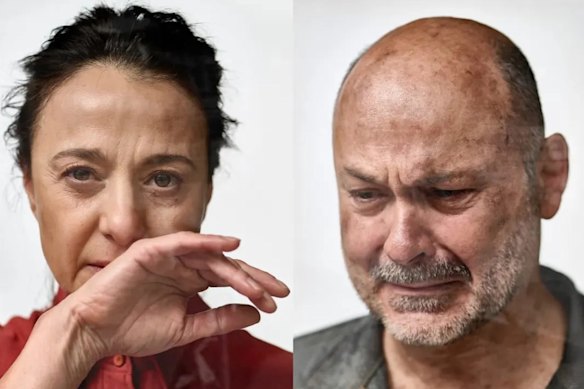
Victor was typical of Italian migrants of that era, says Bastoni. “They saw opportunity, if not for themselves, for their kids. ‘I’ll work my gut to put you in a good school’. Which is something that in Italy didn’t exist. There’s a caste system in Italy, you don’t have the opportunity to leapfrog into [different] social classes.”
Farinacci’s parents met in Melbourne in the early ’60s. Her mother, the youngest of six girls, was 18 when she emigrated. She worked in a pyjama factory as a machinist.
But for her father, things didn’t work out well. “It wasn’t the better life; he felt he had a better life there. My mother has had a really hard life in some ways, it’s not been easy at all,” she says.
In the lead-up to the play, Farinacci, who has lived in the western suburbs since the ’90s, met one of the widows and her now adult children (she won’t name anyone to avoid misrepresentations). What she took away from that was how she stood, her strength and pride. “She’s got this chest that …”
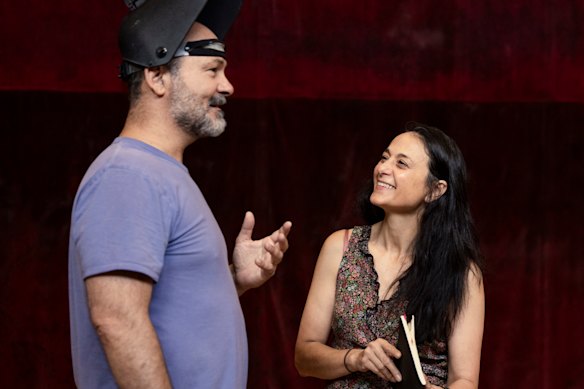
Her character, Frankie, is grieving and filled with rage, she says. “Francesca is not educated, she’s been here 10 years. Her job is keeping house and raising a family and she’s bloody good at it. And then this happens.
“It would be easy to play her as a victim and of course there’s a tragedy there but there’s more to it. She’s a very strong woman, and she had to be.”
McIntosh says the surviving workers, who received only one week’s wages after the disaster and had to find new jobs, threw their own money into the hat for the wives of the deceased. Social workers visited the widows to make sure that their houses were clean and that another partner had not moved in, threatening to take away their benefits.
There are salutary and cautionary messages in events from 50-plus years ago, say Bastoni and Farinacci.
“It’s a cautionary tale of the quest for power going unchecked in the name of progress and technological progress at the expense of human life,” says Bastoni.
The play has prompted Farinacci to think about why class is not as visible or being spoken about today. “Factory workers have always had a kind of invisibility. There is still an underclass of people doing jobs that are not as well paid or as safe.”
McIntosh stresses that West Gate isn’t about how or why the bridge collapsed. “The story is this: resistance is persistence. The story is getting out of bed in the morning, doing the dishes, making the beds. You know, that’s the story. That is the story of resilience, the ability to absorb suffering when there is no avenue of expression, there is no justice, there is nothing. And you’re left with the suffering. And one has to absorb that.”
After the fall
The partly constructed bridge collapsed at 11.50am on October 15, 1970, when a section between piers 10 and 11 weighing 2000 tonnes broke off. The span of approximately 110 metres fell 50 metres. Workers on a lunch break beneath the section were crushed. Many workers were thrown to the ground or burnt to death when tanks holding diesel fuel exploded.
According to the subsequent Royal Commission’s report: “The disaster which occurred … and the tragedy of the 35 deaths was utterly unnecessary. That it should have been allowed to happen was inexcusable.”
When the Milford Haven Bridge in Wales, which had many design similarities to West Gate Bridge, collapsed during construction two months earlier, four workers died and five were injured. English company Freeman Fox and Partners served as consulting engineers on both projects.
Some of the workers who were laid off four days after the disaster returned to work on the bridge when construction restarted six months later.
West Gate is at Southbank Theatre from March 10.
Disclaimer : This story is auto aggregated by a computer programme and has not been created or edited by DOWNTHENEWS. Publisher: www.smh.com.au