On Saturday night, with bombs falling across the Middle East and rumours of the death of Ali Khamenei, the longtime ayatollah of Iran, spreading, the streets of north London resembled a party.
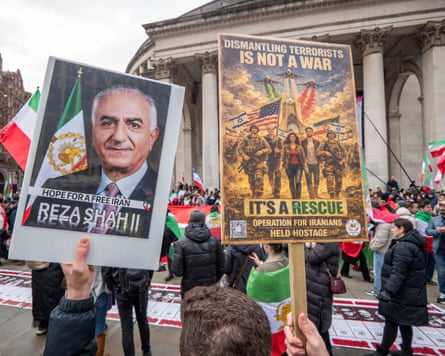
Thousands of revellers filled Finchley Road, a part of London often called Little Tehran because of the large Iranian community, waving a sea of flags, many with the Lion and Sun, the flag of the Iranian state before the 1979 Islamic revolution.
By the following morning, the ayatollah’s death had been confirmed, as had the deaths of hundreds of Iranians killed as the bombs continued to fall over the country, with at least 148 of them being children killed in a strike on an elementary school in the south of the country.
With the number of deaths rising, the celebratory mood among sections of Britain’s Iranian diaspora was far more muted than it had been the night before.
Suri, the 40-year-old manager of a Persian grill up the road in north Finchley, expressed her happiness at the events of the last 48 hours.
“We were happy, we support it,” she said. “The community here, they are very happy, they are dancing and singing in the Finchley area. You know, many people they’ve been celebrating, Iranian and Jewish people.”
Despite the celebrations, Suri, who is originally from Tehran and has been in the UK for 20 years, admitted that Iran’s future remained “very unclear, to be honest, we don’t know anything yet”.
Gholam Khiabany is a senior lecturer at Goldsmiths, University of London. Originally from Kermanshah in the west of Iran, he moved to the UK in 1990, fleeing the regime as a political refugee.
Talking about the US-Israel strikes on Iran, the British-Iranian academic, who now lives in Hammersmith, said: “It was expected, but it’s absolutely devastating.”
Khiabany, whose research focuses on the media and social change, particularly in the Middle East, spoke of the prospect of “devastating turmoil” in Iran following the strikes.
“One of the first English phrases that I learned was ‘troops out’. So all my life in the UK I have been part of that anti-war movement that has been out repeatedly shouting ‘troops out’,” he said.
“And it’s the continuation of that sort of disastrous situation in the Middle East, whether it’s Iraq, whether it’s Afghanistan, whether it’s Lebanon, Libya, Syria, that we see repeatedly, almost every year.”
Despite his anti-war stance – and fears over the chaos and violence that western intervention could bring – Khabiany said he was happy to learn of the demise of Ali Khamenei.
“It’s impossible not to feel a sense of relief that he’s gone after everything which they have done to Iranian people for decades,” he said. “But at the same time, it has also taken away the possibility of the Iranian people seeing them in court and being judged for thousands and thousands of Iranian families which had their kids and relatives arrested, tortured and killed.”
In Greater Manchester, the British region with the largest number of Iranians outside the capital, 29-year-old Mo couldn’t help but smile when asked about the ayatollah’s death and the prospect of a new Iran.
Speaking from behind the counter in a corner shop in Rusholme, he was reluctant to speak about politics, but said: “I’m happy, of course I’m happy. Things need to change. But seeing your country hurting, it hurts me.”
Despite being excited for the future of his country, Mo said that its present situation troubled him. “I don’t want dead Iranians,” he said. “I want peace, which I think will come with different people in power but I don’t want dead children. Soon, I hope it will end.”
Ali, a 33-year-old cafe owner in Stockport, left Iran years ago for reasons unrelated to the political climate that had caused many to flee. Still, he said he held little interest in returning as long as the current regime was in power.
“It was a country where you weren’t free,” said Ali. “The people in charge, they were wrong. They did things that hurt the people. You couldn’t say what you wanted, you can’t be free if you can’t say what you think.”
With the ayatollah dead, Ali’s pick for who should take over was Reza Pahlavi, the son of the former Shah of Iran, Mohammad Reza Pahlavi, who was deposed when Khamenei’s predecessor, Ruhollah Khomeini, took power nearly 50 years ago.
“We want the king to return,” said Ali. “We want his son, we want him to rule.”
When asked if Pahlavi, who was 18 years old when father was exiled from power and who has not stepped foot in Iran since, was the best person to lead the country, Ali was unsure, but said nobody had many better ideas.
“I don’t know, but why not,” he said. “He was there as a child and his mother is still alive, so I think he would make for a good leader. But I’m not sure, I never thought it would get this far.”
Disclaimer : This story is auto aggregated by a computer programme and has not been created or edited by DOWNTHENEWS. Publisher: theguardian.com