This article has been published in partnership with Mobile Creches.
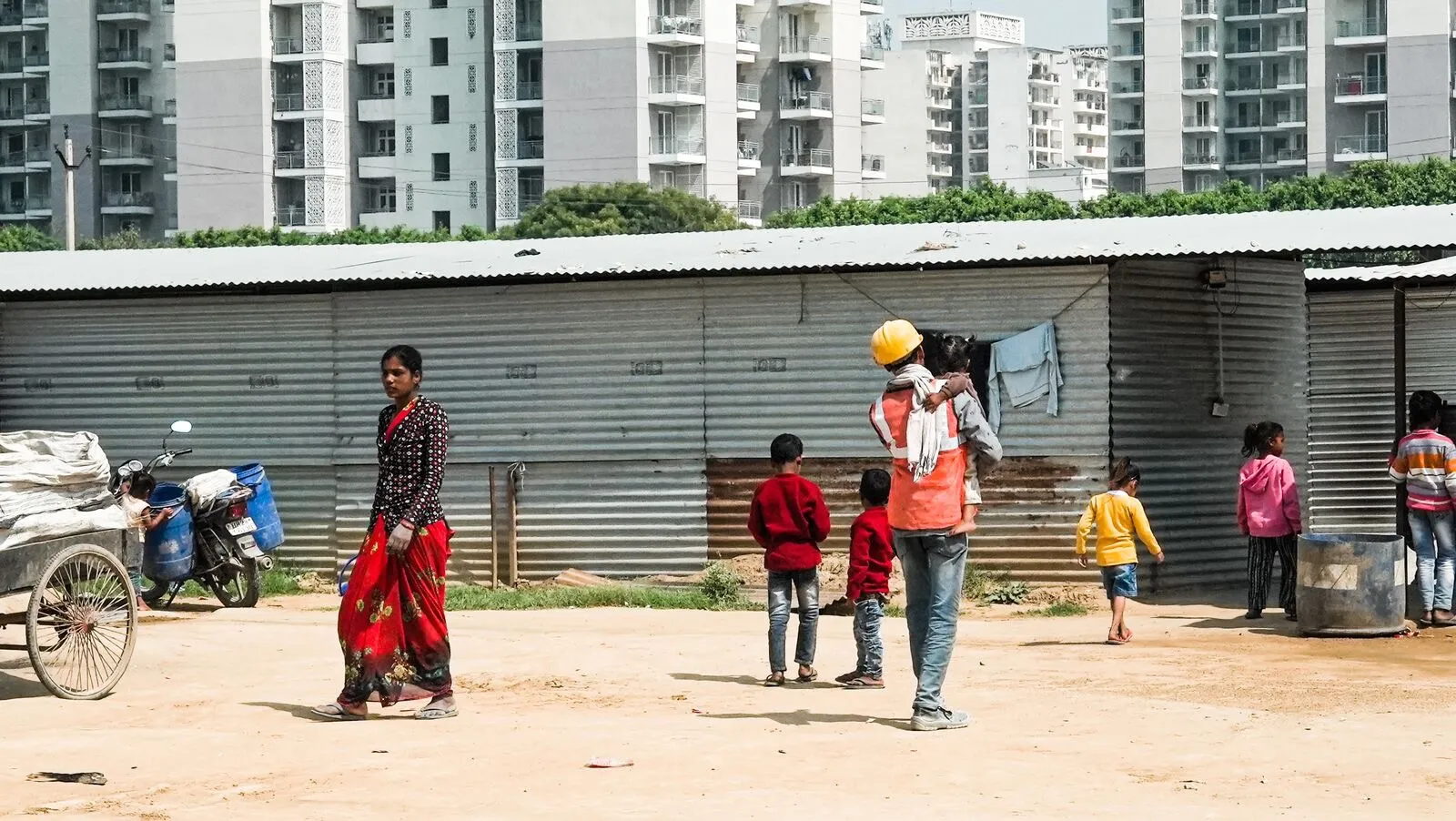
By 8 am, the first children are walking into the creche at Aashiyana, a construction site in Gurugram where their parents work. Lalita is already there.
“We look at every child from head to toe,” she says. “Then we talk to the parents. What did the child eat last night? How did they sleep? Is anything troubling them?”
It is a small ritual, repeated for 48 children every morning. For mothers who hand their children over and walk back into a day of work, it matters most.
“A mother going to work may not know everything the child learns here,” Lalita says. “What she knows is that one didi is taking care of her child and she can work in peace.”
Lalita, 32, has been that didi (elder sister/care giver) for nearly 12 years, a milestone she completes this November. As India marks the UN Global Day for Care and Support on 29 October, and Mobile Creches hosts its India Childcare Champions Awards a day earlier, her story asks a bigger question: what does it take to care for a country’s youngest children well, and who should share the load?
The teacher who stayed
At 20, Lalita, then a private school teacher, noticed a Mobile Creches training centre near her home in South Delhi. “I felt strongly that yes, I should work here,” she says.
She now runs Aashiyana and its bridge course. She paid for her B.Ed. from her own salary, and when she married two years ago, she covered most of the wedding herself.
/filters:format(webp)/english-betterindia/media/media_files/2026/10/12/2-2026-10-12-19-28-24.jpeg)
“I paid 80% of the expenses myself,” she says. Her in-laws are all government employees, and a government teaching post was within reach. She chose the creche. “A lot of the name and respect I have earned, I have earned at Mobile Creches,” she says.
A day built on routine
The creche has separate rooms for ages 0–3, 3–5 and 5–12. “The display is always ready for the children,” Lalita says of the walls covered in poems, stories and a library corner.
The routine: prayer, a morning circle, breakfast of milk with suji or daliya kheer, khel pitara play, and monthly themes, from Jungle to Water, taught with puppets and drums.
“We never change the timetable, no matter who visits,” Lalita says. “The children know when it is lunchtime because it has become a habit for them.” Underweight children get up to six small feeds and eggs every day.
“Everybody is called a care worker,” she says. Helpers are trained daily to step in for an absent care worker, and refreshers on child development, social-emotional wellbeing, safeguarding and the Protection of Children from Sexual Offences (POCSO) Act come every three to four months.
/filters:format(webp)/english-betterindia/media/media_files/2026/10/12/3-2026-10-12-19-34-39.jpg)
Safety comes in layers. The main gate is guarded, and a child cannot leave the site except with a parent or authorised guardian. An inner gate keeps the youngest inside.
“We keep the full details of every child, along with the details and photographs of the parents and others who can pick them up. If they are not on the list, we don’t hand them the child unless parental consent is sought,” Lalita says.
What parents find
At parent meetings, Lalita picks a topic that matches the site, from nutrition to safety to substance abuse. “Every child needs love too,” she says. “Spend at least 15 to 30 minutes with them at home, feed them dinner and put them to sleep properly.”
A year ago, a father of four in Delhi, wary of sending his child to a creche, asked his wife to visit one first and understand how it worked.
Money was tight and balancing childcare with work was a challenge. Both parents needed to work to increase their income, but the mother stayed home with their child.
That visit was the first step. After speaking with the mother, Lalita encouraged her to take up work while leaving her child in the creche’s safe care. Soon, she had the confidence to entrust her child to Lalita and return to work, eventually doubling the family’s income.
/filters:format(webp)/english-betterindia/media/media_files/2026/10/12/4-2026-10-12-19-35-16.jpg)
“Today she is with us in the group, and she supports us a lot,” Lalita says. The group is the Saathi Samuh, trusted parents from the site who help with hospital visits and school admissions. “Didi, you are alone, so we will help you get this done,” they tell her.
Parents describe the same relief. Soni, 26, a site worker at Century, sent five of her six children to the Mobile Creches centre at Homecraft, dropping them at 9 am and collecting them at 5 pm.
That full-day timing matters: Anganwadis operate only until 12 noon, leaving working parents without care for the rest of their shift. Mobile Creches was built on the belief that if parents work, their children need full-day care.
“While my husband and I focus on our work, our children remain completely safe,” she says. “Those hours are what let us work with a peaceful mind.”
The model extends well beyond construction sites to families at factories, tea gardens, brick kilns, mineral-grinding units and MGNREGA worksites, and Mobile Creches runs community-based centres in urban slums and rural and tribal areas.
Halima, a makeup artist in Bengaluru, was paying Rs 6,000–Rs 7,000 a month for private daycare. At a Mobile Creches’ Centre, her daughter got regular checkups and a shift from bottled milk to kheer, khichdi and eggs. For the first time, Halima’s earnings rose to Rs 15,000 a month, allowing her to work without fear.
/filters:format(webp)/english-betterindia/media/media_files/2026/10/12/5-2026-10-12-19-42-46.jpeg)
But staying connected is harder when families move. About 60% of children leave every three to four months, and Sumitra Mishra, CEO of Mobile Creches, says the aim is to make sure none vanish. “They get counted within public entitlements so that they do not disappear into oblivion,” she says.
Lalita recalls a couple who left the site where their older child attended a Mobile Creches centre. At their new site, they learned about their rights as migrant workers and as parents.
“They went to the manager, explained that workers need childcare for their children and placed their demand,” says Lalita. “Then they approached us to set up a centre. They told me, ‘You raised our older child so well. So we trust you to raise our children again.'”
Deep dive into the gap behind the gate
Mobile Creches’ work in Odisha offers some of the clearest evidence of what a well-run creche can change. Regular monitoring showed where the programme needed to adapt, and the team responded. Community engagement increased, and to build ownership, state teams shared data on children’s nutritional status, and how it affects their growth, with families in the local language.
Average attendance rose to nearly 65%, with centres going from 3–4 children to 15–16 each. The proportion of children in the severe (SAM) and moderate (MAM) acute malnutrition categories fell from 20.2% to 8.6%.
/filters:format(webp)/english-betterindia/media/media_files/2026/10/12/7-2026-10-12-19-56-24.jpg)
After nearly three years, a third-party evaluation was commissioned to capture the learning more impartially. Its findings matched the programme’s own MIS data: fewer children were underweight or wasted, which the evaluation linked to active responsive feeding. It also found that:
More than 98% of children in the Creches had vaccination coverage, and nearly 73% of mothers reported that their children fell ill less often after joining.
95% of mothers were satisfied with the creche worker.
97% of workers felt their social standing in the community had risen. They are now seen as a trusted point of contact for families, for health linkages and for accessing welfare schemes.
That last finding echoes Lalita’s experience at Aashiyana, where the care worker is far more than a babysitter.
What 57 years actually teaches
Mobile Creches began in 1969 at the Rajghat construction site, with local women running makeshift Creches. Sumitra explains that “mobile” refers to migrating families. Her list of what every creche needs is short: safety, nutrition, early learning, health and hygiene, and responsive caregiving.
That last one means “a caring adult, a care worker who is trained to do this work with babies for eight to ten hours a day”, she says. “This is why parents keep coming back to these centres, because it makes children feel safe and happy.”
Her pitch to builders is practical. “Running a creche is not your core business,” she tells them. “Building this big real estate infrastructure is your core business, but running a creche is our core business.” The company provides space, operating costs, and security. Mobile Creches provides “the nuts and bolts”.
/filters:format(webp)/english-betterindia/media/media_files/2026/10/12/8-2026-10-12-19-57-12.jpeg)
For Soni, trust came easily because the creche sits inside the site. “We don’t have to look for care outside or travel far,” she says.
That is the model; the hard part is next. “Mobile Creches cannot scale this alone,” Sumitra says.
Recognising the workforce behind childcare
Building a stronger childcare system means recognising its workers. Sumitra argues that childcare, like teaching young children, needs skilled workers, which means a formal pathway through training, certification and recognition, with clear progression from care worker to manager and trainer.
“Childcare workers are part of the green job ecosystem that we are creating in India and care work should be recognised as skilled work rather than something that simply comes naturally to women,” Chirashree Ghosh, Executive Director (Policy and Partnerships) emphasises.
That recognition must extend to how care workers are treated and remunerated. “If we want other genders to join this workforce, it has to be made more recognised and better remunerated,” she says. Bringing care work into the formal system would improve the care children receive and give workers the dignity, security and professional standing they deserve.
/filters:format(webp)/english-betterindia/media/media_files/2026/10/12/2-2026-10-12-20-02-08.png)
The need is urgent in the informal sector, where reliable childcare can determine whether migrant and daily-wage parents take up or retain employment. The people caring for their children therefore enable an entire workforce to participate in the economy.
“We must look at childcare as economic infrastructure and not just as social infrastructure,” Sumitra says. When care workers are recognised, trained and supported, they are not merely looking after children — they are helping build the foundation on which families, workers and the wider economy depend.
A model ready to grow
But now, the conversation is changing, Sumitra says. “Post-COVID was the tipping point for the childcare conversation. When care fell on middle-class homes, it became personal for parents, and there weren’t many organisations doing similar work. So today, when we, as pioneers, see a new non-profit or company enter this sector, we welcome the change. I’m happy that we now have a competitive ecosystem.”
Her vision is a “care circle”, with Mobile Creches as one part. “Localise the idea of a care circle to bring together multiple partners, each with their unique strengths,” she says.
/filters:format(webp)/english-betterindia/media/media_files/2026/10/12/10-2026-10-12-20-08-54.png)
By 2032, Mobile Creches hopes to help 7 million young children access quality early childhood services in four focus states, with half of childcare workers skilled and certified. “It is an opportunity for India to show the world a model for caregiving,” Chirashree says. The slogan: Viksit Bachpan se Viksit Bharat.
Back at Aashiyana
Soni says her children often tell her their teacher is very kind.
Two days before her interview, Lalita’s phone rang. “Didi, I got your number from someone only the other day. This is Anmol (name changed) speaking,” said the voice.
Anmol was five when she cared for him at another site. Now 17 and in Class 11, he had tracked her down himself. “To children who grow up with us, we mean a lot. One day everyone else will also realise that we caregivers build the nation,” Lalita says.
Recognition is what the India Childcare Champions Awards, on 28 October, set out to give childcare workers across the country, bringing “the uncounted, invisible, undervalued work” into view. Care workers, Sumitra says, “have never seen those role models on television, on paper, on big publicity campaigns”. The awards are meant to change that.
Disclaimer : This story is auto aggregated by a computer programme and has not been created or edited by DOWNTHENEWS. Publisher: thebetterindia.com