“Earlier, there was no fixed salary. We didn’t get gloves, masks or shoes either.”
For Mohammad Rafiq, a 30-year-old from Bharatpur, Rajasthan, those words describe the conditions at his previous job. For years, he worked without basic safety equipment, predictable working hours or financial stability.
“The biggest problem I faced was the lack of time. I was unable to give time to my family. I was not able to work on time,” he says.
His experience reflects a larger challenge. Indian cities generate vast quantities of waste, while many urban centres still struggle with inefficient collection, poor segregation and expanding landfill sites. The people who handle this waste often remain invisible.
More than a decade ago, two engineering students began noticing the same problem.
Today, Abhishek Gupta and Abhinav Shekhar Vashistha are the co-founders of WeVOIS Labs, a Jaipur-based waste management company that uses technology to improve waste collection, segregation and recycling. Operating across more than 36 cities, it reaches 46 lakh citizens every day, supports the livelihoods of more than 2,000 sanitation workers and field staff, and has managed over seven lakh tonnes of waste.
But their journey began long before the company did.
A college cleanup drive sparked the idea
Abhishek grew up in Agra, while Abhinav spent his childhood in Jaipur. They met in 2012 while studying mechanical engineering at IIIT Jabalpur. Working together on college festivals, student bodies and campus projects, they discovered that their different strengths made them good problem-solving partners. Entrepreneurship soon entered their conversations.
In September 2014, in the weeks leading up to the launch of the Swachh Bharat Mission on 2 October, the duo were selected to lead their college’s cleanliness initiative.
What began as a student responsibility soon drew more than 100 volunteers for brainstorming sessions, clean-up drives and community activities. The team also organised awareness programmes and a half-marathon that attracted thousands.
The campaign ended on 2 October. The questions it raised did not.
“After that, we could not unsee waste,” says Abhishek.
They began noticing overflowing bins, dumping grounds and growing piles of garbage everywhere. They read reports and studied urban sanitation systems. Delhi’s Ghazipur landfill frequently appeared in the media, but they realised similar waste mountains existed across the country.
“One thing that stood out was that nearly half of urban waste was coming from households. We realised that if cities wanted to solve their waste problem, municipal solid waste had to be part of the solution,” Abhishek recalls.
They also saw a gap in how cities tracked where waste was collected, how it moved and what happened afterwards. For two engineers, the next question came naturally: could technology make the system work better?
After graduating in 2016, Abhishek joined IIT Delhi for research, while Abhinav moved to IIT Bombay. Both, however, felt drawn towards solving problems people encountered in everyday life.
“We wanted to build something that people could use directly in their everyday lives,” Abhinav tells The Better India.
By 2018, the questions that had stayed with them since college had turned into something more concrete. The friends began exploring how technology could help cities collect and track waste better, and soon developed an early platform of their own.
That work led them to Sikar, Rajasthan, where they secured an opportunity to test the system on the ground.
A day with Sikar’s sanitation workers
Before beginning the pilot, they wanted to understand what waste collection actually looked like for the people doing it every day. So they spent an entire day travelling with sanitation workers in garbage collection vehicles.
The experience would shape much more than the technology they were building.
The workers began before sunrise and spent hours moving from neighbourhood to neighbourhood. The work was physically exhausting, but what struck Abhishek and Abhinav most was how little support and recognition many workers received.
“They were working really hard, but people normally blamed them for things beyond their control,” says Abhinav.
The conversations that day revealed problems beyond waste collection. Many workers had irregular incomes, little job security and limited access to financial services. Medical emergencies could push families into debt. Safety equipment was limited, and opportunities for professional growth were rare.
By the end of the day, the founders knew that any system they built would also have to think about the people running it.
When software became an on-ground service
Abhishek and Abhinav formally launched WeVOIS Labs on 6 December 2018. Their initial plan was to develop technology and provide it to municipalities. The Sikar pilot changed that.
/filters:format(webp)/english-betterindia/media/media_files/2026/09/23/tech-waste-management-india-2026-09-23-17-13-53.png)
Local authorities saw improvements in waste collection and operational efficiency and asked the founders to manage the operation themselves. That meant moving beyond software into running collection services on the ground, and testing whether their systems could work at scale.
“Technology alone cannot solve waste management problems,” says Abhishek. “You need strong operations, citizen participation, infrastructure and accountability. We realised that if we wanted to create real impact, we had to be directly involved in implementation.”
On 1 April 2019, WeVOIS began operating waste collection services.
What happens after waste leaves your doorstep?
Most people stop thinking about waste once it leaves their homes. For the duo, that is where the real journey starts.
“When we started studying waste management systems, we realised that one of the biggest challenges was visibility,” says Abhinav. “Cities often did not know whether waste had actually been collected, whether routes had been completed, or what happened to waste after it left a neighbourhood.”
WeVOIS first maps the properties in the areas it serves, including houses, apartments, hotels, hospitals, hostels and commercial establishments. Each property is digitally recorded and given an RFID tag, which works like a unique ID.
This helps the team understand how much waste an area generates and plan more efficient collection routes. Drivers receive these routes on their phones, while residents can track collection vehicles and get alerts shortly before they arrive.
During collection, workers scan the RFID tag at each property, creating a digital record that the waste has been picked up.
“Every collection becomes traceable,” says Abhishek. “Instead of depending on manual reporting, we can verify whether services have actually been delivered.”
This information is then visible on a central dashboard, where supervisors and municipal authorities can track routes, attendance and vehicle movement.
Turning collected waste into a resource
Once the waste reaches processing facilities, it is separated based on what can be reused or recovered.
“Traditionally, waste has been viewed as something that needs to be disposed of, but we look at it differently and see it as a resource that can be recovered and brought back into the economy,” says Abhishek.
Wet waste is sent for composting and other forms of organic processing. Dry waste goes to material recovery facilities, or MRFs, where paper, plastic, cardboard, metal, glass and textiles are sorted.
Cameras, sensors and AI-enabled systems help identify different materials, while workers make sure recyclable waste reaches the right processing stream.
“The objective is to recover as much value as possible before anything reaches a landfill,” explains Abhinav.
Recyclable materials are sent to authorised partners. Waste that cannot be recycled is turned into refuse-derived fuel, which can be used by industries such as cement manufacturers.
For the founders, this is what a zero-waste city is meant to work towards.
“A zero-waste city does not mean a city that produces no waste,” says Abhishek. “It means a city where the maximum amount of waste is composted, recycled or recovered, while landfill dependency is reduced as much as possible.”
And what’s done with discarded clothes?
As operations expanded, the founders noticed that textile waste was still falling through the cracks. Unlike better-established recycling streams for plastic, paper and metal, large quantities of discarded clothing and fabric were still reaching landfills.
/filters:format(webp)/english-betterindia/media/media_files/2026/09/23/tech-waste-management-india-2026-09-23-17-21-10.png)
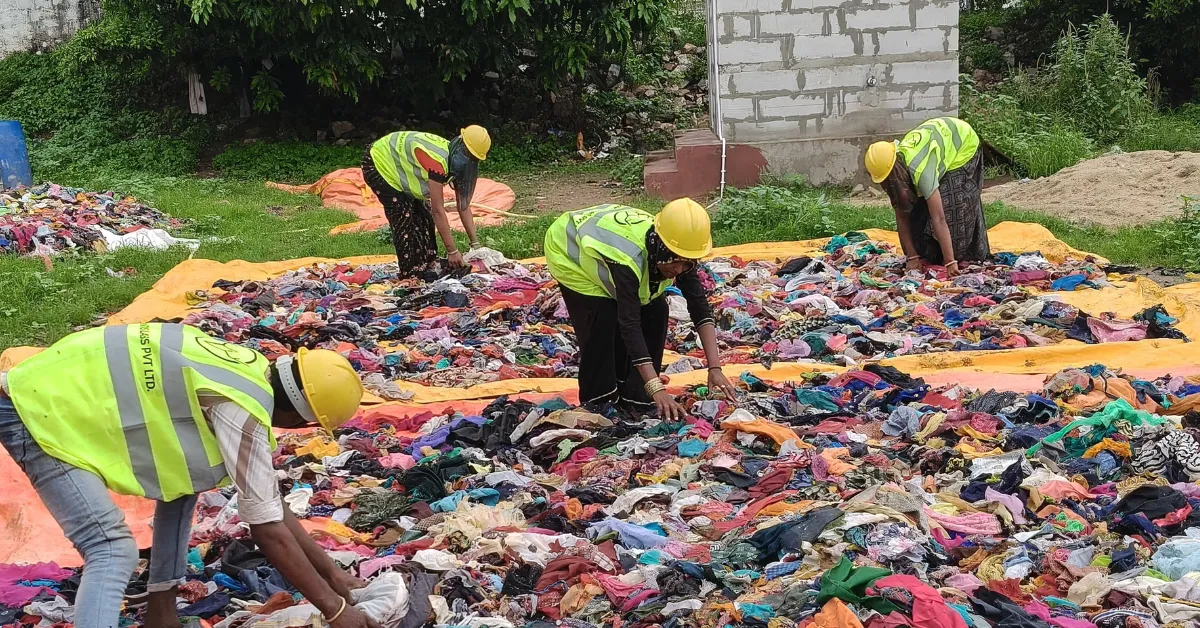
The company set up a textile recycling facility in Jaipur to process pre-consumer and post-consumer textile waste collected from households, residential societies, donation drives and manufacturing units.
Workers sort the material and process discarded fabric into reusable fibres. For Gopilal Pareek, the facility also became a place to learn new skills.
“After joining WeVOIS, I learnt how to operate machines, cut clothes and convert textile waste into cotton,” he says. “I also learnt the importance of preventing clothes from going into the garbage and supporting recycling.”
From one city to 36+
The Sikar model opened doors, but every new city came with its own waste patterns, infrastructure and on-ground challenges.
WeVOIS first expanded across Rajasthan, and later into Maharashtra, Tamil Nadu, Uttar Pradesh, Haryana and other states. In each city, it combined digital tracking, planned collection routes, citizen alerts and local waste-processing systems.
Today, it operates in more than 36 cities and reaches over 46 lakh citizens every day. The company says it has managed more than seven lakh tonnes of waste, while setting up systems for sorting, composting and recycling.
For workers, the change shows up at home
The platform now supports more than 2,000 sanitation workers and field staff. The founders say those workers remain central to how they think about the system.
“Sanitation workers are the backbone of urban waste management, and from the very beginning we believed that no system could be sustainable unless the people managing it were treated with dignity and respect,” says Abhishek.
Nikhil Goyar, who had been with the organisation for six months at the time of the interview, remembers when stable employment felt uncertain.
“Before coming here, my life was not good, and work was not going well. I had to do jobs in the middle of the day and travel a lot,” he says.
After joining, he received training on collection vehicles, citizen engagement and digital tools. “The technology helps me navigate routes and work more efficiently,” he says.
But the biggest difference, for him, is how people respond to his work. “Before, people used to disrespect me because I worked in cleaning. Now, people respect me and my work,” he says.
/filters:format(webp)/english-betterindia/media/media_files/2026/09/23/tech-waste-management-india-2026-09-23-17-31-49.png)
For Rafiq, the change is visible in both time and income. “After joining WeVOIS, my life has improved a lot. I work on time. I can give time to my family, and everything around feels better,” he says.
“Earlier, I used to get a salary of Rs 5,000 to Rs 7,000. Now, I get Rs 11,000. This has helped me in many ways.”
Babita Kumari, who previously worked in sales, also struggled with irregular income. Today, she has a stable salary, a structured work environment and specialised training in textile sorting.
“Receiving my salary on time helps me manage household responsibilities properly,” she says. “People now value and appreciate my work more.”
The goal: 100 zero-waste cities
Nearly 12 years after a college campaign first made Abhishek and Abhinav look closely at where waste goes, their company has secured Series A funding and continues to expand across India.
Their long-term goal is to help build 100 zero-waste cities. They believe that will require stronger recycling systems, greater citizen participation, better infrastructure and continued collaboration with local governments.
/filters:format(webp)/english-betterindia/media/media_files/2026/09/23/tech-waste-management-india-2026-09-23-17-28-01.png)
It will also depend on the people whose work usually begins after our waste leaves the doorstep.
For workers like Mohammad Rafiq, Nikhil Goyar, Babita Kumari and Gopilal Pareek, the impact is measured in everyday things: a salary arriving on time, more time with family, new skills and greater respect for the work that keeps cities clean.
All pictures courtesy WeVOIS Labs.
Disclaimer : This story is auto aggregated by a computer programme and has not been created or edited by DOWNTHENEWS. Publisher: thebetterindia.com