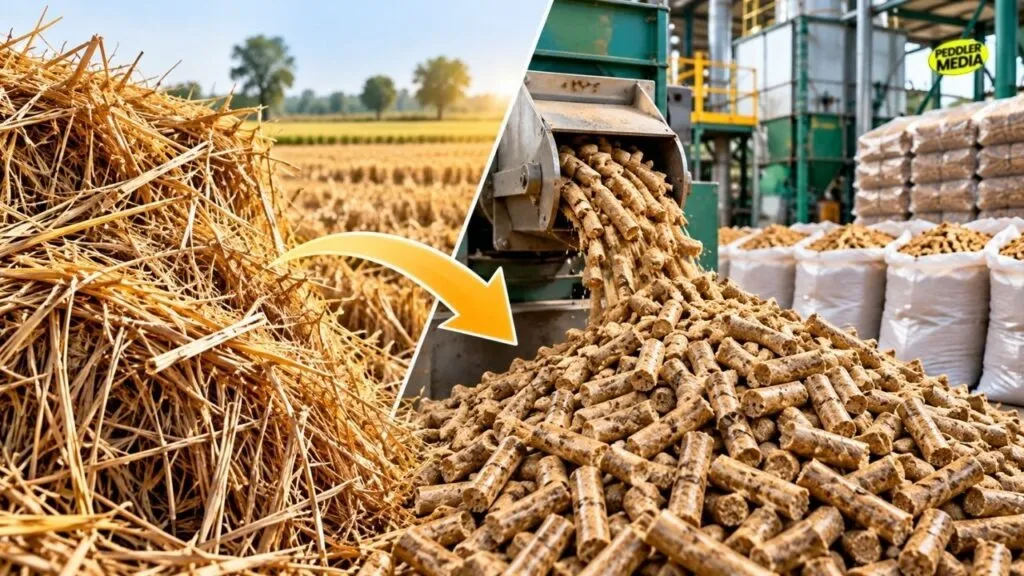
Every year, once the paddy harvest is over, farmers across Haryana face a familiar problem. Their fields are covered with leftover straw, and they need to clear the land before planting the next crop. For many, burning this stubble is the quickest solution. But the smoke that rises from these fields adds to North India’s already severe air pollution.
Now imagine if that same straw could earn money, create jobs and even help power industries.
That’s exactly what two women from Haryana and neighbouring Rajasthan set out to do.
Sanjana, a graduate from Ghoranwali village in Haryana’s Sirsa district, and her friend Sonika, from Bhadra in Rajasthan, saw a business opportunity in something farmers struggled to get rid of. They decided to collect leftover paddy straw, locally called parali, and turn it into biofuel pellets that power plants could use as an alternative fuel.
In 2024, they started SSAR Biomass Green Private Limited with an investment of approximately Rs 2.5 crore. Today, the venture reports an annual turnover of Rs 7–8 crore and employs over 20 people.
From a pollution problem to a business idea
For Sonika, the idea began with a sight she had witnessed repeatedly after the paddy harvest: thick smoke spreading across the sky as farmers burned crop residue.
Concerned about the environmental and public health consequences, she began thinking about how this agricultural waste could be put to better use. Rather than treating stubble burning as a problem with no easy solution, she and Sanjana started exploring ways to convert the residue into a commercially useful product.
Photograph: (Peddler media)
The idea was to address two needs together: give farmers a productive use for their leftover crop residue while creating an alternative fuel that industries could use.
Government policies and initiatives promoting stubble management also helped create an opportunity for the venture to take shape.
Building a factory around farm waste
In 2024, Sanjana and Sonika set up their manufacturing unit in Ghoranwali with an investment of approximately Rs 2.5 crore under the Agriculture Infrastructure Fund (AIF) scheme.
The factory follows a process that begins in the fields. The women source paddy straw through baler operators in Sirsa and surrounding areas. These operators collect and compress the loose residue, making it easier to transport and store.
The stubble is then brought to their factory, where machinery processes it into compact biofuel pellets. These pellets can be supplied to power plants as an alternative fuel.

Photograph: (AI generated using reference)
The scale of the operation is considerable. The unit uses approximately 1 lakh to 1.5 lakh quintals of paddy stubble every year.
Since the raw material is available mainly during the harvesting season, the founders also have to plan for the months ahead. They collect and store the residue after harvest, ensuring that the factory has enough raw material to continue production throughout the year.
This seasonal sourcing and year-round production model allows them to keep the business running beyond the harvesting window.
From discarded straw to a growing rural enterprise
The venture’s impact extends beyond the pellets it produces. By creating a market for paddy straw, SSAR Biomass Green Private Limited also generates business opportunities for local baler operators and others involved in collecting and transporting the residue.
The factory itself provides employment to more than 20 people, bringing work opportunities closer to home for residents in and around the village.
From an initial investment of approximately Rs 2.5 crore, Sanjana and Sonika have built an enterprise reporting an annual turnover of Rs 7–8 crore.

For the two founders, the next harvest season will bring another opportunity to source more stubble, keep production going and expand their business. Their work has given farmers in the region another possible route for managing crop residue, while creating a market for material that would otherwise have little economic value.
In Ghoranwali, the paddy harvest no longer marks just the end of a farming cycle. For Sanjana and Sonika, it also marks the beginning of another season of business, one built around putting farm waste to productive use.
Sources:
‘2 women turn paddy stubble into Rs 8-crore business in Haryana’ by Anil Kakkar for The Tribune, Published on 14 October 2026.
‘These Haryana Women Turned Waste Into ₹8 Crore Business empire!’ by Peddler Media.
Disclaimer : This story is auto aggregated by a computer programme and has not been created or edited by DOWNTHENEWS. Publisher: thebetterindia.com