
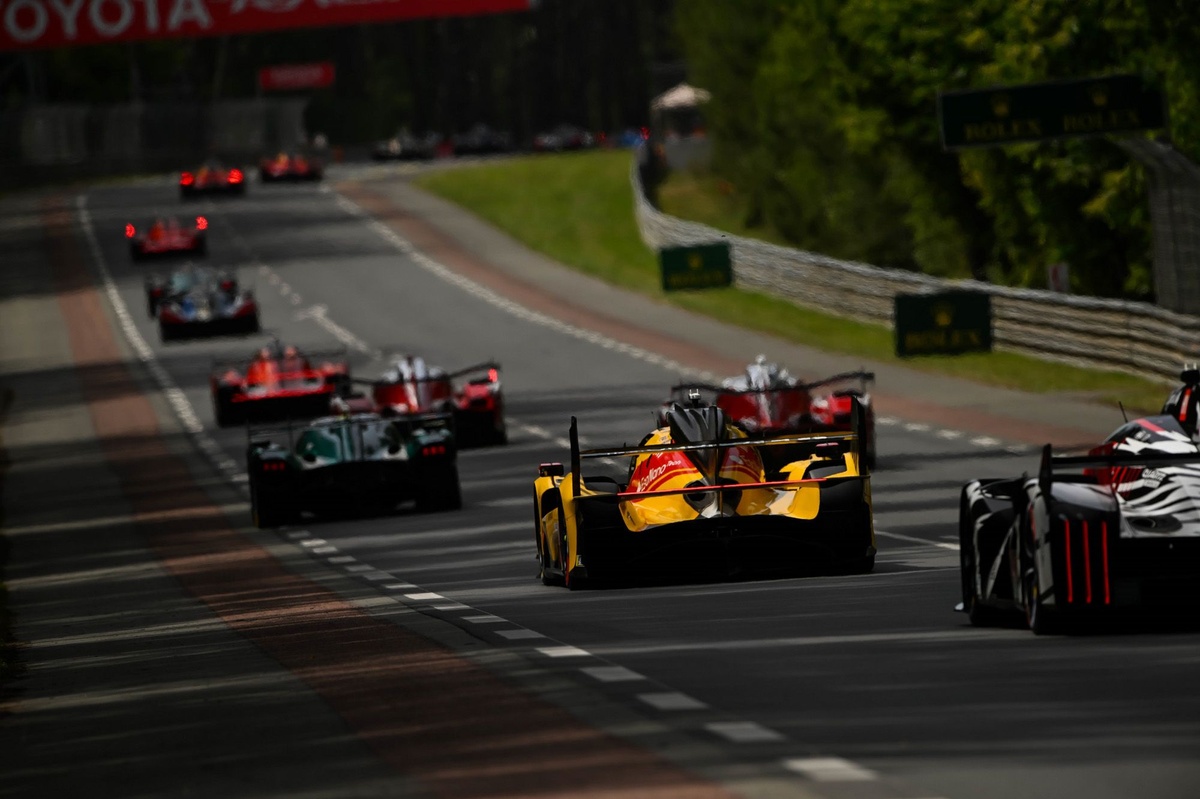
Toyota secured its sixth Le Mans 24 Hours victory this year, finally delivering proof that it can also win against major opposition at the biggest stage in sportscar racing. However, our data analysis reveals that the winning #7 Toyota TR010 was not actually the fastest car on the track.
When looking at the average of the best 60 percent of all race laps, the #7 only ranks fourth. Instead, it was the sister car, the #8 Toyota, that set the pace for the entire field.
A look at the top 60 percent of laps for each car reveals the following picture:
1. Toyota #8 – 3:28.059
2. Cadillac #12 – 3:28.294
3. BMW #20 – 3:28.377
4. Toyota #7 – 3:28.392
5. Cadillac #38 – 3:28.593
6. Ferrari #51 – 3:28.939
7. AF-Corse-Ferrari #83 – 3:28.987
8. Alpine #35 – 3:29.166
9. Alpine #36 – 3:29.195
10. Ferrari #50 – 3:29.201
11. WTR-Cadillac #101 – 3:29.235
12. Genesis #19 – 3:29.271
13. BMW #15 – 3:29.512
14. Aston Martin #007 – 3:29.660
15. Genesis #17 – 3:29.855
16. Aston Martin #009 – 3:29.894
17. Peugeot #94 – 3:30.925
18. Peugeot #93 – 3:31.201
The reason why the #7 missed out on the top spot in pure pace is simple. An early unscheduled pit stop for a slow puncture dropped the TR010 Hybrid deep into the midfield. Later in the race, a lingering sensor issue triggered further slower laps.
In terms of raw lap times, the #8 Toyota was the class of the field, holding a relatively comfortable margin over the second-placed #12 Cadillac. Yet, the #8 suffered from a messy race, hampered first by a penalty and later by unscheduled brake repairs.
Safety cars turn the tide
The data clearly highlights how safety car interventions shaped the outcome. In particular, the rule change introduced in 2023, bunching up the whole field behind a single safety car and effectively erasing all gaps saved the #7.
Under the previous safety car rules, the #7 would have likely remained stranded a full safety car train behind the leaders after falling back by more than a minute.
With the change in rules, Le Mans has increasingly mirrored the 24 Hours of Daytona. Early mistakes or mechanical gremlins are no longer terminal, as the next safety car period inevitably neutralises the gaps and resets the race as long as a car can stay on the lead lap.
All in all, the #8 Toyota had the highest outright speed, while the #12 Cadillac, the #20 BMW and the #7 Toyota followed in a near dead-heat. Meanwhile, the #38 Cadillac suffered a retirement and could not capitalise on the fast track conditions on Sunday morning. It would have ended up somewehere in this region, too.
We also looked closely at the 50 best laps for each car after the final safety car restart on lap 300. For the frontrunners, this represents exactly 60 percent of the remaining laps to the chequered flag:
1. Toyota #7 – 03:27.260
2. Cadillac #12 – 03:27.266
3. Toyota #8 – 03:27.471
4. BMW #20 – 03:27.471
5. AF-Corse-Ferrari #83 – 03:28.141
6. Alpine #35 – 03:28.231
7. Alpine #36 – 03:28.507
8. Ferrari #51 – 03:28.526
9. Aston Martin #007 – 03:28.649
10. Aston Martin #009 – 03:28.884
11. Genesis #19 – 03:28.951
12. WTR-Cadillac #101 – 03:29.034
13. Peugeot #94 – 03:30.059
14. Peugeot #93 – 03:30.943
In this final sprint, the pace ranking largely aligns with the actual race result—with one surprising exception. The #12 Cadillac delivered an outstanding performance, putting in laptimes almost identical to the race-winning Toyota.
This is especially remarkable because the Cadillac is traditionally not known as a strong performer in high temperatures. Early in the race, when track temperatures peaked, the team was forced to run hard tyres. However, once the track rubbered in toward the end, the #12 Cadillac thrived on the medium compound and unleashed blistering pace.
The late-race surge can be largely explained through tyre strategies. Since the safety car allowed teams a free tire change, and the final restart occurred just five hours before the finish, only one triple stint was necessary.
With track temperatures soaring up to 53 degrees Celsius, Cadillac was able to maximise two double-stints and unleash its full performance, having completed the triple stint earlier on.
Cadillac’s FCY Heartbreak
The American entry suffered crucial bad luck during a late Full Course Yellow. Much like the #7 Toyota, Norman Nato had to dive into the pits for an emergency ten-second splash of fuel. Crucially, the FCY ended before the Cadillac could exit pit lane, costing them vital time to the Toyota and potentially throwing away a podium finish.
Meanwhile, the #8 Toyota and the #20 BMW spent multiple laps locked in a fierce track battle, which explains their slightly lower average pace in the final race segment. The #8 Toyota was also compromised by an awkward tyre strategy,.
Because both Toyotas were running nose-to-tail after the restart, the team chose to extend the stints on the #8, leading to seven stints split into two triple and one single stint. This strategy was also used to block the charging #20 BMW to ensure the win for the #7 sister car.
Toyota’s new aero package proved to be a massive success for Le Mans. The TR010 Hybrid completely dominated the opposition in high-downforce corners like the Esses and the Porsche Curves, where no other Hypercar could match their speed. At the same time, Toyota still maintained a respectable top speed.
The #20 BMW excelled on the long straights, almost matching the straight-line prowess of the benchmark Cadillacs. Crucially, the BMW showed almost no weaknesses in the twisty sections either.
Improving on its practice form, the #20 emerged as a genuine threat for the overall victory. Without the safety car interventions, WRT would have likely taken the win, having executed a flawless race, whereas Toyota struggled with several mistakes.
Alpine’s pace crushed
Ferrari unexpectedly claimed the best of the rest title, a position many expected Alpine to hold based on the long-run data from practice. Instead, the French cars faded rapidly from the front and failed to make an impact. Following the opening stint, the #35 (da Costa/Milesi/Habsburg) plummeted from third place and remained stranded outside the top ten.
While Alpine turned heads with strong straight-line speeds during practice, that performance vanished during the race. In several micro-sectors, particularly when accelerating out of slow corners, the A424 was actually slower than it had been during its practice long-runs.
The cause for this drop could be one if these three: Alpine might have struggled with the hotter track conditions, or had to scale back the engine mappings for reliability reasons, or a late Balance of Performance (BoP) adjustment penalized the car ahead of the race. Since the BoP figures are kept strictly confidential this year, it is impossible to verify.
This drop allowed the two remaining Ferrari 499Ps to leapfrog them in the performance rankings. The fact that the #83 AF Corse Ferrari finished behind the #35 Alpine in the final race classification was purely down to pit strategy.
The yellow Ferrari had pitted just before the final safety car and did not take advantage of a stop under yellow. This forced the 2025 winner into a late-race fuel splash, costing it two positions.
BMW #15: The unresolved mystery
With Alpine’s performance being one surprise, the lack of pace from the #15 BMW is certainly the biggest mystery of the race.
Kevin Magnussen dropped back significantly at the start, and the pole-sitting M Hybrid V8 never found its rhythm. While the sister #20 car made significant steps forward on the straights compared to practice, the #15 completely failed to replicate that progress.
BMW Motorsport Director Andreas Roos attributed the performance gap to traffic, noting that the #20 enjoyed clean air while the #15 was constantly mired in pack racing. However, that does not tell the whole story, a fact acknowledged by BMW’s “we need to look into this” stance.
Strikingly, this situation mirrors 2025, but in reversed order. Back then, the #15 BMW was comfortably quicker than the #20 by over four tenths of a second on average. This year, the gap ballooned to a staggering 1.2 seconds in favor of the #20.
While a premature retirement meant the #15 missed out on the rubbered-in, faster track conditions on Sunday, it was already lagging six tenths behind in the long-runs following the test day and free practice.
Genesis can be highly satisfied with its debut pace, showing a very respectable performance for the first time.
Conversely, having one of its cars finishing behind the newcomer will frustrate Aston Martin. The Valkyrie is clearly hampered by excessive aerodynamic drag. While the car matches the Cadillac for the punch out of corners, the V12 hits a wall down the straights as the speeds rise.
As for Peugeot, the numbers speak for themselves. In nearly every micro-sector, at least one—and often both—of the 9X8s anchored the bottom of the timesheets. All hopes now rest on upgrades next year.
For a complete overview, a look at the top 10 percent of the fastest laps for each car tells a familiar story, offering no major surprises at the very top of the field.
1. Toyota #7 – 3:26.527
2. Cadillac #12 – 3:26.603
3. Toyota #8 – 3:26.613
4. BMW #20 – 3:26.907
5. Cadillac #38 – 3:27.169
6. Ferrari #83 – 3:27.522
7. Ferrari #51 – 3:27.576
8. Alpine #36 – 3:27.612
9. BMW #15 – 3:27.622
10. Alpine #35 – 3:27.641
11. Ferrari #50 – 3:27.769
12. Aston Martin #009 – 3:27.794
13. Cadillac #101 – 3:27.836
14. Aston Martin #007 – 3:27.890
15. Genesis #19 – 3:28.174
16. Genesis #17 – 3:28.679
17. Peugeot #94 – 3:29.509
18. Peugeot #93 – 3:29.829
One final word on the margin of victory: 10.913 seconds beat the 13.854 seconds from 2011, when Audi narrowly beat Peugeot. This makes it the third-closest finish after the artificially induced photo finish of 1966 and the legendary duel between Ford and Porsche in 1969. However, due to the late safety car, this race was effectively reduced to a five-hour contest to determine the final margin.
We want your opinion!
What would you like to see on Motorsport.com?
– The Motorsport.com Team
Disclaimer : This story is auto aggregated by a computer programme and has not been created or edited by DOWNTHENEWS. Publisher: motorsport.com






