
This article has been published in partnership with Aditya Birla Group.
Every year on 5 June, World Environment Day prompts a familiar chorus of pledges, campaigns, and calls to action. But in the corridors of a government hospital in Malad, Mumbai, and along the walls of a navy school in the suburbs, the conversation has already moved well past pledges.
Here, you might notice something unexpected: a dense, layered thicket of trees pressing up against the boundary, alive with birdsong, fluttering with butterflies, smelling faintly of wet soil even in the middle of summer.
These are not remnants of some forgotten wilderness. They were planted deliberately, sometimes in as little as 100 square feet of ground, by one man with a very specific conviction: that India’s cities are not too crowded to have forests. They are just too accustomed to thinking small.
Subhajit Mukherjee, founder of Mission Green Mumbai and the Subhajit Mukherjee Foundation, has spent years making this case not through speeches or petitions but through soil preparation and sapling selection. He calls this the “no green without blue” philosophy, believing that planting trees without solving for water is what kills them.
According to him, tree loss in India often has less to do with the number of saplings planted and more to do with the failure to build the water systems needed to keep them alive.
Subhajit has personally created over 40 dense urban pocket forests across Mumbai, Pune, and Chennai. Through citizen groups, institutional partnerships, and corporate social responsibility programmes in multiple cities, he has contributed to planting more than 3 lakh trees under this initiative.
This makes him a true Force for Good hero, showing how one individual’s commitment can spark environmental change at scale.
The projects he takes on individually range from 2,000 to 12,000 trees, with new installations happening almost every week. The model has also spread beyond Mumbai, replicated by citizens, schools, hospitals, and housing societies across India, who can access the full toolkit free of charge.
Why India’s cities desperately need this
The urgency behind Subhajit’s work is not difficult to understand. Indian cities are warming faster than their rural counterparts, a well-documented consequence of dense construction, shrinking tree cover, and the proliferation of heat-absorbing concrete and asphalt.
Research published in 2024 found that urbanisation in India has enhanced city-level warming by as much as 60% compared to surrounding non-urban areas, and temperatures across major metros routinely breach 44–47°C during summer. Most Indian cities fall dramatically short of the 20–40% green cover that urban planners globally consider a baseline for liveable cities.
Mumbai, which Subhajit calls home and where most of his work is rooted, has a green cover of around 13% against the government-recommended 33%. The city’s rapid development has consumed the open land that once allowed communities to plant trees at scale.
“Mumbai has a lot of infrastructure development work going on,” he tells The Better India, “and we do not have the space to do re-plantation.” It is precisely this constraint that his pocket forest model was built to address.
‘We can now take walks during the day’
The difference this kind of greening makes is not abstract. At the General Hospital in Malad, Manoj, a senior pharmacy officer, describes what the campus looked like before Subhajit’s team began working on it roughly three years ago. “It was a very dry area with only dead grass and trees that were not useful,” he says.
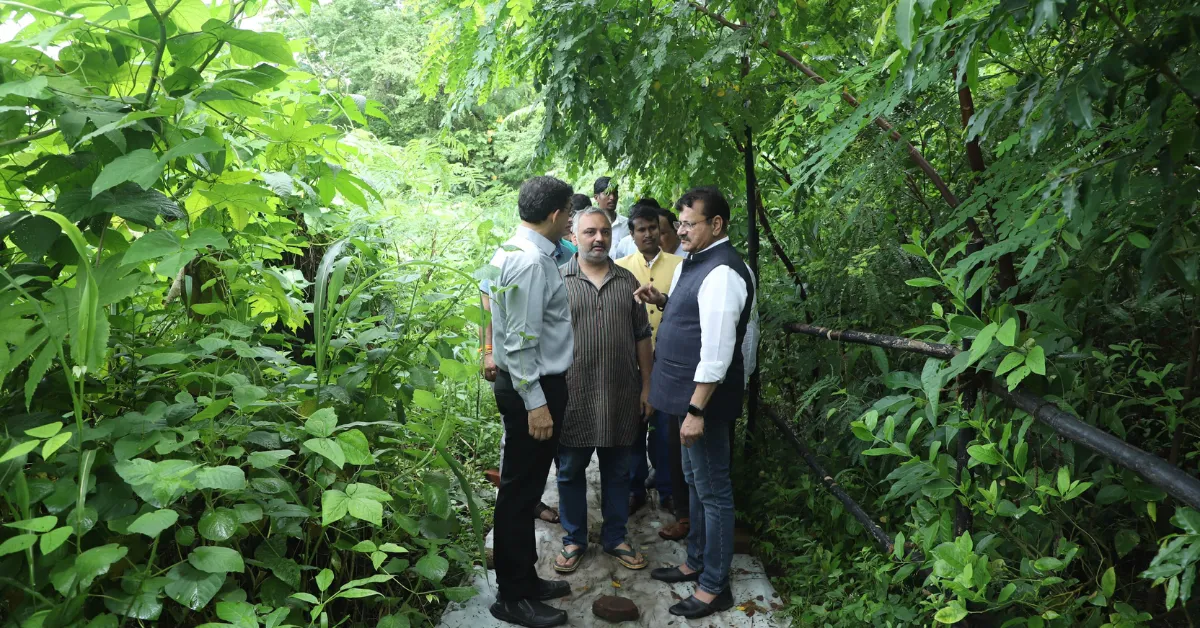
Today, pocket forests line the boundary walls and fill the spaces between buildings. They are watered entirely using the hospital’s own RO reject water and wastewater from the effluent discharge plant, which would otherwise go to waste. Butterflies and birds now shelter there, and Manoj says the difference through the summer months is tangible.
“There is at least a 50% improvement in conditions. It may not be the most dramatic change, but it is much better this summer, and people are able to feel the difference. We can now take walks outside the building during the day.”
/filters:format(webp)/english-betterindia/media/media_files/2026/06/04/3-2026-06-04-16-16-16.png)
To see how Subhajit’s model addresses these urban challenges, it helps to understand what a pocket forest looks like and how it is built.
How a pocket forest actually works
The concept draws from the Miyawaki method, a Japanese technique for creating dense, multi-layered native forests in small urban spaces.
Subhajit has adapted the method for Indian cities, putting water first in every step. Soil preparation, species selection, and planting layout are all designed so the forest can survive India’s long dry months with minimal irrigation, and eventually without any water at all.
The result is a planting structure roughly analogous to a pyramid: canopy trees at the top, sub-canopy species beneath them, then shrubs and undergrowth, with climbers winding through the whole structure. Each layer has a role, creating a self-regulating ecosystem far more resilient than ornamental trees in a concrete planter.
The minimum space needed is 100 square feet, about the size of a medium bedroom. With three to four saplings per square metre, even this small patch can hold 28 to 37 plants across 8 to 15 native species.
For spaces larger than 200 square feet, Subhajit recommends aiming for 15 to 25 species. The diversity is not aesthetic preference but ecological necessity: more species means more food sources, more nesting microhabitats, and a forest that can sustain itself without constant human intervention.
The soil preparation is as important as the planting. Each cubic metre of the bed contains 50% local topsoil, 30% well-cured organic compost, 10–15% cocopeat or rice husk for moisture retention, and 5–10% coarse sand or biochar for aeration.
/filters:format(webp)/english-betterindia/media/media_files/2026/06/04/4-2026-06-04-16-16-40.png)
Microbial boosters — mycorrhiza and Trichoderma — are added at this stage, along with neem cake as a natural pest deterrent. Excavation reaches at least two to three feet to ensure drainage and create a deep, loose soil column that encourages roots to grow downward for moisture rather than spreading laterally.
That root behaviour is central to Subhajit’s philosophy. During the three monsoon months, the trees grow rapidly, and their leaves expand to capture maximum sunlight. When the dry months arrive, and above-ground water disappears, the roots go deeper, accessing groundwater that ordinary ornamental plantings never reach.
After about two years, the forest largely takes care of itself. “You don’t even have to water it after one year,” he says, describing mature installations where the closed canopy and fallen leaves retain moisture and feed the soil’s microbial life.
‘My school looks so beautiful now’
One of the most distinctive aspects of Subhajit’s model is that it begins with a question: What do you want to bring back? The answer shapes everything — species selection, layout, and the kind of micro-habitat built into the design.
For someone who wants to see more butterflies, he creates what he calls a butterfly pop-up forest, planting species like Aristolochia indica, which hosts the Common Rose butterfly, Curry Leaf (Murraya koenigii) for swallowtails, and Nirgundi (Vitex negundo), an aromatic shrub whose flowers draw bees and butterflies in abundance.
He has created 12 to 13 such butterfly forests across the region, and they have proven among his most popular installations.
Principal Madhulika Mishra of PM Shri Kendriya Vidyalaya INS (Indian Naval Ship) Hamlog, a navy-affiliated school, asked for exactly this when she reached out to Subhajit in 2023 through the school’s sponsoring agency. The result was a butterfly garden and general plantation covering approximately 200 square feet, with a drip irrigation system installed along the school’s boundary.
/filters:format(webp)/english-betterindia/media/media_files/2026/06/04/6-2026-06-04-16-17-14.png)
The garden is young, and the pre-monsoon heat has been testing the saplings, but Mishra says the campus already feels different. “It creates a very scenic and green look to my school,” she says. “Finding something like this in the city is tough. But we have it here in our school, and it makes a big difference. We have also spotted several butterflies recently, but the first monsoon will tell the fuller story.”
Tailored forests for birds, people, and place
For bird lovers, Subhajit plans forests with territorial behaviour in mind. Sparrows avoid trees taller than 15 feet, while crows nest higher. To accommodate this, species such as Tamarind, Amla, and dense Ficus are planted in the lower canopy for sparrows, and the overall structure avoids open perches that pigeons and crows prefer.
Other variants include Sanjeevani forests planted with medicinal species, high-oxygen production designs using dense canopy species, and mixed permaculture plots that combine fruit trees with vegetables for communities interested in food production.
In coastal sites, the front line of planting typically includes salt-tolerant species such as Pongamia pinnata (Karanj), Terminalia catappa (Indian Almond), and Calophyllum inophyllum (Undi), which form a windbreak that shelters more delicate species behind them.
The underlying principle across all variants is the same: use only species native to within a 50 to 100 kilometre radius of the planting site. “Every 100kms, nature changes,” Subhajit explains. A sapling grown in Chennai’s climate, acclimatised to its soil and rainfall patterns, will perform entirely differently when transplanted to Mumbai.
This is why, while his own toolkit focuses on the Mumbai region and draws from species native to the Konkan coast and the Western Ghats foothills, he insists that anyone attempting the model elsewhere must source saplings locally and adapt the species palette to what is genuinely native to that landscape.
For people in cities he has not yet visited, he offers remote guidance, connecting them with local nurseries and helping them build a species list suited to their specific climate and ecology.
/filters:format(webp)/english-betterindia/media/media_files/2026/06/04/7-2026-06-04-16-22-03.png)
The model is designed to travel, not as a fixed prescription but as a set of principles that any city can apply with the right local knowledge.
The free toolkit that anyone can use
What makes Subhajit’s initiative particularly accessible is that professional installation is only one of two paths he offers. For anyone who wants to build their own pocket forest, there is a complete free toolkit available — all it takes is a WhatsApp message to Mission Green Mumbai (9323942388).
The toolkit covers everything: site selection, soil preparation, species choices for birds, flowers, pollinators, and coastal resilience, a planting-day checklist, a 24-month watering schedule, budget estimates, and a full bill of materials for a 100-square-foot plot.
The budget guidance is grounding for anyone who has assumed urban greening must be expensive. A DIY, community-led pocket forest of 100 square feet costs between Rs 21,000 and Rs 48,000 for materials, depending on how much of the soil amendment, mulch, and irrigation the community can source locally.
If you prefer professional help, a contractor-managed turnkey installation typically runs Rs 60,000 to Rs 80,000 for the same footprint. Either way, the cost is a fraction of what most urban landscaping projects demand, and maintenance needs drop sharply once the forest establishes itself.
/filters:format(webp)/english-betterindia/media/media_files/2026/06/04/8-2026-06-04-16-24-14.png)
He is also available for follow-up support over calls, and provides video documentation for people attempting the model in cities where he cannot travel in person. He is candid about the forests he has lost when maintenance was neglected — failures that have almost always come from insufficient attention in the critical first two years, when a young forest needs consistent watering, monthly weeding, and regular mulch top-up before it can begin sustaining itself.
‘We keep our windows open on summer afternoons’
Jyotsna Venkat, a Chennai resident, used the free toolkit two years ago to set up a 100 square foot garden on her verandah, planted with peace lilies, hibiscus, Gulmohar, and other flowering species. Manure she collects free from the local farmers’ market; water comes entirely from her household RO reject.
The total investment was Rs 50,000 — a one-time cost she has not had to revisit since. “Summers are extremely hot in Chennai, but for the last two years we have been able to keep our doors and windows open even during afternoons — the heat simply doesn’t come in,” she says. “Before the garden, we could feel the heat trapped in the walls at the verandah.”
Corporate CSR mandates have brought Subhajit to the premises of companies, including Otis Elevators and Schneider Electric. Government partnerships have seen forests go into the Brihanmumbai Municipal Corporation (BMC) gardens in Mumbai and public spaces in Pune. In some cases, the sites carry additional strategic significance: he has planted forests at Indian Army and Indian Air Force facilities, using dense native canopy to provide natural camouflage cover for sensitive infrastructure.
The range of contexts the model has travelled into is, at this point, genuinely difficult to map.
When climate action starts at home
At a time when climate action frequently feels abstract, contested, or simply beyond the reach of ordinary citizens, there is something quietly radical about a model that starts with a 10-by-10-foot patch of soil and a WhatsApp message. Subhajit’s work does not promise to reverse deforestation at a national scale or rewrite urban policy.
What it does is give anyone a society garden, a school compound, a hospital boundary wall, or a rooftop terrace a concrete, replicable, ecologically grounded way to contribute — one that works with Indian ecology rather than against it.
The fallen leaves that accumulate on the forest floor are not debris to be swept away. They are, in his framework, the forest’s most important resource: the layer that retains moisture through the dry months, feeds the soil fungi, and makes the system progressively less dependent on human care.
Even the water source need not be a burden. At the hospital in Malad, it is RO reject water keeping the forest alive. At a housing society, it might be water drained from a washing machine or a rooftop tank. The ingenuity is not in finding new resources but in recognising that the ones already being wasted are enough.
Over 10,000 people have reached out to Subhajit’s inbox asking about the model, from cities across India. Every week, somewhere in the country, another forest is going in — in a school compound, a corporate park, a government hospital, a boundary wall.
For a country planting millions of trees each year but losing many, his work asks a simple question: what if the challenge was never the planting itself, but what came afterwards?
To receive the free Urban Dense Pocket Forest Toolkit, send a WhatsApp message to Mission Green Mumbai at 9323942388. You can also reach Subhajit Mukherjee at [email protected] or follow the initiative here.
All images courtesy of Subhajit Mukherjee.
Disclaimer : This story is auto aggregated by a computer programme and has not been created or edited by DOWNTHENEWS. Publisher: thebetterindia.com



