In December 2023, a tiger crossed the Makri River and entered a mangrove patch near a village in Kultali, in West Bengal’s Sundarbans.
For the people living nearby, its presence was a serious safety concern. The tiger, too, was in danger.
Over the next three days, forest officials, wildlife experts and local volunteers worked together to guide the animal back to its natural habitat. They tracked its movements, put up nylon nets and carefully created a passage towards the forest.
On 11 December, the tiger finally swam across the river and returned to the mangroves, without needing to be captured.
The successful operation showed how much difference trained local volunteers can make when people and wild animals come face to face.
Now, more residents of the Sundarbans are learning how to help in such situations.
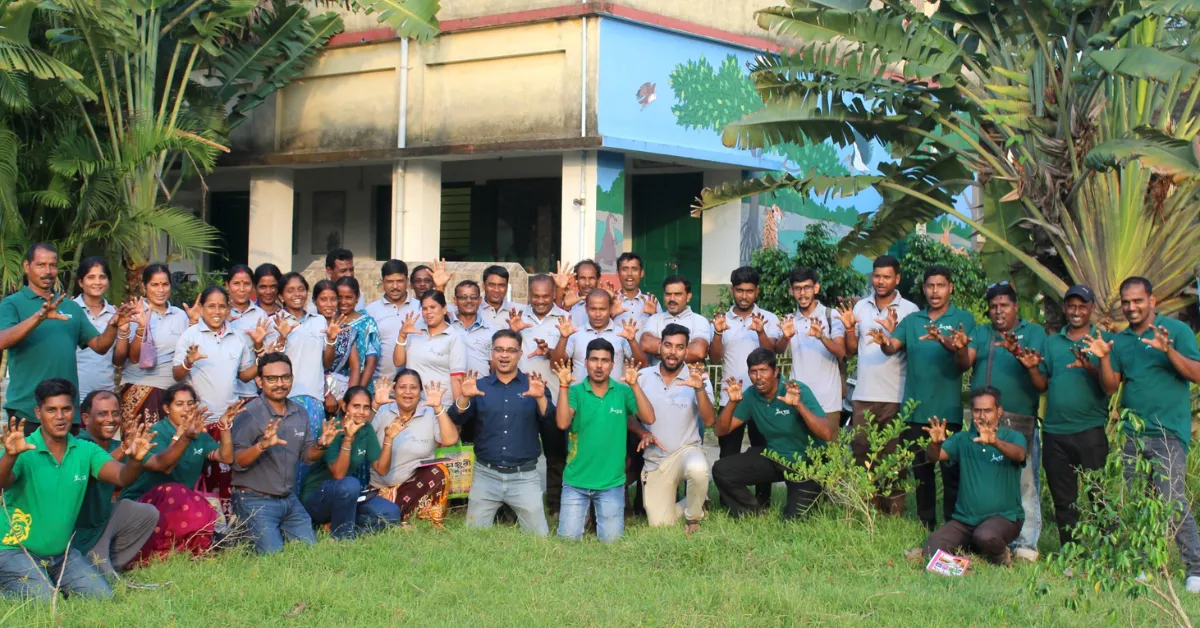
On 24 October 2026, the Wildlife Trust of India (WTI) trained 33 newly engaged local volunteers, including 10 women, from Kultali block in South 24 Parganas district to help manage encounters between people and tigers.
Their responsibility is an important one: helping protect their neighbours while ensuring that a tiger finding its way into a village can return safely to the forest.
What happens when a tiger enters a village?
For people living along the forests of the Sundarbans, encounters with tigers are a real concern.
Many residents depend on fishing, crab collection and other forest-based activities for their livelihoods. At times, tigers also cross rivers and enter areas where people live.
When that happens, frightened residents may gather around the animal or try to drive it away. Confusion and panic can make an already dangerous situation worse.
This is where Primary Response Teams (PRTs) come in.
These teams consist of trained local volunteers who act as the first point of contact when wildlife enters a settlement.
Their job is to alert forest officials, share information about the animal’s movements, help keep crowds away and explain safety precautions to residents.
They work alongside the Forest Department and trained wildlife rescue teams, rather than attempting dangerous rescues themselves.
And because they belong to these communities, they understand the local landscape and the concerns of the people living there.
Teaching 33 villagers how to respond safely
The latest training took place at Sundarban Prakritishala, an education centre at Ambikanagar Haripriya High School.
Led by WTI’s Dr Abhishek Ghoshal and Prosenjit Sheel, with technical support from biologist Samrat Paul, the workshop focused on understanding tiger behaviour and responding safely when an animal enters a village.
Participants learnt how tigers move, how their presence can be monitored and why people’s reactions can influence what happens during an encounter.
The sessions also addressed misconceptions about tigers.
Dr Ghoshal explained that some residents believe all Sundarbans tigers deliberately hunt humans or that their saliva is poisonous. Such fears can influence how people react when an animal approaches a settlement.
Understanding a tiger’s natural behaviour can help volunteers explain the situation to their neighbours and discourage actions that might put people or the animal at greater risk.
There is research supporting the importance of these precautions.
A 2022 study examining 118 tiger attacks on people around Uttar Pradesh’s Dudhwa and Pilibhit reserves found that 88.1% were accidental or defensive, rather than deliberate attempts to hunt humans.
Although the findings come from a different landscape, they show why preventing sudden encounters and understanding animal behaviour matter.
For the Kultali volunteers, the training also included learning how to communicate with residents, manage difficult situations and rebuild trust following an encounter.
Can technology help stop tigers from entering villages?
Alongside learning how to respond, the volunteers were introduced to tools that could help warn communities about approaching wildlife.
These included camera traps, drones and a device called the Animal Intrusion Detection and Repellent System (ANIDERS).
Think of ANIDERS as a modern, sensor-powered scarecrow.
When an animal approaches, its sensors can trigger bright lights and sounds intended to scare it away without injuring it. Cameras can also help identify animal movements and send alerts.
In 2026, WTI and the local Forest Department began introducing these devices in tiger-prone areas of the Sundarbans as an experimental measure.
But the technology has limitations. Each device can monitor only a restricted area, while the region’s salty conditions can damage equipment over time.
It therefore needs maintenance and cannot replace trained people on the ground.
The idea is to give communities another way to detect danger early, alongside the knowledge needed to respond appropriately.
33 Primary Response Team members participated in a human-tiger conflict mitigation & coexistence workshop in #Sundarbans. Hosted by WTI, @ForestDeptWB & supported by @IUCN through the Integrated Tiger Habitat Conservation Program (ITHCP) Read more: https://t.co/AKIz3UQuOK https://t.co/pClO367iXO
— Wildlife Trust of India (@wti_org_india) October 26, 2026
A growing network of neighbours looking out for one another
The October workshop builds on several years of work in Kultali.
Since 2018-19, WTI has established a network of 98 Primary Response Team members, including 18 women, through its human-tiger coexistence project.
These volunteers help the Forest Department manage tiger-related emergencies and monitor approximately 24 km of protective nylon net fencing along Kultali’s eastern coast.
The fencing helps reduce the chances of tigers moving into settlements, while the volunteers help identify problems and support responses when an animal crosses into a village.
The latest training group, which includes 10 women, also brings more women into these community-level efforts.
The initiative is supported by the International Union for Conservation of Nature (IUCN), through its Integrated Tiger Habitat Conservation Program, and the West Bengal Forest Department.
For local residents, its value lies in having people nearby who understand the risks, know whom to contact and can help others respond safely.
Veteran volunteer Ajay Kumar Das, known as a Bagh Bondhu, or Friend of the Tiger, describes his role as protecting the Sundarbans’ tigers and mangrove forests while being “equally responsible for the safety of villagers when a tiger enters a village”.
That responsibility was visible in December 2023, when local volunteers helped guide a tiger back across the river.
And it is the same responsibility that the 33 newly trained volunteers are preparing to take on.
In the Sundarbans, where people’s livelihoods and tigers’ habitats overlap, a timely warning, a well-informed neighbour and the right response can make a difference to both human and animal lives.
Sources:
‘PRT members in Sundarbans receive training to manage human-tiger interactions’: By Wildlife Trust of India, Published on 25 October 2026
‘Predicting negative human-tiger (Panthera tigris) interactions in mosaic landscapes around Dudhwa and Pilibhit tiger reserves in India’: By Mayukh Chatterjee,Nilanjan Chatterjee, Poonam Chandel, Tapajit Bhattacharya, Rahul Kaul, Published on 11 October 2022
‘Use of an action-selection framework for human-carnivore conflict in the Bangladesh Sundarbans’: By Adam C D Barlow, Christina J Greenwood, Ishtiaq U Ahmad, James L D Smith, Published on 24 October 2010
Disclaimer : This story is auto aggregated by a computer programme and has not been created or edited by DOWNTHENEWS. Publisher: thebetterindia.com