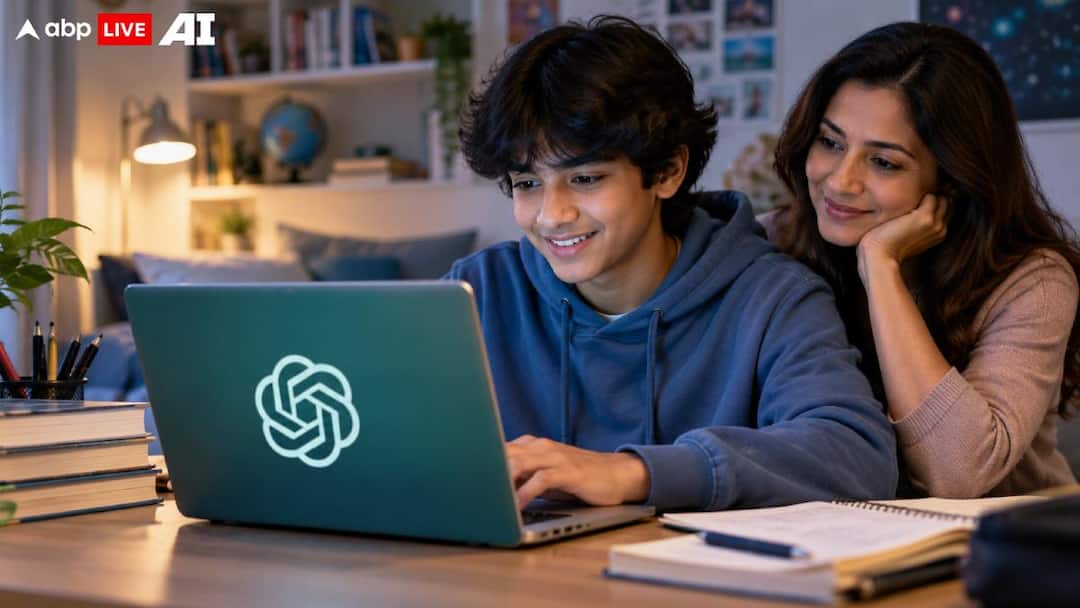
- Teenagers increasingly use AI for studies, prompting careful parental oversight.
- ChatGPT’s ‘Study Mode’ provides guided learning, not instant answers.
- Features include quizzes, visual aids, and independent homework support.
- Parental controls manage usage, set study hours, and restrict content.
From solving difficult maths questions to preparing for exams, teenagers are increasingly using AI tools as part of their study routines. The challenge for parents is making sure that technology supports learning rather than becoming a shortcut around it. ChatGPT for Teens includes learning-focused features and parental controls intended to encourage more independent study while giving families greater control over how the service is used.
Here are five features parents should know about.
ALSO READ: No Cap With Megha Prasad | AI Is Advancing Fast, But Can Humans Still Control It?
Study Mode Focuses On Learning Instead Of Just answers
Study Mode is designed to make interactions with ChatGPT more like a guided lesson. Rather than immediately providing a solution, it can break a problem into smaller parts, ask questions, provide hints and check whether the student understands the concept.
Students can use prompts such as:
- “Show me where I went wrong.”
- “Give me a hint for the next step.”
- “Help me work this out without giving me the answer.”
This approach can be particularly useful for homework because the student remains involved in the problem-solving process instead of simply copying an AI-generated answer.
Homework Reminders Can Push Students Towards Independent Work
ChatGPT can also use reminders when it detects that a student may be attempting to get an assignment completed rather than learn from it. Instead of simply fulfilling a request such as “write my history assignment,” the experience can encourage the student to identify the main arguments, organise their thoughts and develop the response themselves.
The idea is to make AI a support system for schoolwork rather than a replacement for the student’s own effort. For parents, this distinction can be important when setting expectations around AI-assisted homework.
Lessons Can Be Turned Into Quizzes & Visual Learning Experiences
Students do not have to limit ChatGPT to conventional question-and-answer interactions. A chapter or topic can be converted into a quiz, while practice questions can be generated to help students test how well they remember what they have studied.
Learning Visualizations add another option for maths and science. They allow students to explore more than 70 core concepts interactively, making it possible to observe how formulas, graphs and variables change instead of relying entirely on memorisation.
This can make revision more active, particularly when a student is struggling to understand a concept through textbooks alone.
Parents Can Establish Study & Screen-Time Routines
Parental controls allow families to introduce boundaries without requiring parents to monitor every individual conversation. Parents can set Study Hours, during which new chats start in Study Mode, and Quiet Hours, when access to ChatGPT can be restricted.
Other controls cover features including voice mode and image generation, along with protections designed to limit exposure to sensitive content.
In limited high-risk situations involving serious self-harm concerns, ChatGPT can also send parents a safety notification. The broader purpose of these controls is to give families tools for establishing routines while allowing teenagers an appropriate degree of independence.
Better Prompts Can Make Revision More Structured
How a student uses ChatGPT can significantly affect its value as a study tool. Instead of asking for answers, teenagers can use prompts that make the AI test their knowledge, organise their study schedule and identify areas where they need additional revision.
For example, students can ask:
- “Quiz me on this chapter and make the questions harder as I improve.”
- “Help me create a 30-minute revision plan.”
- “Ask me five questions to test what I remember without my notes.”
- “Based on my answers, what should I revise again?”
Used in this way, ChatGPT can turn revision into a more active process. It can help students identify gaps in their understanding and practise recalling information, while teachers, classroom instruction and textbooks remain important parts of the overall learning process.
Disclaimer : This story is auto aggregated by a computer programme and has not been created or edited by DOWNTHENEWS. Publisher: abplive.com