The distaste surrounding the Dallas Cowboys couldn’t be any worse. Once again, after having a big lead against a lesser opponent, the Cowboys unraveled at the end of the ballgame and lost. It’s the second time this season the Cowboys have had a 98 percent win probability, only to squander it, resulting in a disappointing loss.
The Philadelphia Eagles were a dying bird lying in the middle of the road, and the Cowboys still couldn’t put them out of their misery. No Dallas Goedert, no Saquon Barkley, Jordan Davis traded, and still, the Cowboys managed to blow the lead and fall to 5-7. It’s unacceptable how poorly this team executes down the stretch of games. It’s also unacceptable how the head coach does this week in and week out, only to promise that things will get better or that the problems will be fixed, yet the issues remain.
Advertisement
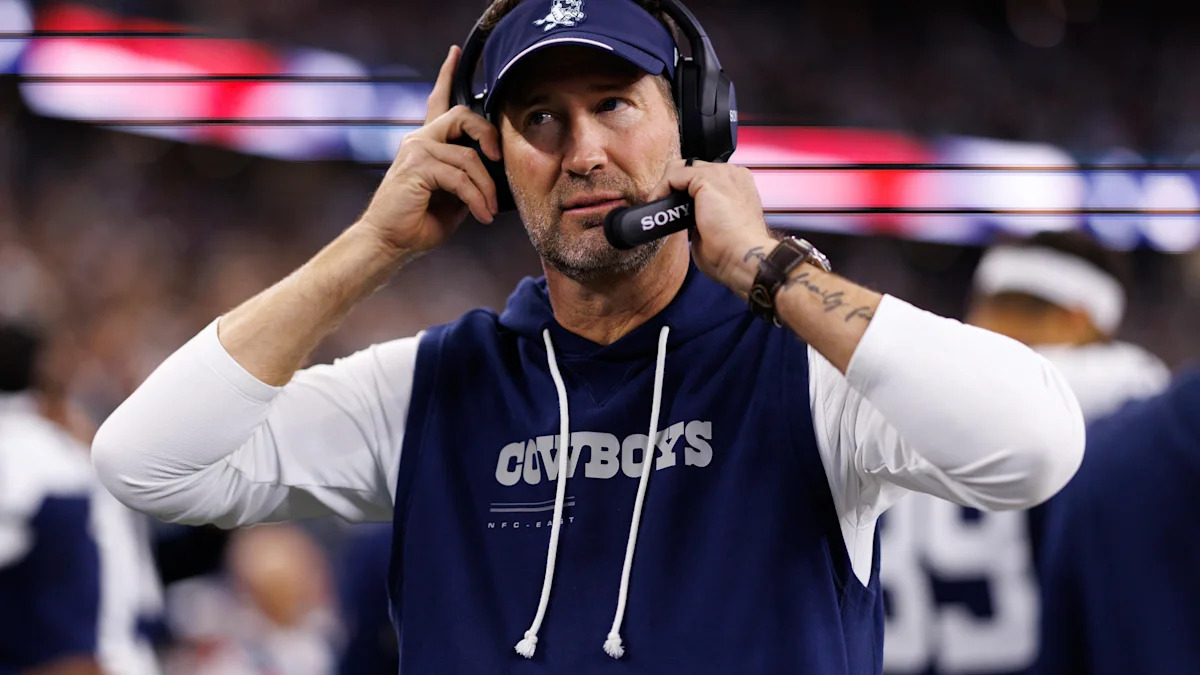
Dallas undoubtedly has a head coaching problem. When you reexamine many of the Cowboys’ close losses this year, they can be tied back to a decision made by Brian Schottenheimer. That happened once again on Thanksgiving. Jerry Jones has stated that he will stand behind Schottenheimer, and that’s a big mistake. Here are five coaching mistakes made during the game that cost the Cowboys.
5. Wasting a timeout on an unsuccessful challenge
Fourth quarter — 7:48 remaining | Dallas leads 38–30
As if the Cowboys hadn’t made enough mistakes on special teams, Brian Schottenheimer decided to introduce another one. After Britain Covey returned a Bryan Anger punt 23 yards to the Dallas 49-yard line, Schottenheimer challenged the ruling regarding whether Covey was down by contact. The ruling stood, costing Dallas a timeout.
Advertisement
Considering what had transpired to this point in the game, why risk a timeout without compelling evidence that the ruling would be overturned? The Cowboys had already watched a 21-point lead shrink to eight, and Philadelphia was threatening to make things even more uncomfortable.
Fortunately, Cobie Durant intercepted Joe Milton three plays later, temporarily bailing out the Cowboys. Yet that doesn’t necessarily absolve Schottenheimer of the decision. When you’re watching a commanding lead evaporate, situational awareness becomes increasingly important. The failed challenge was another example of Dallas potentially making an already difficult situation more complicated than it needed to be.
In what was shaping up to be a tight race to the finish, timeouts were like gold, and Schottenheimer wasted a valuable resource. With that timeout, Dallas could have approached the end of the game with more flexibility.
4. Taking the foot off the gas offensively
Second half, particularly the fourth quarter | Dallas leads 31–10 late in the third quarter
Advertisement
There’s a difference between running the clock and running an effective offense. Philadelphia had already lost Cooper DeJean, while CeeDee Lamb and George Pickens had demonstrated they could exploit the Eagles’ secondary.
Still, Schottenheimer became increasingly conservative with his play selection, relying heavily on inside runs. Javonte Williams finished with 101 rushing yards on 29 carries, averaging just 3.5 yards per attempt. Meanwhile, Prescott averaged 10.4 yards per pass attempt. Which one do you think made more sense?
One particularly questionable sequence involved Jashaun Corbin being stopped on third-and-one early in the fourth quarter, preceding the blocked punt. Even in that scenario, you could still roll the dice on fourth down with your offense and try to maintain possession. It was surprising that by the fourth quarter, Dak Prescott hadn’t hit the 300-yard passing mark, considering how well he was throwing the football. This was reminiscent of the Baltimore Ravens game earlier this year, when Schottenheimer elected to throttle back his scorching-hot offense to manage the clock.
In effect, Schottenheimer’s decision to prioritize clock management over maintaining the offensive efficiency that helped Dallas establish its lead signaled the beginning of the end for the Cowboys. Dallas scored only 10 second-half points, and you can start to see why.
Advertisement
3. The special teams breakdowns
Nick Sorensen isn’t in the clear either. Special teams breakdowns have cost the Cowboys multiple times this year, including the aforementioned game against the Ravens. Two special teams plays completely changed the complexion of the game.
Fourth quarter — 13:53 remaining
Dallas probably should have gone for it on fourth down. Instead, the Cowboys chose not to. Dallas’ opponents have been able to identify a weakness in its punt team and have come very close to blocking punts several times this season. Sorensen hasn’t adjusted to this, and Ty Robinson was able to break through the protection and block Bryan Anger’s punt. Kenny Moore II was all alone when he recovered the football and returned the blocked punt for a touchdown, cutting the Dallas lead to 31–24.
Advertisement
Fourth quarter — 10:11 remaining
Britain Covey’s 55-yard kickoff return
If you’re trying to be conservative and merely escape with a win, it doesn’t make much sense to kick the ball into the landing zone and give the Eagles a chance at a big return, but that’s exactly what happened. Britain Covey found a big hole in the Cowboys’ kickoff coverage and was free down the left sideline. Eventually, Caleb Downs and Brandon Aubrey chased Covey out of bounds.
However, the damage was done. Philadelphia started at the Dallas 42-yard line and scored three plays later with ease. Inadequate special teams preparation and a lack of operational discipline defined just how bad special teams were for the Cowboys yesterday.
Advertisement
2. Trusting Brandon Aubrey
Fourth quarter — 3:27 remaining | Dallas leads 38–30
Brandon Aubrey is not the same kicker he was a couple of years ago. As a long-distance kicker, his performance has declined tremendously. Look at his success rate from 50-plus yards by season to understand just how far that decline has gone.
2023: 10/10 — 100.0%
2024: 14/17 — 82.4%
2025: 11/17 — 64.7%
2026: 6/11 — 54.5%
This isn’t a player worthy of taking the ball out of the offense’s hands. He missed a 40-yard kick in a one-score game, preventing the team from extending its lead to 11 points. You can say the laces weren’t out on the kick, but you still expect the highest-paid kicker to make that kick at that stage of the game.
Advertisement
For all the criticism surrounding the Dallas defense, it finally delivered the turnover the Cowboys desperately needed. The Cowboys had just forced Joe Milton into a rare mistake when he was intercepted by Cobie Durant, and once again, Schottenheimer took the conservative approach.
Dallas had a golden opportunity to secure another first down, drain more clock, and potentially finish the game with a touchdown. Instead, Schottenheimer’s approach to the offensive plays preceding the field goal attempt was another example of what has become commonplace with Dallas: failing to execute down the stretch of games.
1. The fourth-and-one play call with 55 seconds remaining
Fourth quarter — 0:55 remaining | Dallas leads 38–36
Advertisement
The coup de grâce. Going for it wasn’t necessarily the wrong decision. Philadelphia was out of timeouts, and a first down would have effectively ended the game. The bigger problem was the play-call itself.
With Javonte Williams in the backfield and Prescott lined up under center, Dallas could have presented a more credible threat of the run. There’s a debate to be had that maybe they should have run the ball in that situation.Instead, lining up in shotgun effectively told the Eagles to expect the pass, and there was no credible threat of the Cowboys electing to run the ball.
Schottenheimer called a drop-back pass looking for CeeDee Lamb on a slant. Philadelphia took away the primary option, and Prescott was sacked. The Eagles took over near midfield and needed only 11 yards to set up Jake Elliott’s game-winning 59-yard field goal. The predictability of the play-calling played right into the Eagles’ hands, and Jake Elliott made them pay.
Disclaimer : This story is auto aggregated by a computer programme and has not been created or edited by DOWNTHENEWS. Publisher: Sports.yahoo.com