
This article has been published in partnership with S M Sehgal Foundation.
For 26-year-old Anchal of Hussaini village, leaving home for a meeting was once difficult to imagine.
Her days revolved around household chores, livestock, farm work and caring for her children. In her community, women had few opportunities to attend meetings outside their homes or speak to people from the village.
So when she decided to join the Hussaini Mustard Oil Enterprise in Chhata block of Mathura in 2023, the first hurdle was at home.
“They felt that the women of the house should not go out and work,” she recalls.
It was not an easy argument to make. Anchal had a household to run and three children to care for, two of whom have disabilities and need regular treatment. But staying at home had begun to weigh on her.
“I was confined at home, and getting stressed. I wanted to do something of my own,” she says.
Nearly three years later, Anchal is part of the team running the mustard oil unit in her village. She earns around Rs 5,000-6,000 a month and contributes towards her children’s treatment.
But to get there, she first had to find a way to step outside a life that had largely been defined for her.
The first hurdle was at home
Anchal had completed her bachelor of arts after studying up to Class 12 in her village. Yet her education had not translated into work outside the home.
“I didn’t want to be confined to the house. I was waiting for a chance to step out and work,” she says.
Her family did not agree immediately. She had to convince them that she could work while continuing to care for her children and manage the household. She began waking early to finish her chores before leaving for the unit.
Anchal joined the enterprise in November 2023. Her mother-in-law takes care of the children while she is away, and Anchal returns early whenever they need her.
Joining the enterprise changed more than her daily routine. She had also been uncomfortable speaking to anyone outside her immediate circle.
“Earlier, we couldn’t speak freely with anyone outside our community. We hardly had any contact with outsiders,” she says.
That changed once she began working at the unit, alongside women she had never had any reason to speak with before.
‘I was just looking for a chance to work’
Preeti, now 32, arrived at the enterprise from a different starting point.
Originally from Haryana, she moved to Hussaini after marriage. She had completed her bachelor of arts and taught children at schools in her village for around three years. Her father had also taught her tailoring and encouraged her to become self-reliant.
After marriage, however, her days became centred on the household, cattle and fields.
“I was always looking for a chance to work somewhere,” she says.
The opportunity came through the Shri Ji self-help group, which is linked to the National Rural Livelihoods Mission.
When S M Sehgal Foundation began discussing a mustard oil unit in Hussaini around January-February 2023, Preeti became involved. But like Anchal, she first had to convince her family.
Her in-laws worried about women working outside the home, what people might say and whether they could be exploited. Preeti asked her husband to come and see the work for himself before deciding.
“I wanted him to understand what I was doing before I stepped out to work. If he was comfortable, I would take the chance,” she says.
He eventually supported her and helped convince his parents.
Preeti also helped prepare the space for the enterprise, including arranging money for the electrical connection through contributions from home and their milkman.
The women were ready to work. The next challenge was getting the enterprise itself off the ground.
Before production, they had to win trust
The Hussaini Mustard Oil Enterprise was set up in 2023 with a total investment of Rs 14 lakh. Of this, Rs 8 lakh came through the S M Sehgal Foundation’s project supported by HDFC Bank Parivartan, while Rs 6 lakh was mobilised as community contribution, largely in kind.
The idea emerged after a survey found that families in the area widely used mustard oil. Given the Foundation’s existing work with local women, the team felt the women could run the enterprise on their own.
Not everyone agreed.
Chhaya Singh, 36, a field specialist in data and documentation at S M Sehgal Foundation, has worked closely with the enterprise for the past three years. She remembers village elders suggesting that the project be handed to men instead.
“They believed women could not do it. That only made us more determined to prove them wrong,” she says.
For Chhaya, the goal was always for the women to take charge of the enterprise themselves.
“We wanted women to be part of an enterprise, but more importantly, we wanted them to run it themselves,” she says. “We also wanted them to see what is possible and help other women get the same opportunities.”

For five to six months, the team met regularly with the women’s family members, explaining what the enterprise involved and making the case for why the women were capable of running it.
Once that groundwork was done, the team trained the women in financial literacy, stock management, and technical skills to prepare them for the work ahead.
Five women now run the whole unit
For Anchal, even approaching the mustard oil machine initially felt intimidating.
“At first, I was afraid to even touch the mustard oil machine. I had never worked with anything like it before. But slowly, I learnt, and today I can run it on my own,” she tells The Better India.
With training from a technical expert, she learnt to operate the machine, understand the demand, track prices, and work through different stages of production.
Preeti learnt the technical side too.
“I learnt all the work in just 10 to 15 days because the team was always there to guide and support me,” she says.
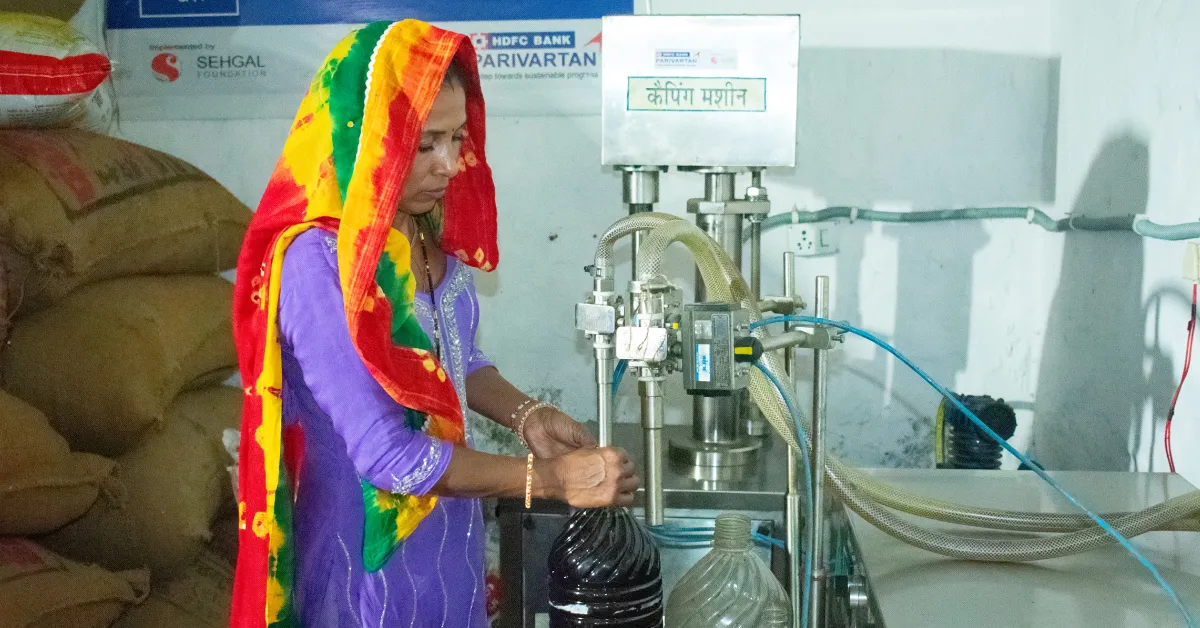
The machine at the centre of it all — an expeller that crushes mustard seeds to extract oil — was initially unfamiliar to all of them. Eight women received technical training from an expert who supplied the expeller unit. The five women who run the enterprise today were among them. They learnt every step of the process, from handling mustard seeds to filtering the oil, filling and capping bottles, and even resolving voltage issues on their own.
S M Sehgal Foundation supported the unit during its initial years and gradually stepped back as the women took on greater responsibility.
How the women run the business today
The unit is run by the Shri Ji self-help group, and decisions are taken collectively.
Five women associated with this unit since its inception run the enterprise today. Kavita, the president, coordinates the group, reviews accounts, leads meetings and works on market linkages. Preeti, the treasurer, handles accounts, expenditure and cash flow.
Anchal, the secretary, oversees operations, maintains registers and tracks stock, receives visitors and participates in decisions. Bati cleans mustard seeds and extracts oil, while Ritu handles filtration, filling, sealing, labelling and packaging.
Between January and August 2026, the women sold 2,995.5 litres of mustard oil and 3,841.5 kg of oil cake. Their market now extends beyond Hussaini and neighbouring villages to Kosi Kalan town in Chhata block of Mathura district, as well as Mathura, Aligarh and Bulandshahr in Uttar Pradesh; Gurugram, Faridabad, Palwal and Hodal in Haryana; and parts of Rajasthan.
According to the Foundation’s latest figures, the enterprise generated Rs 6,53,980 in sales between January and August 2026. Since beginning commercial operations in November 2023, its cumulative sales have crossed Rs 24 lakh.
Five percent is set aside for maintenance, and the remaining amount is divided equally among the five members. If someone does not need her share immediately, it can remain with the group and be lent to another member at one percent interest.
‘Money has given me stability’
For Preeti, the biggest changes can be seen outside the unit too.
She has travelled for meetings in Uttarakhand, Mathura and Chhata. She contributes towards her children’s school fees and household expenses and is able to save some money herself.
Her family now sees her work differently. Her mother-in-law, who was initially unsure about her stepping outside the home, now cooks with the oil the enterprise produces and has come to rely on Preeti’s earnings too. Even with that growing support, Preeti still seeks her in-laws’ permission before visiting other people’s homes. She hopes this will change with time.

For Anchal, earning has changed how she can contribute at home. Before she began working, she had to depend on her husband’s income for purchases. Today, she can share those expenses, including the ongoing care her two children with disabilities need.
“Earlier, my husband had to manage every expense on his own. Now, I can share that responsibility. If my children need medicines, I don’t have to wait or depend on him to buy them,” she says.
“My biggest wish is to see my children get better. I am ready to work as hard as I have to if it can help make that happen,” she says.
What the work looks like beyond Hussaini
The Hussaini enterprise sits within a wider network of women involved in S M Sehgal Foundation’s work. The organisation has worked with rural communities for 28 years, focusing on skills, market connections and helping communities manage enterprises themselves.
In Maharashtra, women in Nanda Agade’s self-help group, who previously worked as farm labourers, now run a Custom Hiring Centre with its own tractor. The initiative has reduced annual rental costs by Rs 4 to 5 lakh.
In Kolar, Karnataka, 389 women are shareholders in the Laxmisagara Horticulture Farmer Producer Company.
‘I have a lot of hope for this enterprise’
Anchal hopes to see another enterprise come up in Hussaini one day, giving other women the same chance to work and earn that she had. But her children remain at the centre of what she wants for the future.
For Preeti, earning more is tied to the opportunities she hopes to give her children. She wants them to receive the best education possible and dreams of seeing them become teachers, following a path she once envisioned for herself. This is also part of why she has begun thinking about the future of her enterprise, as its growth will shape the opportunities she can provide for her children.
“I have a lot of hope for this enterprise. I want to see it grow stronger so that all of us women can run it confidently on our own,” she says.
Both women came to the unit with fairly simple wishes. Anchal wanted space beyond a home life. Preeti wanted work that felt like her own. Both also needed an income of their own: Anchal for her children’s treatment, and Preeti for school fees and household expenses.

Since then, both women have challenged what their families once thought possible for them. They have learnt to operate unfamiliar machinery, taken on responsibilities they once had little opportunity to pursue, and grown more confident in making decisions for themselves.
Today, when mustard arrives at the unit, the women collectively know how much to buy, how to run the machine, how to keep the accounts, how to fill and seal the bottles and how to speak with customers.
And when a decision has to be made, the women sit together and make it.
All pictures courtesy S M Sehgal Foundation.
Disclaimer : This story is auto aggregated by a computer programme and has not been created or edited by DOWNTHENEWS. Publisher: thebetterindia.com




