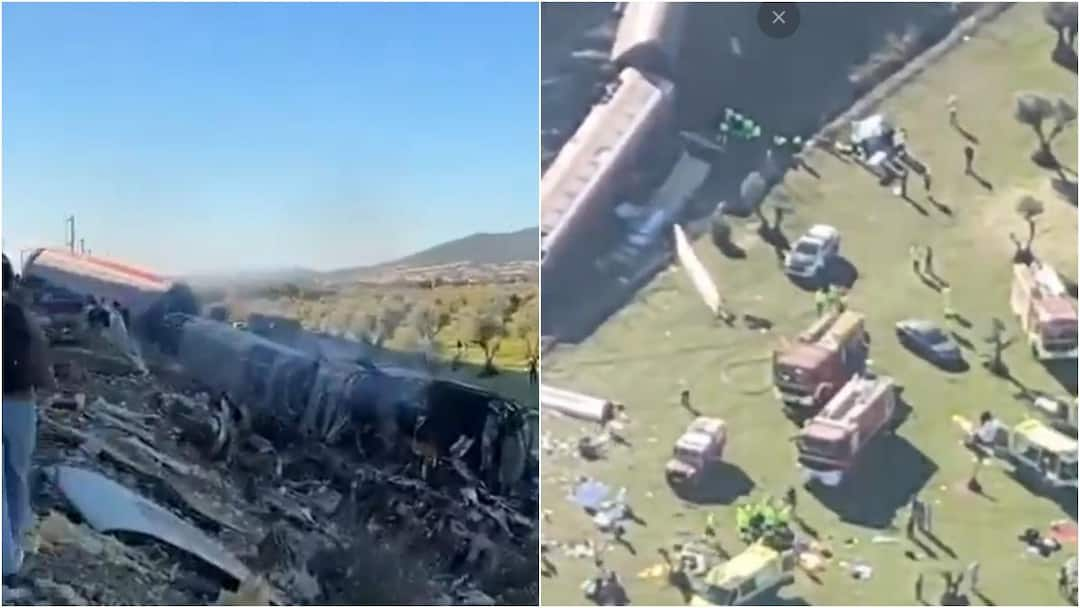
- High-speed train collision near Toledo left 68 dead.
- Human error suspected after signalling system malfunction.
- An AVE train struck stationary Iryo from behind.
At least 68 people have died in a train accident near Urda station in Toledo, Spain, on Wednesday morning, according to government sources, who warned that the death toll could rise further. “It could be worse than Adamuz,” the site of a rail disaster in Córdoba that claimed 46 lives on January 18, government sources said.
Authorities said 80 people were injured, including 50 who were seriously hurt. At least 55 people had been taken to hospitals in the region, the regional government of Castilla-La Mancha confirmed.
An AVE high-speed train collided with an Iryo train that was stationary on the tracks, according to emergency services. Two carriages reportedly fell down an embankment. Initial reports suggest the AVE train struck the Iryo train from behind, causing two of the latter’s carriages to derail, El Pais reported.
Spain’s state-owned rail operator Renfe announced the suspension of train services between Madrid, Ciudad Real and Andalusia. Both the government and opposition canceled their schedules for Wednesday following news of the accident.
Done Footage Captures Site
Drone footage from the crash site showed a white-and-purple Renfe AVE train largely remaining on the tracks, while several carriages of a red-and-white Iryo train had derailed.
Some damaged carriages were seen tilted over the railway embankment, while others lay in a field below. Twisted metal and debris were scattered around the wreckage.
WATCH: Dozens confirmed killed as aerial footage reveals devastation after train collision in Toledo, Spain https://t.co/vwdz3IlGlT
— Klaxon Wire (@KlaxonWire) October 28, 2026
Emergency services deployed ambulances, fire engines, police vehicles and medical helicopters to nearby fields. Rescue personnel wearing high-visibility jackets were seen moving between the damaged carriages and emergency vehicles.
PM Pedro Sanchez Expresses Solidarity With Victims
Prime Minister Pedro Sanchez said he was in constant contact with the transport minister and the premier of Castilla-La Mancha. In a post on X, he said emergency services were working at the scene to assist those affected and ensure their safety in coordination with the relevant authorities.
“My thoughts, solidarity, and support go out to all the victims and their families,” Sanchez wrote.
Former Popular Party labour minister Fátima Báñez was among the passengers, although her condition remained unknown. Antonio Sanz, Andalusia’s regional minister for the presidency and head of emergency management, said authorities were in contact with her family, who had reached the area, and were gathering information.
Human Error Suspected In Train Collision
Government sources said initial assessments pointed to a possible human error by an operator at state-owned railway infrastructure company Adif, following a malfunction in the main signalling system.
The safety system is automated but switches to manual operation if it fails. According to preliminary analyses, several trains in the area stopped after the system malfunctioned. They were subsequently instructed to resume movement, but the Iryo train remained stationary.
Initial findings suggest an operator at the Atocha control centre in Madrid mistakenly instructed the Renfe train to proceed despite the Iryo train blocking the track. The Renfe train then collided with the stationary train from behind. The speed at which the collision occurred has not yet been determined, and investigations are continuing.
Rafael Escudero, spokesperson for the Railway Union, described the accident as “very unusual” in an interview with Antena 3 radio. He said the area had no passenger stop, train movements were monitored in real time, and trains received live information about track conditions. He added that a train should stop if an obstacle, such as another train, is detected ahead.
Passengers Recall The Impact
A passenger travelling in one of the rear carriages told EL PAÍS that he felt a “strong impact” about 40 minutes into the journey. The collision occurred near kilometre marker 118, between the towns of Mora, Orgaz and Urda in Toledo.
Another passenger, Miguel Ángel Pérez, told Spanish state broadcaster TVE by phone that the accident was “terrible, indescribable”. He was travelling in the last carriage of Renfe’s AVE 2080, which had 397 passengers on board.
“We’ve come to realise the immense gravity” of what happened, Pérez said. Recalling the impact, he said passengers began clinging to their seats amid the violent jolt and rattling. He added that they managed to escape from the carriage by breaking its windows before he ended the call to provide his identification to authorities.
‘What I Encountered Was Horrific’
Ambulances and hearses continued to arrive at and leave the crash site on Wednesday morning as rescue teams worked to recover the bodies. A priest from Consuegra, a town near the site, said he arrived at around 10 am and administered last rites to two people near the tracks.
“What I encountered was horrific — many victims in very bad condition. Most of them were young people. I had never faced a situation like this before,” he said.
Esther Padilla, spokesperson for the regional government of Castilla-La Mancha, confirmed to TVE that there were numerous fatalities and warned that the toll was likely to rise.
She added that the Military Emergency Unit had offered assistance, alongside the regions of Castilla-León, Madrid, Andalusia and Navarre.
Spain Recalls Previous Deadly Rail Disasters
The accident has drawn comparisons with the derailment of two high-speed trains in Adamuz, Córdoba, on January 18. That crash was described as Spain’s most serious train accident since 2013, when an Alvia train travelling from Madrid to Ferrol derailed on a curve near Angrois, close to Santiago de Compostela. The 2013 accident killed 80 people and injured 145.
Spain’s worst railway disaster is widely considered to be the accident in Torre del Bierzo, León, on January 3, 1944. An express train, a shunting locomotive and a freight train collided inside a tunnel, with the official death toll put at 78. However, the actual number of fatalities is believed to have been higher, with allegations that the Franco regime concealed the true toll.
Other major rail disasters include a head-on collision near El Cuervo in Seville on July 21, 1972, which killed 86 people and injured 112, and the Valencia Metro derailment on July 3, 2006, which left 43 dead and 47 injured.
Members of the Adamuz victims’ association have offered to help those affected by the latest accident and share their experiences from the January disaster. José Manuel, a member of the association’s board and a relative of a woman injured in the earlier crash, said: “Every step they take from here on out has consequences they are not yet able to fully assess.”
Disclaimer : This story is auto aggregated by a computer programme and has not been created or edited by DOWNTHENEWS. Publisher: abplive.com