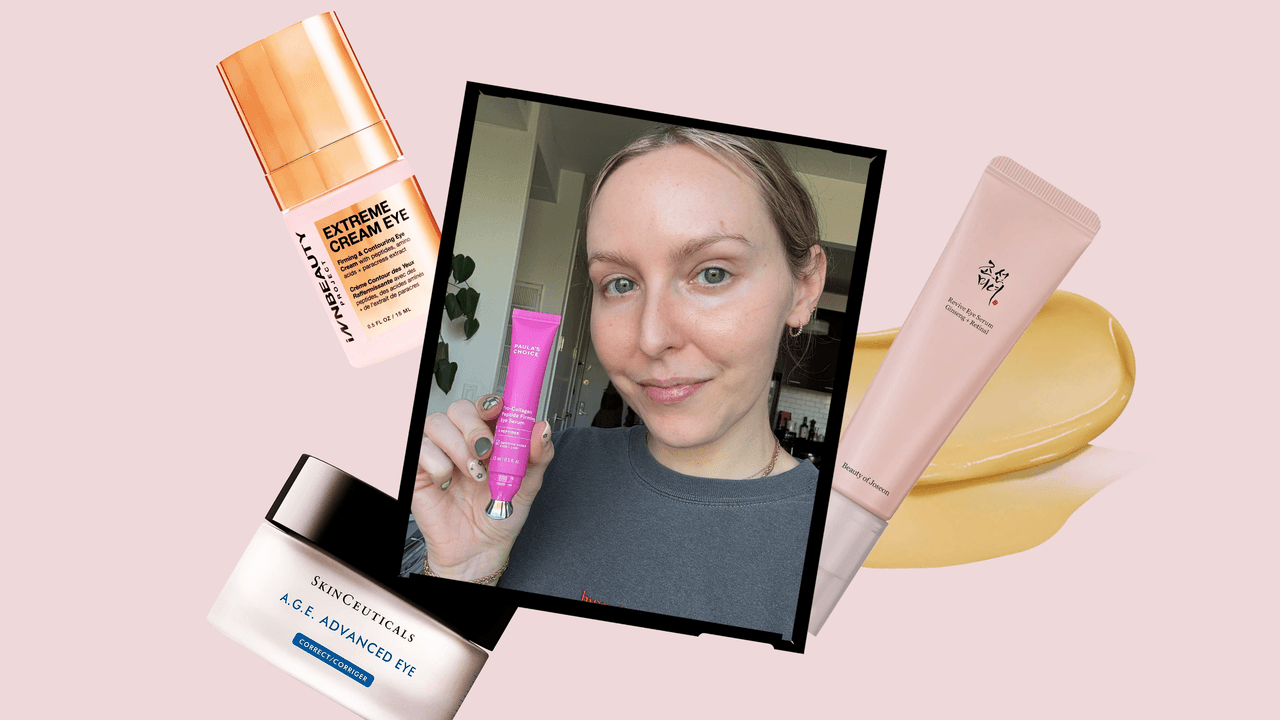
We also love that the silky gel texture (courtesy of squalane and glycerin) absorbs quickly enough to double as an excellent primer—no creasing, pilling, or makeup meltdown in sight.
Frequently Asked Questions
What do peptides actually do in an eye cream?
In eye creams, they’re typically used to support collagen production, improve skin elasticity, and soften the look of fine lines over time. Different peptides target different concerns, but overall, Lu says to think of them “less as instant fixers and more as long-game support for skin structure.” Because they’re generally gentler than stronger actives, peptides also tend to work especially well in formulas designed for the delicate eye area.
Here’s a quick breakdown of the main types of peptides you’ll spot in skin care:
- Signal peptides: These essentially “nudge” skin into repair mode, helping stimulate collagen and elastin production for firmer-, plumper-looking skin.
- Carrier peptides: Often copper-based, these deliver trace elements involved in wound healing and collagen support, while also offering antioxidant benefits.
- Enzyme-inhibitor peptides: These work by slowing down enzymes that naturally break down collagen over time (a process that starts earlier than we think—around our 20s).
- Neurotransmitter-inhibitor peptides: Sometimes nicknamed “Botox-like peptides,” these are designed to help soften the appearance of expression lines by temporarily relaxing the look of muscle movement, though nowhere near the extent of injectables.
Does it matter what peptides I should look for on the ingredient list?
Yes, but decoding peptide ingredient lists can get confusing fast. “Peptides include a wide range of ingredients that don’t always work in the same way,” says Fu. Different peptides target different concerns, from fine lines to puffiness to skin repair, and many can appear under multiple names depending on the formula or trademarked complex. Still, there are a few standout peptides with especially strong reputations in skin care:
- Matrixyl (palmitoyl peptides): “This is a family of signaling peptides known as matrikines that help support collagen production and skin repair,” says Lu. ”These are among the most well-studied peptides in skin care and are commonly used to improve the look of fine lines over time.”
- Copper peptides: “These are peptides involved in wound healing and skin regeneration pathways,” says Fu. Fu notes that their real-world cosmetic benefits are still a little hazy—not to mention tricky to formulate stably.
- Acetyl hexapeptide-8 (Argireline): “One of the most common Botox-like peptides because it’s marketed as helping reduce muscle contraction signals that contribute to expression lines,” says Lu.
Are peptide eye creams as effective as retinol?
Peptide eye creams aren’t as effective as retinol—at least not on their own. “Retinoids have decades of data showing they can directly increase cell turnover and stimulate collagen, making them one of the most proven ingredients for wrinkles and hyperpigmentation,” says Fu. While peptides often play in the same skin-care arena, they work through different pathways and, overall, have less research supporting their benefits than retinol.
Can peptide eye creams help with dark circles?
Sometimes, but it really depends on both the cause of your dark circles and the specific peptides used in the formula. “Dark circles are complex,” says Lu. Some ingredients target pigmentation, while others focus on visible blood vessels or thinning skin under the eyes.
Peptides can help in some of those pathways, but Lu notes that it’s “highly dependent on the actual peptides used.” One example is Haloxyl, a trademarked peptide blend created by the same company behind Matrixyl, specifically developed and tested to help reduce the appearance of dark circles. In other words: Not every peptide eye cream is automatically a dark-circle treatment, but the right formula can absolutely help.
Meet the experts
- Y. Claire Chang, MD, a board-certified dermatologist at UnionDerm based in New York City
- Victoria Fu, a cosmetic chemist and cofounder of Chemist Confessions based in New York City
- Gloria Lu, a cosmetic chemist and cofounder of Chemist Confessions based in Clark, New Jersey
- Jane Yoo, MD, a dual board-certified dermatologist and Mohs surgeon based in New York City
How we test and review products
Before reviewing any makeup, we ask questions about a number of factors: What ingredients are in it? Does the brand offer a wide shade range inclusive of consumers with all skin tones and undertones? Is it safe for readers who have sensitive skin or wear contact lenses? Is it on the affordable side or more of a splurge? Is its packaging consciously designed or needlessly wasteful?
For our review of the best peptide eye creams, we enlisted the help of multiple editors, writers, contributors, and professional makeup artists to review the products. This ensures our testing base spans different skin tones, genders, and dermatological conditions. We considered each product’s performance across four primary categories: wear, longevity, color variety, and ease of use. For more on what’s involved in our reporting, check out our complete reviews process and methodology page.
Our staff and testers
A beauty product is a personal purchase. You might be searching for a face cream to address persistent dryness or a new nail product to add to your Sunday self-care routine; you may simply be browsing around for the latest launches to hit the hair market. No matter what you seek or your individual needs and concerns, Allure wants to ensure that you love anything we recommend in our stories. We believe that having a diverse team of writers and editors—in addition to the wide range of outside testers and industry experts we regularly call upon—is essential to reaching that goal.
After all, can we really say a skin-care product is the “best” for people over 50 if the only testers we’ve solicited opinions from folks who have yet to hit 30? Can we honestly deem a high-end diffuser worthy of your hard-earned cash if it’s never been tested on curls? We’re proud that our staff spans a wide range of ages, skin tones, hair textures, genders, and backgrounds, which means that we are able to fairly assess any beauty product that comes into the beauty closet.
Disclaimer : This story is auto aggregated by a computer programme and has not been created or edited by DOWNTHENEWS. Publisher: www.allure.com