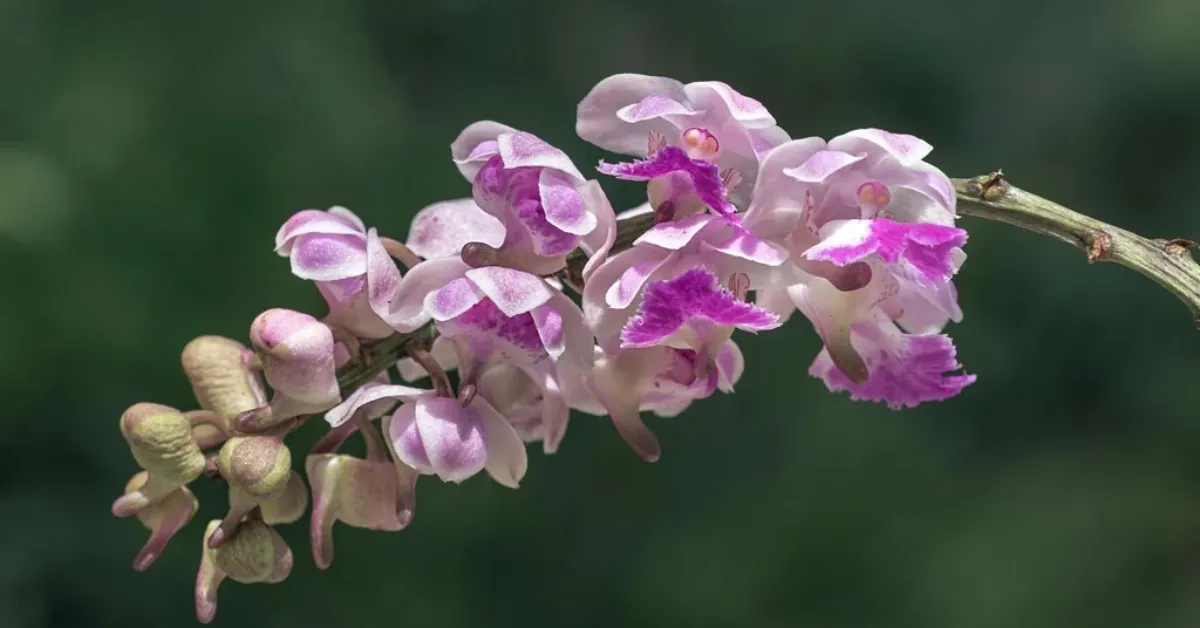
When trees along a road are marked for felling, the loss extends beyond their shade and canopy.
For thousands of orchids growing on their trunks and branches, the removal of a single tree can mean losing their entire habitat.
In Kozhikode, Kerala, researchers faced this challenge as road-widening projects threatened mature trees supporting native orchids. Instead of allowing the plants to be lost along with the trees, they began rescuing and relocating them to other landscapes.
A study published on 15 October 2026 in the scientific journal Plants has now documented the outcomes of this effort.
Researchers assessed 27,324 native orchids belonging to 21 species that were relocated to three sites in Kozhikode. After monitoring them for 12 to 24 months, they found that 19,511, or 71.4%, had survived.
Why roadside trees matter to orchids
Unlike terrestrial orchids that grow in soil, epiphytic orchids grow on the trunks and branches of other plants.
They use trees as support, relying on their bark, moisture, shade and surrounding canopy conditions to survive. When a mature host tree is felled, the orchids growing on it can lose their habitat at once.
The scale of this dependence is evident from an earlier survey in Kerala.
A 2025 study, Distribution and Abundance of Native Orchids on Roadside Trees in a Global Biodiversity Hotspot, recorded nearly 10,000 orchids belonging to 13 species on approximately 600 trees across Wayanad. The trees represented 72 different taxa, and the orchid population included six regional endemics.
The October 2026 study notes that road construction and widening have increasingly threatened these mature host trees and the orchid communities they support.
The researchers involved in the latest study included Mithun Venugopal and Pradeep N Sukumaran of the KSCSTE-Malabar Botanical Garden and Institute for Plant Sciences in Kozhikode, and Viswambharan Sarasan of the Royal Botanic Gardens, Kew, in the UK.
More than 17,000 native orchids representing 22 species had initially been transferred to Sarovaram Biopark as part of the earlier rescue programme.
The subsequent effort also involved relocating orchids to two other sites: the Malabar Botanical Garden and Kappad Beach.
Three sites, different survival outcomes
The researchers examined how the rescued plants adapted to three distinct environments, all located in Kozhikode’s coastal region.
Sarovaram Biopark, an urban wetland with mangrove cover, provided a humid and relatively sheltered environment. The Malabar Botanical Garden offered a mix of shaded, marshy and moderately elevated areas.
Kappad Beach, meanwhile, exposed the orchids to stronger winds, direct sunlight and salt spray.
The differences were reflected in their survival. According to the study, Sarovaram recorded the strongest overall establishment, while the exposed coastal location presented greater challenges for the plants to take root and survive.
However, Kappad recorded the highest flowering rate among surviving orchids, at 35.6%.
It also had the highest proportion of flowering plants producing capsules, at 62.3%. At Sarovaram, the corresponding figures were 26.3% and 34.8%, while the Malabar Botanical Garden recorded 27% and 40.1%, respectively.
What the findings mean for conservation
The study also examined 6,126 rescued orchids belonging to 12 regionally endemic species. Of these, 3,368 survived, translating to a survival rate of 55%.
The group included eight species endemic to India and four shared between southern India and Sri Lanka.
This was lower than the overall survival rate of 71.4%, highlighting the additional challenges involved in relocating species with more restricted natural distributions.
The researchers found that some high-altitude and mist-forest-associated orchids also managed to survive and reproduce after being moved to lower elevations, although their establishment depended more on the receiving site.
Orchids of India Calanthe biloba Lindl. #Orchids #India #Conservation #Biodiversity @ForestDeptt @Sdg13Un https://t.co/mZDyHDj2Mc
— Dr. Sanjeet Kumar (Ecologist) (@BiotechSanjeet) October 19, 2026
Beyond survival, the researchers also looked at whether the rescued orchids could reproduce in their new surroundings. They found capsules containing embryos among the relocated plants, indicating that some had progressed beyond simply adapting to their new locations.
However, the team stresses that relocation is not a substitute for protecting natural habitats. It is an additional conservation measure for situations where the removal of orchid-bearing trees cannot be avoided.
Before a tree is marked for felling to make way for a wider road, there may be dozens of plants growing quietly on its trunk and branches. For orchids, the loss of that tree can mean the loss of an entire habitat. Identifying these plants before construction begins can make room for infrastructure without overlooking the smaller ecosystems that depend on the trees being removed.
Sources:
‘When Roads Remove Trees, Conservation Must Move Fast: A Rescue Translocation Model for Keralam’s Native Epiphytic Orchids’: By Mithun Venugopal , Pradeep N. Sukumaran, Viswambharan Sarasan, Published on 15 October 2026
‘Distribution and Abundance of Native Orchids on Roadside Trees in a Global Biodiversity Hotspot’: By Viswambharan Sarasan, Mithun Venugopal, Ratheesh M. K. Narayanan,Sidharth S. Nair, andPradeep N. Sukumaran, Published on 19 August 2025
Disclaimer : This story is auto aggregated by a computer programme and has not been created or edited by DOWNTHENEWS. Publisher: thebetterindia.com