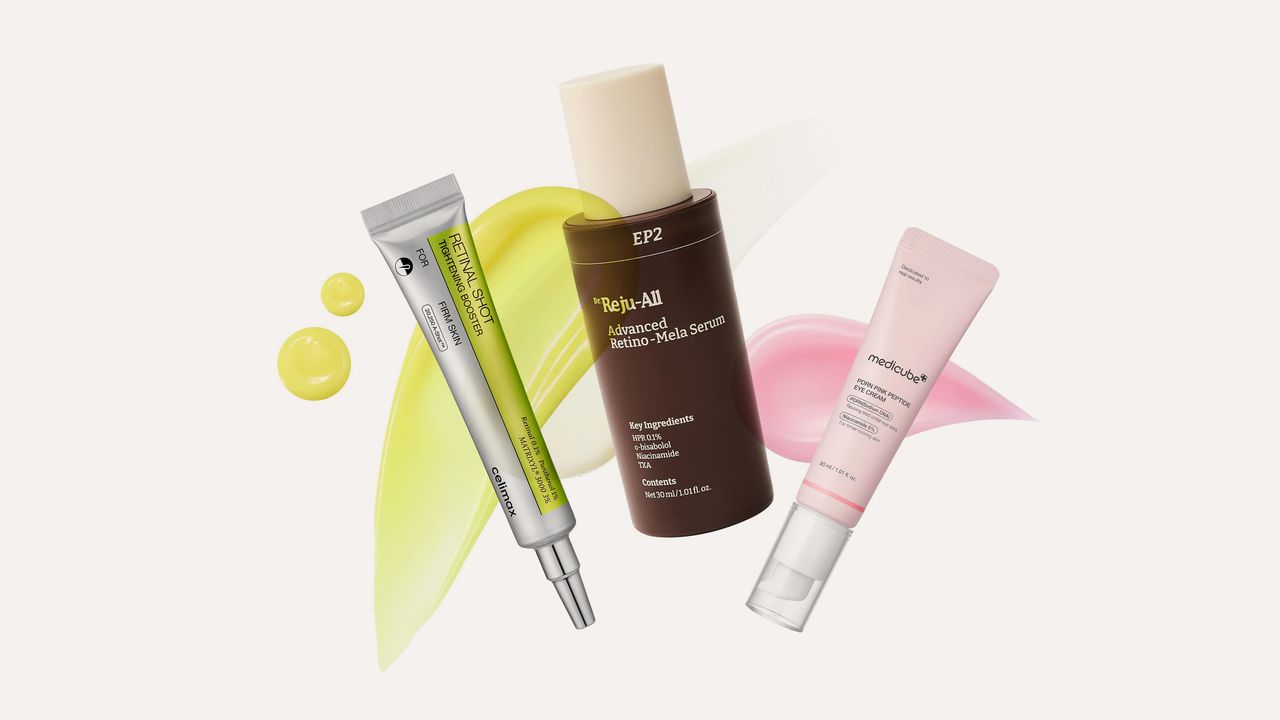
Ingredient-wise, the formula checks all the boxes for that plump, glass-skin look: Hydrolyzed collagen, multiple forms of hyaluronic acid, glycerin, and betaine flood skin with hydration, while Centella asiatica and its soothing components (madecassoside, asiatic acid, and asiaticoside) calm redness and support the barrier. “Targeting wrinkles, fine lines, and sagging skin, it’s my go-to when I need to look refreshed and lifted for important meetings or events,” says Sarah Chung Park, creator of K-Beauty World at Ulta Beauty based in Los Angeles.
Frequently Asked Questions
What’s the most common form of retinol in K-beauty?
The most common retinol forms you’ll see in Korean beauty products are actually a mix of classic retinol plus gentler or more stable vitamin A derivatives. The big ones are:
- Retinol: Especially around the 0.1% mark
- Retinal (retinaldehyde): Increasingly popular in newer K-beauty launches because it works faster than retinol while still being available OTC
- Bakuchiol: A plant-based retinol alternative that’s sometimes paired with retinol to gently boost efficacy
- Hydroxypinacolone retinoate (HPR): A newer-gen retinoid sometimes called “granactive retinoid.” HPR can interact directly with retinoid receptors, without the conversion steps required by traditional retinol. That said, compared to classic retinoids, research on HPR is still relatively limited
- Retinyl palmitate: A milder vitamin A derivative (goes through three conversion steps in the skin before it becomes retinoic acid) that shows up in beginner-friendly or sensitive-skin products
What’s especially common in K-beauty isn’t just the retinoid ingredient itself, but the way it’s formulated: Many products use encapsulated retinol, liposome delivery systems, slow-release technology, or “micro-dose” approaches designed to minimize irritation. They’re also frequently buffered with barrier-supporting ingredients like “cica, ceramides, panthenol, heartleaf, and peptides” to keep skin hydrated, says Dr. Yoo.
If a product doesn’t list a retinol percentage, how can you tell how strong it is?
If your Korean skin-care products don’t list the retinol percentage, the best clue is usually the type of retinoid it contains. “It can be difficult to know the exact strength without knowing the actual percentage,” says Dr. Yoo. “However, you can get a sense by knowing the type or form of retinoid.” Generally speaking, retinyl esters are considered the weakest and gentlest, followed by retinol (the most common OTC option), then retinal/retinaldehyde, which tends to work faster and hit harder. Prescription-strength tretinoin and adapalene sit at the more potent end of the spectrum, while HPR (hydroxypinacolone retinoate) is often marketed as powerful but still lacks as much comparative research.
Dr. Yoo also points out that formulation matters just as much as the ingredient itself: A milder retinoid in a lightweight gel serum may end up feeling stronger than a more potent retinoid suspended in a rich cream. In other words, strength isn’t just about the percentage—it’s also about the delivery system, texture, and what the formula is combined with.
Do you still need sunscreen in the morning with Korean retinol?
Even if your Korean retinol feels gentler or more barrier-friendly than traditional retinoids, sunscreen is still non-negotiable the next morning (regardless of its origin). “Retinoids increase cell turnover, and this makes the skin more vulnerable to UV damage,” says Dr. Yoo. In other words, all that overnight work your retinol is doing to help soften fine lines, smooth skin texture, and even out skin tone can quickly backfire if skin isn’t protected from the sun during the day. Translation: Your retinol and sunscreen are a package deal.
Meet the experts
How we test and review products
When Allure tests a product, our editors look at it from every angle in an effort to best serve you. We review ingredients, scrutinize brand claims, and, when necessary, examine peer-reviewed scientific and medical studies. In addition to testing each and every product that’s included in each and every review, we rely on experts who shape their fields, including dermatology, cosmetic chemistry, and medicine, to help us vet the ingredients and formulas.
For our list of the best Korean retinol products, we considered each product’s performance across five primary categories: product ingredients and efficacy, packaging, fragrance, texture, and product wear. Every product was determined to have excelled in each category by our editorial team, which is composed of in-house writers and editors as well as contributors—along with special consideration from board-certified dermatologists. To learn more information on our reporting and testing processes, read our complete reviews process and methodology page.
Our staff and testers
A beauty product is a personal purchase. You might be searching for a face cream to address persistent dryness or a new nail product to add to your Sunday self-care routine; you may simply be browsing around for the latest launches to hit the hair market. No matter what you seek or your individual needs and concerns, Allure wants to ensure that you love anything we recommend in our stories. We believe that having a diverse team of writers and editors—in addition to the wide range of outside testers and industry experts we regularly call upon—is essential to reaching that goal.
After all, can we really say a skin-care product is the “best” for people over 50 if the only testers we’ve solicited opinions from folks who have yet to hit 30? Can we honestly deem a high-end diffuser worthy of your hard-earned cash if it’s never been tested on curls? We’re proud that our staff spans a wide range of ages, skin tones, hair textures, genders, and backgrounds, which means that we are able to fairly assess any beauty product that comes into the beauty closet.
Disclaimer : This story is auto aggregated by a computer programme and has not been created or edited by DOWNTHENEWS. Publisher: www.allure.com