Khartoum, Sudan – For 26 years, Amal Suleiman Ahmed al-Haj has worked as a secondary school teacher in Sudan.
But her monthly salary of 132,000 Sudanese pounds ($13.20) only covers her family’s basic needs for a few days. Just buying a cooking gas cylinder will set her back about 170,000 pounds ($17).
Recommended Stories
list of 3 itemsend of list
With teachers in Khartoum State no longer paid enough to survive, they have gone on strike for a third week.
“My salary does not cover even a quarter of our needs. It may not last a family more than three or four days,” Amal told Al Jazeera. “Teachers are extremely exhausted and have to find other jobs in the evenings to supplement their income. In reality, we have become secondary workers in the education sector.”
Underpaid and under pressure
Beyond their salary issues, teachers are also unhappy with the lack of opportunities for promotion and accumulated unpaid entitlements.
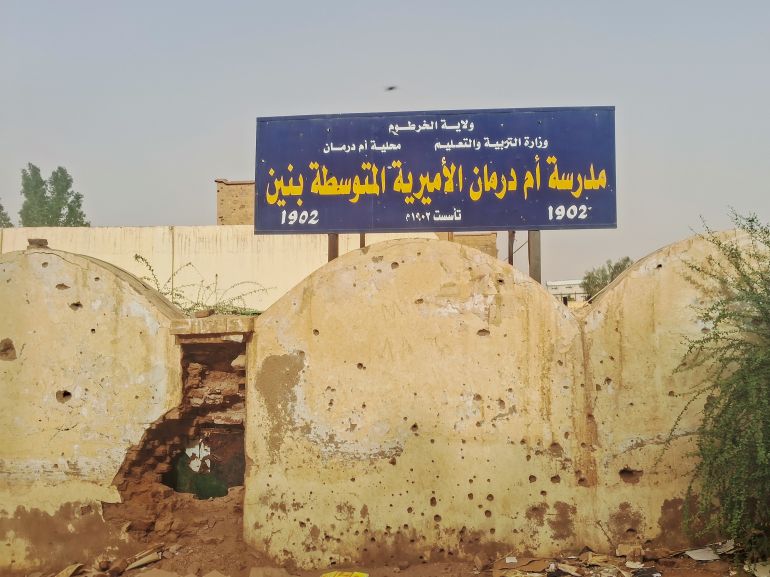
They are also worried about deteriorating conditions in schools, caused by war and a lack of investment. Some classrooms at Amal’s school are no longer suitable for teaching.
“There is a classroom where I teach and its roof has collapsed, leaving us directly exposed to the sun. This is the environment in which we teach, and it affects both us and the students,” Amal told Al Jazeera.
“Those of us who stayed in Sudan [during the war] lost out. We did not lose our jobs, but we were not working and were not receiving salaries. As a result, our outstanding payments accumulated with the government.”
Amal said that teachers have resorted to strike action after exhausting all official channels to demand their rights.
Advertisement
“We submitted memorandums to the Ministry of Education, the Ministry of Finance and the presidential palace, but nothing came of it. We also spoke through the media, and there was no solution left except going on strike,” she said.
“How can a teacher educate students when they cannot afford to get to school, pay for transport or provide for their children?” she said.
Many teachers Amal knows are considering leaving the profession. Some have already quit their jobs, taken unpaid leave, or sought alternative sources of income.
Amal admits that the suspension of classes during the strike is negatively affecting her students. But with Sudan’s education system in crisis, she says teachers need at least the basic conditions necessary to do their jobs.
“Teachers are human beings. They have needs, families and responsibilities. How can they fulfil their educational mission under these pressures? Some teachers walk long distances to reach their schools, while others faint because of malnutrition and exhaustion,” she said.
“We are not asking for luxuries. We just want to be able to live, get to our schools and continue our educational mission.”
A long-haul strike
The Sudanese Teachers’ Committee has organised staggered, intermittent strikes to pressure the government into addressing teachers’ demands.
Sami al-Baqir, the committee’s spokesperson, said participation was initially widespread, but later declined after alleged attempts by the government to undermine the industrial action. The measures included relaxing administrative controls over staff attendance to make schools appear operational despite the strikes and providing model schools with mechanisms to generate additional funding. Some teachers also received partial outstanding payments from the government when new strikes were announced.
After a meeting between Sudanese ministers and unions last month, Prime Minister Kamil Idris ordered the payment of money owed to teachers across all Sudanese states. However, the government did not give a detailed payment schedule or address teachers’ other demands concerning salaries and allowances, leading to the continued impasse.
The Sudanese teachers’ union says it is braced for a long battle to resolve its members’ grievances.
“We called … [for] a long-haul strike to absorb the tactics the government is using. It tries to circumvent the problems rather than solve them,” al-Baqir told Al Jazeera.
Their demands include an increase in the minimum wage from 12,000 Sudanese pounds ($1.20) to 500,000 pounds ($50), based on poverty-line benchmarks and a cost-of-living study for a family of five conducted by the Sudanese Teachers’ Committee.
Advertisement
The body also wants three cabinet decisions made more than seven months ago to be implemented, including an increase in the meal allowance to 90,000 pounds ($9), the introduction of a housing allowance, and a 130,000-pound ($13) allowance to address salary disparities among public sector employees.
“These decisions were issued by the cabinet, but they have not been implemented so far. This indicates that the government is not serious about addressing teachers’ problems,” al-Baqir said.
Government responds
The ongoing war between the Sudanese army and paramilitary Rapid Support Forces (RSF), which broke out in April 2023, has contributed to the problems faced by teachers and school administrators, al-Baqir explained.
“For schools to reopen, teachers to return and the education system to stabilise, the problems facing schools and teachers must be addressed,” he added.
The conflict has disrupted schooling, destroyed educational facilities and turned some into shelters for the displaced or military sites, depriving millions of children of access to education.
The UN has documented 67 attacks on schools in Sudan since 2024, alongside more than 150 reports of armed groups commandeering educational facilities.
Lily Neyestani-Hailu, head of education in emergencies at UNESCO, said the conflict had forced hundreds of thousands of children out of school and put millions more at risk of missing out on education.
She said about 30 percent of Sudan’s schools were damaged or closed due to the war and more than 1,400 schools had been attacked.
Other estimates say that nearly half of the country’s schools are not functioning because of war damage or because they are being used as shelters or military facilities.
According to Sudan Education Cluster data published in January, 97 percent of schools in North Darfur have stopped classes. Only 13 percent of schools are operational in South Darfur and just 27 percent in West Darfur – two of the areas that have been worst-hit by the war.
At least 8 million children are now out of school, according to the UN, with poverty-stricken parents sending their children to work to help cover rising living costs.
School closures, a lack of investment in education and underpaid teachers are putting huge pressure on Sudan’s public education system.
“We are genuinely afraid that public education will be phased out,” al-Baqir said. “The government’s disregard for teachers’ rights, its failure to spend on education and the current administrative disorder in schools all send a message to parents that anyone who can afford private education will take their children there.”
Disclaimer : This story is auto aggregated by a computer programme and has not been created or edited by DOWNTHENEWS. Publisher: aljazeera.com