
‘It can kill us’: Kenyans fear impact of El Niño with floods predicted
-
Published
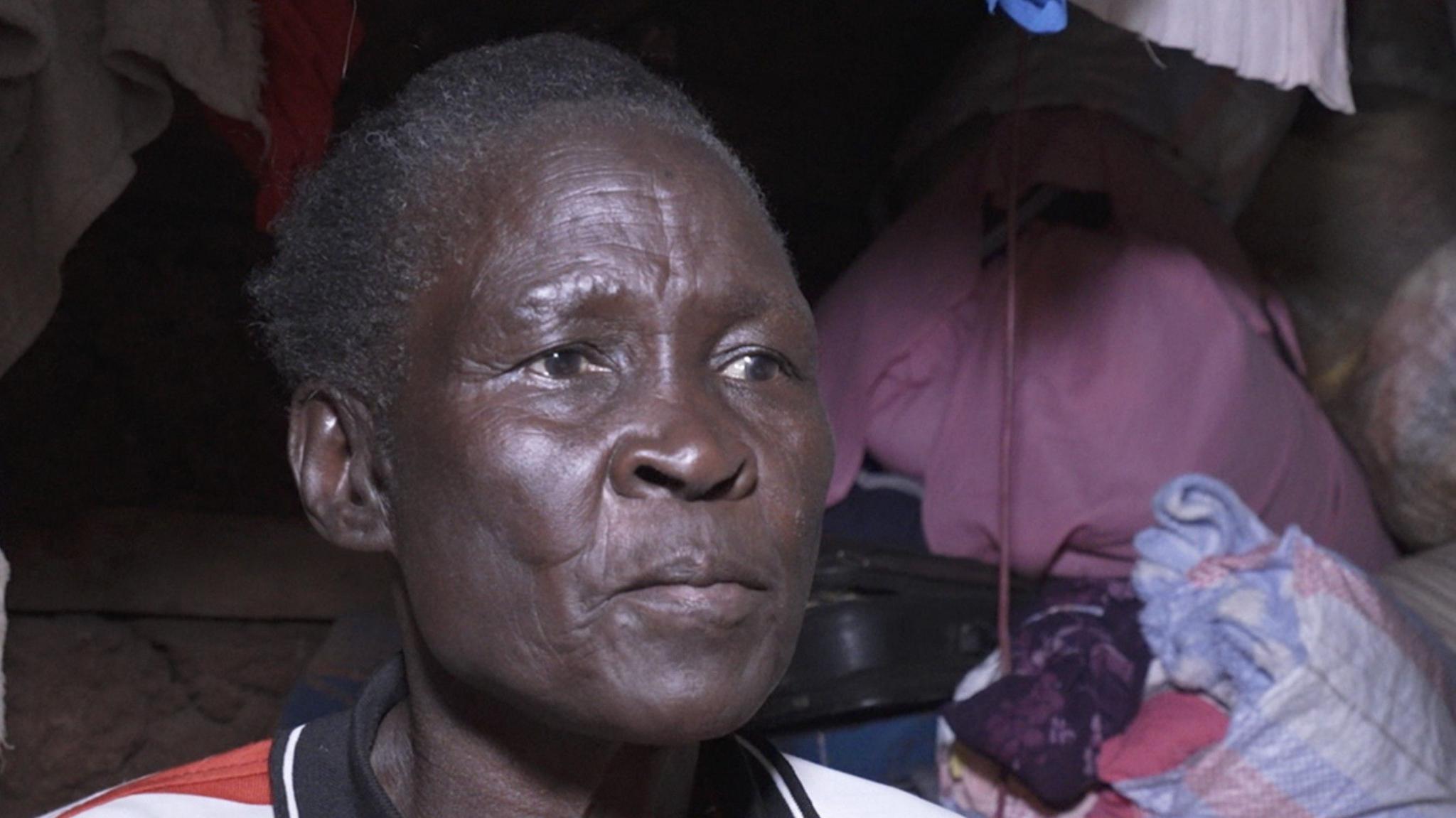
“It flooded up to here in March,” Agnes Shikoli says, pointing to a spot halfway up the six-foot [1.8m] corrugated iron wall of her home in Kibera, one of the largest informal settlements in Kenya.
Her tiny house lies just a couple of metres from the Ngong river, which runs through this densely populated area in the capital, Nairobi.
The scars of floods in the long rainy season earlier this year can still be seen – including a broken TV in the corner which was immersed in water.
Tucked out of sight is a photo of her sister Beatrice Khalayi, 58, who died when intense rains caused widespread destruction in Kibera. She was among more than 60 people across the country who lost their lives.
“Someone called me to tell me that she had died of electrocution after her house flooded,” Shikoli recalls. “When I see a picture of her, I feel uneasy, that’s why I keep it far from me, so I don’t see it.”
With Kenya’s short rainy season now starting, Shikoli tells the BBC she is afraid – especially following warnings that the El Niño weather phenomenon could bring a new round of flooding.
“I feel like it can kill us. These houses aren’t made of stone,” says the 62-year-old. “They can fall on us, or the water can drown us.”
Kibera – and Kenya more widely – are on the frontline of preparations for the potential impact of El Niño.
Forecasters have warned that this year could see one of the strongest on record, bringing extreme weather to many parts of the world.
In southern Kenya, that means the threat of rains even more intense than usual.
Outside Shikoli’s house, groups of men and women wearing high-visibility vests are shovelling and raking garbage out of the riverbed and disposing it far from the water.
This programme called Climate Worx, under the office of President William Ruto, is meant to rehabilitate Nairobi’s rivers. Such exercises have intensified since August when warnings increased about the possible scale of this year’s El Niño.

Similar work to unclog drainage systems is ongoing across Nairobi, a sprawling city built on hilly ground crossed by three major rivers.
But the workers have a huge task on their hands.
Blocked drains and inadequate sewage systems were widely blamed for the high number of deaths after the floods earlier in the year, as the excess rainfall had nowhere to escape.
The Nairobi County disaster management chief, Bramwell Simiyu tells the BBC that drainage systems have been “untouched for many years” and that removing the rubbish from them will save lives.
Floods disproportionately affect informal settlements in Nairobi, especially those near rivers, like Kibera and Mathare.
In most of these settlements, houses sit just a few metres from rivers. Some people, including Shikoli, live on the slopes of the river itself due to the constant expansion of the settlements. When flash floods occur, these houses are swept away, endangering the lives of their occupants.
Nairobi’s drainage system hasn’t been upgraded to deal with the rapid growth in the population and infrastructure over the decades
“The existing drainage system was developed 30 years ago to cater for a population of about 2.5 million residents but we’re dealing with about 7 million in the daytime and 5.5 million night-time,” Simiyu says.
He adds that investment of up to $192m (£143m) is needed to upgrade the sewerage and drainage system entirely.
But there is little sign that either the cash-strapped national or city council will able to raise this kind of money.
The Nairobi River Basin Regeneration programme, a government programme aimed at restoring the city’s rivers, found that settlements near rivers, and where there is weak enforcement of regulations, have increased flooding risks. It recommended a “buffer” to protect rivers and “humane relocation” of communities where necessary.
However, rising poverty has driven many people to live close to rivers.
“Our worst case scenario looking at low-income settlements is that up to about 100,000 people are at risk,” Simiyu says. “Moderate projections is about 5,000 households or about 20,000 people may be at risk.”
Anyone forced to leave their homes will be relocated to 167 designated holding grounds where a stockpile of relief food and supplies will be distributed, Simiyu says.
Nobody knows exactly when the rains will come – or how much rain there will be.
But Kenya’s meteorological department warns that November is usually the peak rainfall month of the short rainy season, which normally lasts from October to December.
A regional forecast from the Intergovernmental Authority on Development (Igad) warned in September that there was “an 81% probability of a very strong El Niño during October–December 2026”.
So far, the heavy rains predicted have not occurred but experts remain concerned.
In East Africa, this El Niño is being widely compared to a similar weather event in 1997-1998 which caused widespread flooding and destruction in Somalia and Kenya.
Weather forecaster Jemima Gacheru tells the BBC that’s because temperature conditions in the Indian Ocean in the 1997 El Niño and those recorded now are similar. This interaction, she says, has been seen to result in very strong rainfall.
“For this season we have a very strong El Niño already in play in the Pacific and then we have a positive Indian Ocean dipole,” Gacheru said. This is often called the “Indian Niño” because of its similarity to its Pacific equivalent and refers to the difference in sea-surface temperatures in opposite parts of the Indian Ocean.
“We expect to have some enhanced rainfall over several parts of the country.”
The UN’s migration body the International Organization for Migration (IOM) has warned that almost 900,000 people could be forced to leave their homes in Kenya this year, mostly because of the predicted floods.
 Image source, Anadolu via Getty Images
Kenya is not the only African country worried about the potential impact of El Niño.
In neighbouring Somalia, the country’s disaster management agency has warned that 1.2 million people are at risk of displacement caused by extreme weather – including the risk of both floods and drought.
The 1998 floods killed 2,000 people in Somalia and forced a further 250,000 to flee their homes, according to the Food and Agriculture Organisation. Up to 80% of crops were destroyed in some parts of the country.
The United Nation’s famine warning system IPC has warned of the increased risk of food insecurity in Somalia due to supply chain issues exacerbated by the impact of El Niño.
Elsewhere on the continent forecasters fear El Niño could bring extreme heat and prolonged periods without rain.
It could cause a crisis for farmers across parts of West Africa, including the semi-arid Sahel region south of the Sahara, as well as in southern parts of the continent, where the risk of crop failure is high.
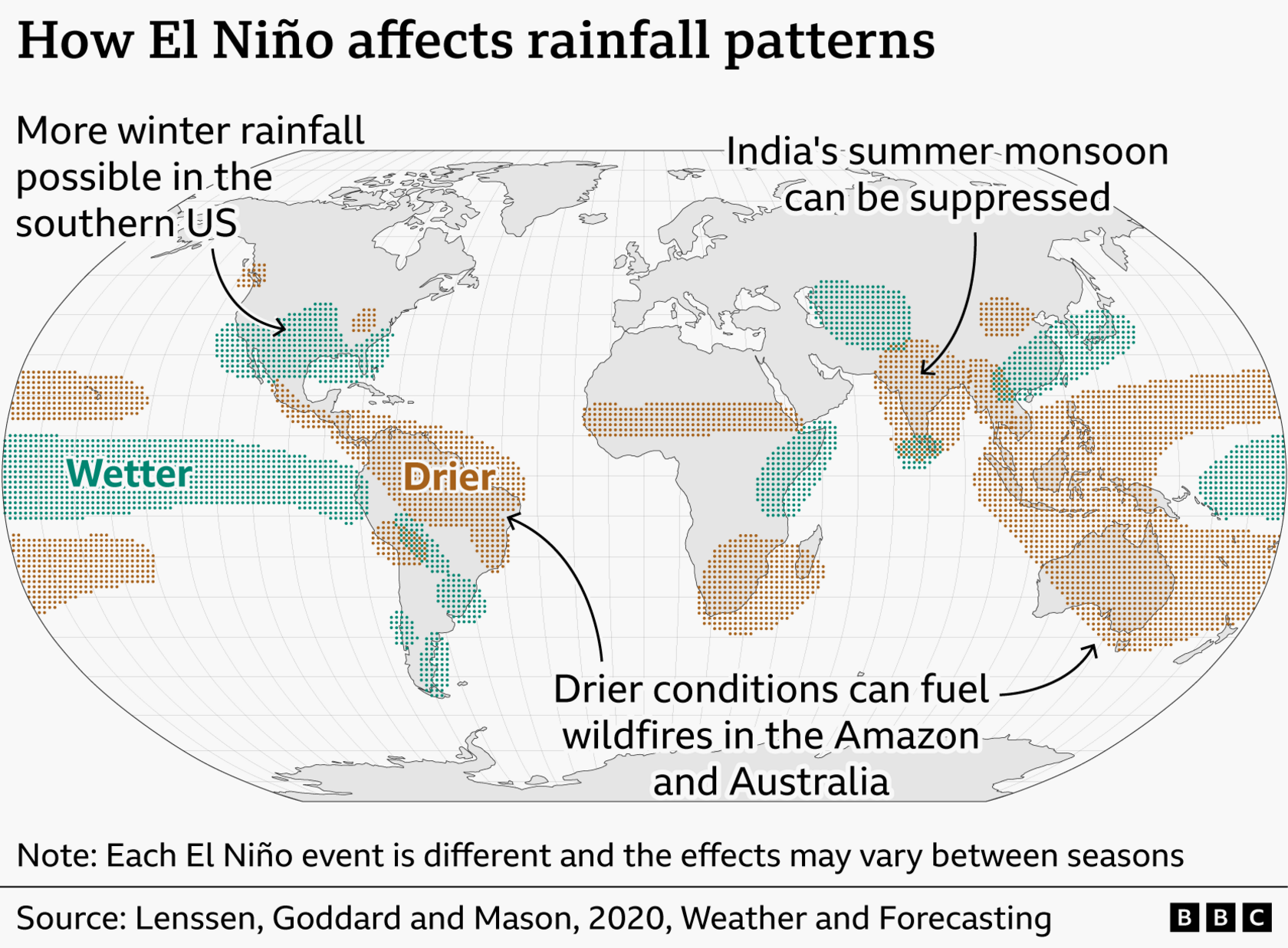
There are fears El Niño’s impact will worsen existing issues.
Communities like Kibera are already grappling with poor housing and rampant poverty, while parts of Somalia are already in the middle of a devastating drought.
National governments in many countries are doing what they can to prepare but the extent of El Niño’s impact is impossible to predict.
Back in Kibera, Shikoli and her family are preparing for the worst.
Council officials have told them they should leave their home on the riverbank until the rainy season has passed but Shikoli makes just $2 (£1.5) a day selling groundnuts and fruit from a small stall next to the river.
“I want to move,” she says. “But I don’t have the means.
“We just have to persevere and leave it to God.”
You may also be interested in:
-
Scientists predict 2026 hottest year on record as climate talks begin
-
Published1 day ago
-
-
Kenya floods: What a deluge reveals about Nairobi’s vulnerability
-
Published30 April 2024
-
-
UN warns of ‘supersized’ El Niño as countries prepare for impact
-
Published3 September
-

Go to BBCAfrica.com, external for more news from the African continent.
Follow us on Twitter @BBCAfrica, external, on Facebook at BBC Africa, external or on Instagram at bbcafrica, external
BBC Africa podcasts
Disclaimer : This story is auto aggregated by a computer programme and has not been created or edited by DOWNTHENEWS. Publisher: newsrss.bbc.co.uk




