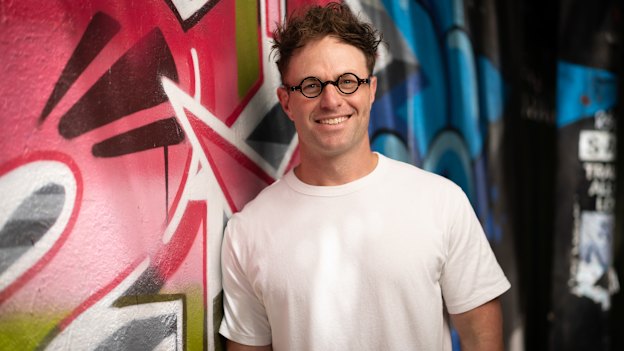
The lunch plates have been cleared and the tape recorder turned off when Dan Palmer poses a suitably random question. “What do you know about rogue bees?”
Palmer goes on to explain within a hive full of disciplined worker bees, there are a handful of rogues who don’t follow the rules, and don’t fly off dutifully to the known food source. They instead fly around whimsically and, in doing so, discover the all-important new supplies of nectar for the hive.
It’s part of a riff from Palmer on the value of blue-sky research in science, and non-conformism in general. But it may as well be an insight into Palmer himself, whose unique collection of polymathic achievements – which range from elite sport to complex brain science, and even showbusiness – make him one of Australia’s most interesting people.
But by now you’re five paragraphs into this story, and still probably trying to place Palmer. He’s vaguely familiar without being well-known, and for an introvert that is just how he likes it.
But Palmer has also done his time in the spotlight. In a former life, he was a professional rugby player, and played prop for the Wallabies in 2012. In 2020, he came out as gay in a powerful first-person column on the front page of The Sydney Morning Herald, describing the torment of hiding his sexuality in the macho world of men’s sport.
After retiring from rugby in 2014, the brawny footballer began studying the human mind, and 10 years later, Palmer emerged with a PhD in cellular neuroscience. Throughout, Palmer continued to coach scrummaging in professional rugby, and over the last six years, found time to create documentary audiobooks with the cerebral British broadcaster, Stephen Fry.
“I have always had broad interests,” Palmer says with a shrug. “And I like having lots on my plate. I’ve never been able to just do one thing.”
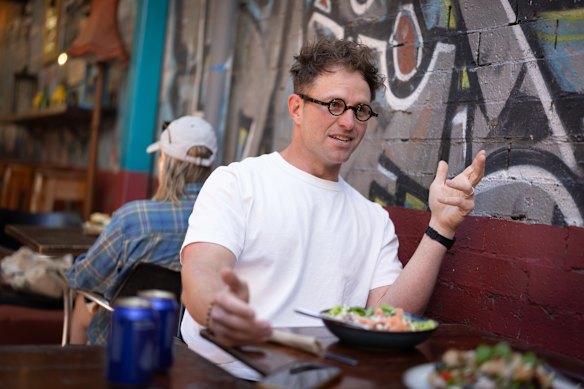
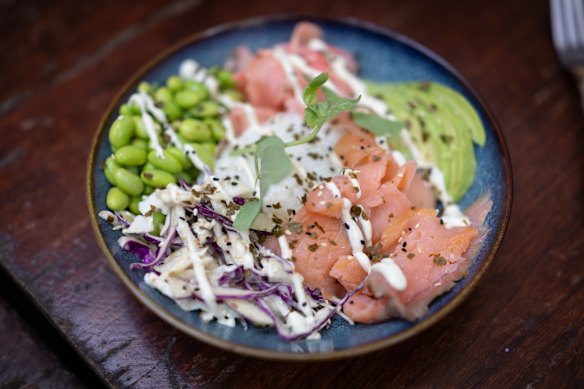
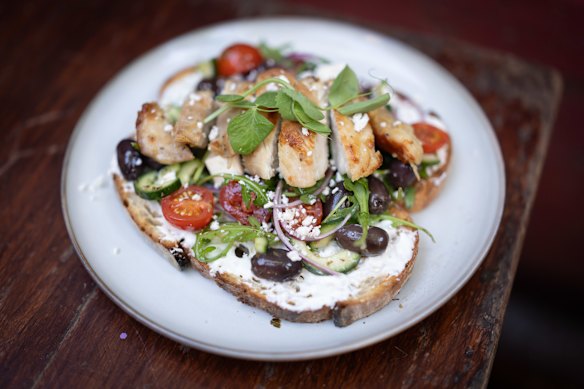
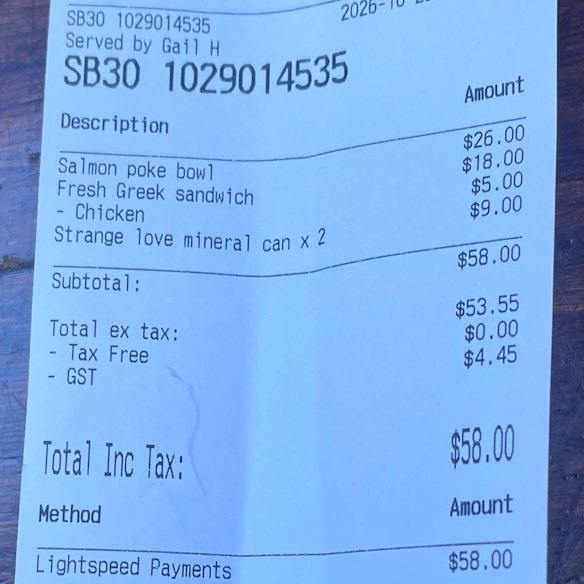
We meet for lunch in the courtyard cafe at the back of Palmer’s favourite bookshop in Glebe, Sappho Books. The orders are simple but tasty: a salmon poke bowl and an open Greek chicken sandwich.
“Normally, I would just get six poached eggs but seeing as you’re taking photos …,” Palmer laughs.

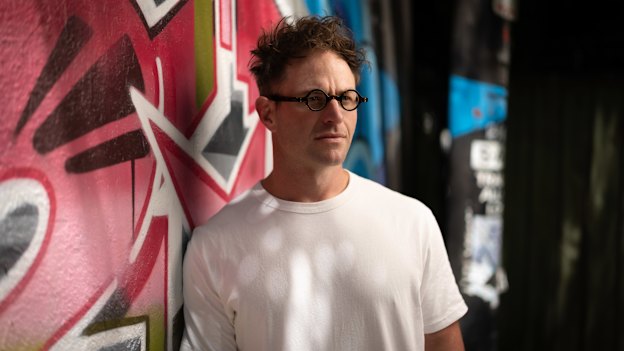
Palmer is still athletic but has lost 30 kilograms since his days as a rugby front rower, and with a finger-in-power-socket hairstyle and horn-rimmed glasses, is leaning into the mad scientist look.
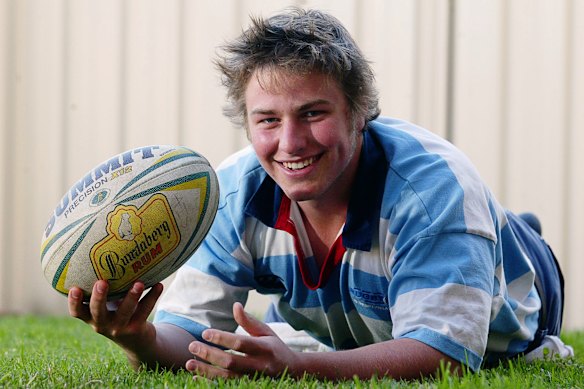
I first met Palmer in 2008 when he was as an outsized 18-year-old who’d been selected to play in his first Super Rugby game for NSW. He grew up in Shellharbour, in the Illawarra region, as one of three kids.
Though he was “not blessed with hand-eye coordination or athleticism”, Palmer had the right genes for a rugby prop – father Peter also played for NSW – and he could push like a tugboat. The only thing that kept Palmer in school was a desire to play in the Australian schoolboys team.
“Otherwise I probably would have left school in year 10, and gone into carpentry or something,” he says.
Palmer won a contract with NSW as a teenager, before moving to Canberra to play for the Brumbies in 2011. It was a transformative move, on several fronts.
Palmer ended up playing more, and in 2012 he achieved his dream of playing for the Wallabies, against Scotland on a wet night in Newcastle.
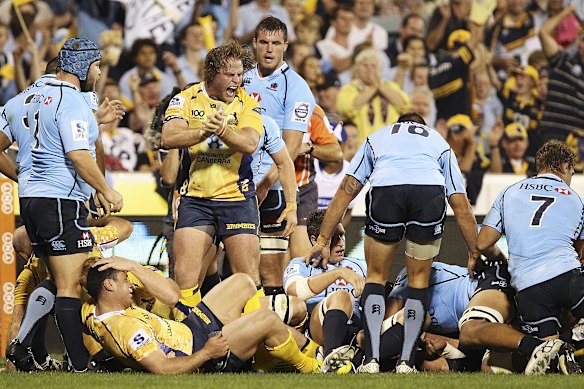
But moving to Canberra also saw Palmer become surrounded by a more scholarly crew of teammates and friends, like Clyde Rathbone, Matt Toomua and future senator David Pocock.
“Clyde and I, in particular, our training would be book-ended by coffees talking about philosophy and science and all kinds of things,” Palmer said. “And I got to the point pretty quickly where that became far more interesting to me than running into people.”
While playing, Palmer earned money on the side as a debt collector and private investigator, which saw him sometimes paid to follow a spouse by “rich husbands who think their wives are cheating”. But it was mostly repossessions and using his 120kg to darken a door frame.
I asked Palmer at the time, for a story, what happened if someone said no. “They don’t say no, mate,” came the reply.
Injury denied Palmer more chances with the Wallabies, and he moved to France to play for Grenoble in 2014. He was alone there, and it proved to be a dark period, in which his struggle to hide his true identity saw him abusing painkillers and alcohol.
Waking up one morning in his own vomit prompted Palmer to fly to London, come out to a friend and retire from rugby. “It wasn’t really even a choice,” he said. “Like, I had to go. I had to stop playing rugby and I had to go and study. It’s just what I wanted to do.”
Palmer moved back to Canberra to go to university, and was offered a part-time job as scrummaging coach at the Brumbies. Fascinated by the human mind, he started out studying philosophy and psychology.
“I found it interesting, but I wasn’t really getting the answers I wanted,” Palmer explains. “Eventually, I ended up in cellular neuroscience. So, effectively, what we’re talking about is just different levels of analysis. You’ve got the high conceptual level of philosophy, and then down to the behavioural level of psychology, and then I really wanted to understand, basically, the hardware that underpins it.”
After completing a double degree in psychology and science, Palmer embarked on a PhD in cellular neuroscience at the John Curtin School of Medical Research in 2021.
“I studied the structure of particular neurons and circuits in the brain, trying to understand sensory processing and memory at the deepest level,” he said.
“I was working in the olfactory cortex, so the sense of smell, and it turns out that the olfactory cortex is the only sensory cortex that stores its own memories. So it’s almost a one-stop shop for studying sensory processing, and storage and memory.”
Palmer loved nothing more than finishing coaching and doing all-nighters in the lab, conducting experiments. “I was viewed as a fish out of water on all fronts: I was the rugby guy in science, and the science guy in rugby,” he said.
It was this unique combination of worlds that served as the catalyst for Palmer being, improbably, recruited to work with Fry in 2020. Through Pocock, Palmer had been introduced to Andrew Sampson, a London-based Australian producer and long-time business partner of Fry. Sampson got in touch with a request for help.
“Andrew said, ‘We’re doing this audio documentary on the brain’,” Palmer said. “He asked me to have a look at their proposal that they were going to send to Audible. I went through it, and we ended up working on it together, and changing it quite a bit and rewriting it.
“They ended up sending that to Audible, which got accepted. So I stayed on the project.”
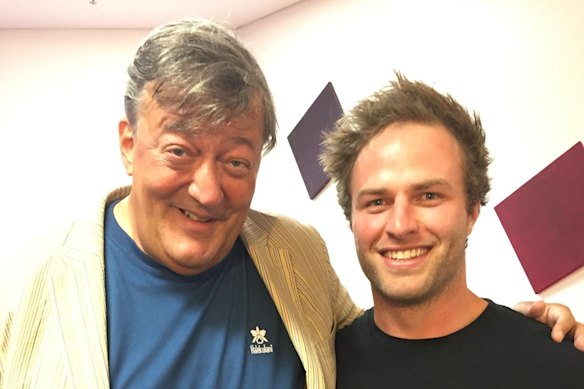
The 12-part series, narrated by Fry, looked at “basically all the core themes of neuroscience and psychology”.
“It went quite well and Audible wanted to go again.”
In a team of three, Palmer then helped create a Fry series Wonderful Life, tracing the origins and evolution of life on Earth, which was released in 2025. He is recently back from London, where a third series is being mapped out.
What is it like working with Fry? “I don’t know what your impression is of him, but I think that the general impression of him is pretty accurate,” Palmer said. “He’s really funny, he’s intelligent, he’s really impressive. I understand how lucky I am.”
Palmer is happiest behind the scenes, so it took much gumption to decide to write a column for the Herald in 2020, in which he shared his experiences of being a closeted gay man in sport.
“I despised myself and the life I was living. I was trapped in a false narrative and could see no way out. Most nights, I cried myself to sleep and routinely numbed myself with a heavy cocktail of opioids,” he wrote.
Palmer’s friends and family had known about his sexuality for a while by the time of the article, but the story of a well-known male athlete “coming out” was still big news around the world.
“The response was overwhelmingly positive, really,” Palmer reflects. “Like I said, I’m not really a fan of attention or being in the spotlight, so I tried to avoid a lot of that afterwards.”
So why did you do it? “It’s a good question. It was around that Israel [Folau] time, I just felt like there needed to be a stronger kind of voice, not necessarily against Israel, but just a stronger voice, in support,” Palmer said.
“I don’t really spend any time thinking about Israel or that situation. That [Folau being sacked by Rugby Australia for homophobic social media posts] got blown well out of proportion in a lot of ways. From where I’m sitting, he became a puppet for other people.

“But the kind of noises that were floating around at that time, I felt like there needed to be a stronger voice, and as much as I didn’t necessarily want the attention, I did feel a duty to say something.”
Palmer says the decision for athletes – current or retired – to reveal their sexuality is a personal choice, and he hopes one day it won’t be seen as newsworthy. “The goal really is to get to a point where you don’t have to [come out],” he says. “I’ve never been sat down by one of my mates that said, “Listen mate, I’m straight.” So like the best response is, “I don’t give a shit.”
“I don’t think anyone should feel compelled or have to do it. If I had my way, ideally I wouldn’t have to speak to anyone about that because it’s also the most uninteresting part of who anybody is. I have as much control over that as my height, and they’re both very banal, uninteresting topics.
“But if me or anybody else saying something helps people, especially younger kids who might be in that phase of really struggling, that’s a good thing.”
Palmer’s love of being busy was tested when he was also the Wallabies’ scrum coach in 2023, during the troubled tenure of another workaholic, coach Eddie Jones. “I was knackered at the end of that year, I must admit,” Palmer says.
But, a decade after he first planned to do it, Palmer last month cut the cord with rugby, stepping down as scrum coach of the Waratahs. Living in Sydney with partner Callum, he is excited to dive headlong into – as usual – a wide number of projects; some known, some yet-to-be discovered.
“I’ve got other things that I want to explore. I’m going to be dead soon, so I’ve got to get it done before then,” Palmer says.
Palmer used to do a Q&A series on Substack, called “Thoughts of the Human Mammal”, in which he would finish up by asking subjects: “What makes a good life?”
I throw it back at Palmer, to wrap up. He asks for more time to give an answer, and texts through an hour later. “The Zizek quote jumps to mind,” Palmer writes. “Why be happy when you can be interesting.”
Read more great conversations over lunch
Start the day with a summary of the day’s most important and interesting stories, analysis and insights. Sign up for our Morning Edition newsletter.
Disclaimer : This story is auto aggregated by a computer programme and has not been created or edited by DOWNTHENEWS. Publisher: www.smh.com.au