Erica Sweeney
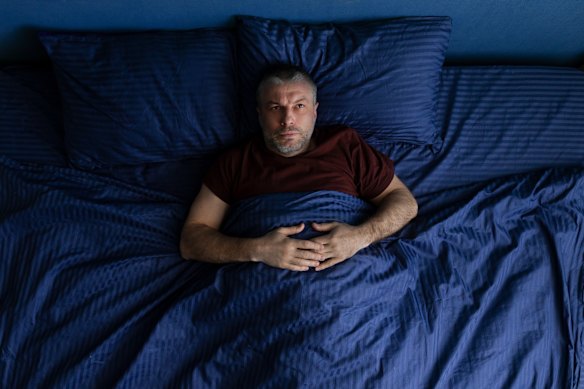
If you often find yourself lying wide awake at night – when you should be sleeping – stewing over an argument you had earlier in the day or worrying about an important upcoming meeting, you’re not alone.
Nighttime anxiety is “incredibly relatable to most people, myself included,” says Natalie Solomon, a psychologist board certified in sleep medicine at the Stanford University School of Medicine. “Our emotional regulation decreases at night, so you might have the same stresses or worries during the day, but they really seem to sharpen at night for many people.”
Around one in four Australians will experience anxiety in their lifetime. Research shows that anxiety symptoms, including racing thoughts and nervousness, can peak at different times during the day and are highest at 8am, 4pm and 1am, with racing thoughts in particular generally increasing in the evenings.
There seems to be a “bidirectional relationship” between anxiety and sleep, Solomon says. In other words, anxiety revs up your fight-or-flight system, which tells your body to activate and become alert, which makes it more difficult to sleep. Lack of sleep then makes you more vulnerable to anxiety, and so the cycle continues.
There are several reasons anxiety often worsens at night. Here’s what to know, how to handle it and when to seek help.
Why anxiety increases at night
Work and personal demands typically consume your attention during the day. But at night, there are fewer distractions, giving you “more space for thinking about the things you’re either concerned about or worried about,” says Candice Alfano, a psychology professor at Stony Brook University who researches the relationships between emotions, behaviours and sleep. “All of this can elevate anxiety.”
It can also be more difficult to cope with emotions in the evening, Solomon says. Research suggests that levels of strategic reasoning, which governs the ability to analyse information and make informed decisions, are lower at night. Impulse control also drops when you’re tired and sleep-deprived, studies show.
So, “your anxiety outweighs the more logical parts of the brain,” Solomon says.
A 2022 study referred to this as the “mind after midnight” phenomenon and suggested that being awake during times you’d like to be asleep negatively affects the brain’s decision-making, rational thinking and risk-reward processing, and increases negative moods.
Worrying and racing thoughts can also wake you up in the middle of the night and make it difficult to go back to sleep, says Elizabeth Hoge, a psychiatry professor and director of the Anxiety Disorders Research Program at Georgetown University School of Medicine.
This can push your sleep period later, disrupting your circadian rhythm (the body’s natural internal clock) and creating irregular sleep patterns, Alfano says.
You might even start to expect sleep disruptions and feel anxious about the fact that you’re not sleeping, says Michael Grandner, director of the Sleep and Health Research Program at the University of Arizona and a co-author of the “mind after midnight” study.
Then, “sleep becomes predictably stressful,” he says. The “anxiety that you carry into the bedroom becomes anxiety about sleep, which becomes the barrier to sleep itself”.
At some point, everyone has probably felt anxious at night and not slept, Grandner says. But people who tend to worry and ruminate or have trauma, anxiety or sleep disorders may be more likely to experience this regularly, Alfano says.
How to manage nighttime anxiety
If anxiety tends to creep up and intensify at night, experts suggest trying these tips:
Designate time to worry
Schedule “worry time during the day,” Hoge says, which can help you get all of your thoughts out earlier and may prevent anxiety from cropping up at night. Solomon recommended spending five or 10 minutes writing down what’s on your mind that day and listing what you can and can’t control about it. If bothersome thoughts do come up later in the evening, she says to remind yourself that you will reexamine them tomorrow.
Wind down before bedtime
Give yourself “enough time and space to be ready for sleep when the time comes,” Grandner says. About 30 minutes to an hour should suffice. During this time, Alfano says to turn off your screens and do something calming, like listening to music, reading, meditating or taking a bath. This helps your mind and body shift into rest mode and signals that it’s time to sleep.
Listen to your body’s internal clock
There’s no ideal bedtime to prevent nighttime anxiety, Solomon says. Instead, she suggests going to bed when you feel sleepy and following your natural clock, if possible. Also, try to set consistent bedtime and wake-up times, which can help set you up for success at night. If you can’t sleep, get up and do something relaxing until you feel sleepy, Grandner says, explaining that this keeps your brain associating your bed with sleep (not alertness).
Practice healthy sleep habits
Make your sleep environment “like a cave,” cool, dark and quiet, Alfano says. Consider using blackout curtains, a white noise machine or ear plugs to prevent disruptions. Avoid caffeine and alcohol close to bedtime, as both will keep you awake and disrupt sleep, Alfano says.
When to get help
If nighttime anxiety regularly strikes, despite implementing the above, Alfano suggests seeing a therapist or sleep specialist. They can determine if you have a mental health condition, such as an anxiety disorder, or a sleep disorder, such as insomnia or sleep apnoea, and recommend the appropriate treatment, Hoge says.
You may have insomnia if you struggle to fall or stay asleep at least three times a week for at least three months and have daytime sleepiness, Grandner says. The mainstay treatment is cognitive behavioural therapy for insomnia, which involves working with a therapist to change your thoughts and behaviours around sleep.
“It’s essentially a set of strategies to get people out of their own way” when it comes to sleep, Grandner says.
Fixing sleep problems will usually improve anxiety, too, he says. “It doesn’t matter which came first. They’re causing each other.”
Washington Post
Make the most of your health, relationships, fitness and nutrition with our Live Well newsletter. Get it in your inbox every Monday.
From our partners
Disclaimer : This story is auto aggregated by a computer programme and has not been created or edited by DOWNTHENEWS. Publisher: www.smh.com.au