Liam Denning
People loved – loved – the Cybertruck. There were just not that many of those people. Worse, the man behind it, Elon Musk, seemingly strived to shrink that cohort even further.
The Cybertruck will soon be no more. Less than three years since the launch, Tesla has announced production is to stop. Vehicle models come and go, but this one carries heavy symbolism for several reasons. One is that Tesla doesn’t have many models anyway. Second, more than any other, the Cybertruck was like a manifestation of Musk’s id, unleashing his desire for “the future to look like the future”, in his words.
Third, and most importantly, the Cybertruck’s brief lifespan captures the effective end of Tesla’s original mission to bring electric vehicles to the masses as Musk’s other interests and politics took primacy. Tesla today is all in on Robotaxis, robots and artificial intelligence; its EV sales have stalled.
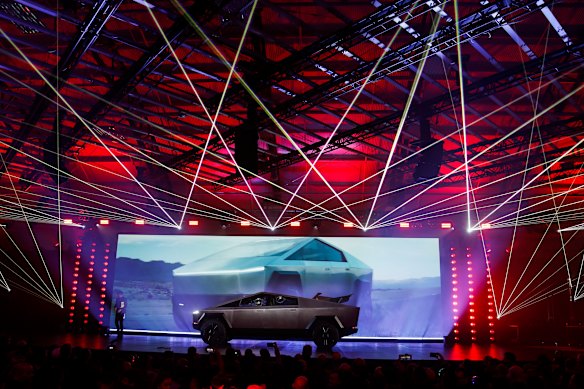
Whereas Musk once touted potential annual Cybertruck shipments of 250,000, estimated sales in its best year were less than 40,000, and only about half that over the past four quarters. Its quality defects – so many recalls in so little time – and luxury price didn’t help. The bigger issue was that the Cybertruck was never really going to be a mass-market product. Just look at it.
Electric pick-up trucks are a tough sell at the best of times. The aerodynamics of a brick limit range, and that range drops further if you tow anything. Production of Ford Motor Co’s F-150 Lightning, which beat the Cybertruck to launch and benefited from the pedigree of America’s best-selling truck, ended after less than four years. Selling an electric pick-up is less about converting existing pick-up drivers and more about luring the EV curious who want something different – think Rivian Automotive, Inc.’s finely honed outdoorsy branding.
In that sense, the Cybertruck’s foundational concept of “let’s surprise people” – as Musk put it to his design team, according to the biography by Walter Isaacson – was the right one, albeit taken to the extreme. The angular styling was polarising, or even disqualifying in certain overseas markets. A classic deadpan quote from one owner to Wired – “women don’t like the vehicle” – is largely borne out. Cybertruck buyers skew 94 per cent male, according to the latest New Vehicle Experience Study from Strategic Vision, a buyer behaviour consultancy based in San Diego. That is higher than the 88 per cent for full-size pick-ups, and well above the 70 per cent ratio for EVs, and 55 per cent for all vehicles.
Those mostly male buyers were mostly hardcore fans, though, says Alexander Edwards, chief executive at Strategic Vision. Segmenting customers according to “attitudes,” or the personal beliefs that find expression through a product, Edwards highlights the unusually high proportion of Cybertruck buyers over the past three years classified as “innovators”: 44 per cent, compared with 31 per cent for Tesla in general and 11 per cent for vehicle buyers as a whole.
They are tech-savvy and not “quiet” buyers, Edwards says, summing up their thinking as: “I am buying a vehicle that will not only express my individuality, but actually does all the things it needs to do, so that when I express who I am, it’s not a fake.” The “who I am” bit became a liability, though. There is a natural limit on the pool of well-heeled, college-educated professionals yearning for a vehicle that captures their love of technology and excitement who then picture a stainless-steel trapezoid, weighing more than 2720 kilograms. Musk drained that pool further.
About two weeks before the Cybertruck launched in November 2023, Musk touched off a storm of criticism by endorsing an antisemitic post on X, the former Twitter social media platform he had acquired the year before. His embrace of the hard right deepened from there, and the following year, he also endorsed President Donald Trump in his successful bid for another term and then briefly, and infamously, joined the administration. Sales of Tesla EVs, which had long tapped into a liberal- and green-leaning customer base, suffered quickly in key markets including California and Europe. It was into this environment that the Cybertruck had just launched.
An unusual product that could have used an all-out effort to persuade an inherently finite set of people into making a purchase was, instead, hamstrung from day one by Musk’s extracurricular activities. For the majority of “innovators” who identify as Democrats or independents, the Cybertruck’s expression of their individuality now came with a hefty dose of far-right politics and racism, turning them off.
Musk’s abandonment of Tesla’s natural buyer constituencies in 2024 went further, with the company also dropping plans to produce a cheap EV model in favour of pivoting hard to a Robotaxi strategy. The Cybertruck, whose hulking profile and sticker price were definitely not ideal for spreading the energy transition, prefigured this. Even though battery-powered, it paradoxically symbolised Tesla’s move away from the vanguard of the electric revolution. The fact that the Cybertruck’s discontinuation coincides with a midterms drubbing for Musk’s Republican allies may be mere coincidence, but if so, it is a useful one. The Cybertruck was a passion project that crashed into the unbridled passions of its very own creator.
Bloomberg
The Business Briefing newsletter delivers major stories, exclusive coverage and expert opinion. Sign up to get it every weekday morning.
From our partners
Disclaimer : This story is auto aggregated by a computer programme and has not been created or edited by DOWNTHENEWS. Publisher: www.smh.com.au