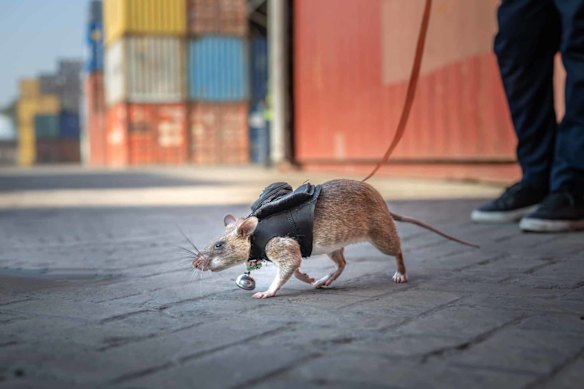
In the streets, villages and corners of Siem Reap, other spectacles are waiting to be discovered.
I think I may have fallen in love with a rat named Gertrude. In the thick afternoon heat of Siem Reap, Cambodia’s second-largest city, I watch the African giant pouched rat scurry across a sandy enclosure. The size of a small cat, with oversized ears and a twitching pink nose, she’s sniffing for explosives, scratching the ground when she detects TNT and earning a treat from her handler.
Gertrude is one of the HeroRATs used by APOPO, a Belgian non-profit that trains the animals in Tanzania, then deploys them in Cambodia and other countries to detect landmines. Too light to detonate the explosives, the rats can search an area the size of a tennis court in less than half an hour, a task that might take a human, working cautiously with a metal detector, four days.
An estimated 1.7 million Cambodians died under the Khmer Rouge in the 1970s and decades of conflict left 4 to 6 million landmines buried across the country. Despite three decades of clearance efforts, the explosives are still claiming victims, with 39 people killed or injured in 2025 alone. Gertrude is a small but mighty solution.
A day earlier, I’d gone looking for wonder on a grander scale. Beneath a swirling monsoonal sky at Angkor Wat, the world’s largest religious monument and the centrepiece of Cambodia’s vast Angkor temple complex, I watched dawn smudge the silhouettes of its five lotus-shaped towers. There was no spectacular sunrise, just diffused light falling over ancient stonework, and influencers posing for photographs against a backdrop of rain-soaked, almost neon-green forest.
It was my third visit to Angkor, and although I appreciate its extraordinary scale and artistry, it’s never given me the tears or goosebumps I often experience when I travel. Maybe it’s the crowds or the weight of expectation, but the awe I keep wanting to feel has always eluded me.
After bidding Gertrude farewell, I head out of Siem Reap, past roadside stalls piled high with fruits, before the countryside opens into rice paddies dotted with candy-coloured stilt houses and hump-backed cattle. I’m with Chhunnin Neat from the Shinta Mani Foundation, the charitable arm of the hotel where I’m staying. We pull up outside a village home, where a small group of women is weaving bags and baskets in the shade using dried water hyacinth, an invasive weed I’d seen choking Tonlé Sap Lake earlier in my trip. Each bag takes four days to finish, the women tell me, as I calculate how many I can squeeze into my suitcase. The work allows them to earn an income without leaving their children to find seasonal agricultural work.
Raised by a single mother who woke at 2am to sell cakes at the market, Neat was encouraged to pursue an education. Now she works to give other women the same chance. “I really want to help women like me,” she says as we drive back into the city. “I’m tired, but when I see the women’s faces, it charges me.”
Back in Siem Reap, I wander through the Made in Cambodia market, running my fingers over colourful, handwoven blankets and admiring shelves of ceramics, crafts with centuries-old roots in Cambodia. My next encounter with Siem Reap’s enterprising women comes with a fresh lotus flower, presented by my tuk-tuk driver the same evening. She works for Tuk Tuk Lady, an association founded by Kim Sokleang, a single mother of two who began driving to support her children, despite being told that women belong at home and driving is men’s work. Her network now includes 25 women, each earning their own income and choosing their working hours.
My driver drops me at Phare Circus, where things take a wonderfully peculiar turn. Beneath the big top, performers scatter rice across the stage, tracing patterns in the grains before launching into dizzying acrobatics as live music swells around them. Rice rains from the ceiling while a painter, seemingly oblivious to the chaos, works on a canvas, revealing his finished painting to thunderous applause. Part Cirque du Soleil, part celebration of Cambodian culture, the circus grew out of a 1994 art-therapy program established by young Cambodians returning from refugee camps.
On my final morning in Siem Reap, I consider returning to Angkor but, instead, follow the Siem Reap River, past shuttered bars and enormous rain trees strung with lights, towards Wat Bo, one of the city’s oldest Buddhist temples. Inside, local families are gathering to make offerings and receive blessings. There isn’t another tourist in sight and, feeling like an intruder, I slip outside into the gardens. There, almost by accident, I discover two long rows of statues of Buddhist monks, their faded saffron robes and golden lotus pedestals forming a silent corridor beneath the trees. I stand before them in the early morning light, goosebumps rising on my arms, and tears finally pricking my eyes.
The writer travelled courtesy of Shinta Mani Angkor and G Adventures.
Read more from Good Weekend magazine:
Disclaimer : This story is auto aggregated by a computer programme and has not been created or edited by DOWNTHENEWS. Publisher: www.smh.com.au