
Edwina Throsby
Like millions of Australians, when I finished school I took a gap year to live and travel in Europe. My minimum-wage waitressing jobs only went so far, and with little to spend I would baulk at the often hefty entrance fees for galleries and museums. My travelling companion – a few years older and infinitely more wise – gave me some excellent advice. You won’t remember whether your hostel had a shared bathroom, but you will remember walking up the marble stairs at the Louvre and seeing the Nike of Samothrace for the first time.
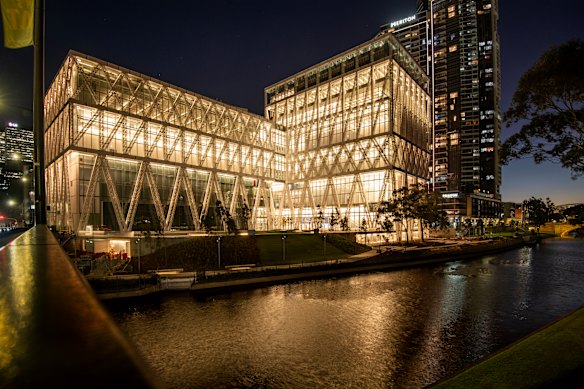
The same philosophy might end up being applied to the massive new Powerhouse museum, which has claimed a heritage house, a high-profile job and almost a billion dollars in its rise on the edge of the Parramatta River. For NSW, it represents a level of public investment in culture not seen since the construction of the Sydney Opera House, and a ringing declaration of confidence in the continued growth of western Sydney, an area not traditionally well-served by major cultural landmarks. Coming as it does amid cuts across the struggling arts sector, its progress and opening have been heavily scrutinised and wildly controversial. Is it worth it?
On a humid Friday afternoon, a week after the grand opening weekend inspired vastly mixed reviews from the enthusiastically positive to the downright damning, the building is bustling with crowds so diverse as to defy categorisation. Not all visitors seem to be here for the exhibitions – the coffee shops and restaurant are well-attended, and a small group has settled on chairs in a vast concrete corridor to share a lunch out of supermarket bags. It’s an excellent spot for a picnic, with airconditioning and panoramic views patchworked with jacaranda. If one of the aims of a modern museum is to provide a community meeting place, this box is ticked.
Overflow
In contrast to the old Ultimo site, there is a clear delineation between exhibition and non-exhibition spaces. In Ultimo as soon as you walked through the door you were among displays, whereas in Parramatta the shows are mostly set behind separate doorways. The exception to this is Overflow, one of five opening exhibitions. It’s set in a wide open space surrounding a shallow sandstone-hewn pool that rises and falls in synch with the tide of the Parramatta River.
On the far wall a huge screen plays a series of films by Ivan Sen, celebrating First Nations Australians’ relationship with water. Sen’s cinematography has the lush gorgeousness of an expensive tourism commercial, but it’s hard to hear what his subjects are saying over the happy squeals of toddlers, shoes off and splashing in the water. This play is exactly what the space is intended for and it’s good to see it so joyously taken up, even though the noise renders fully appreciating the artwork impossible. Some headphones would help.
The Dark
Families will also be drawn to The Dark. Its conceptual starting point is appealing: many children are afraid of the dark, but what wonders might it contain? The exhibition is deliberately theatrical, with concepts developed by director Kip Williams, and set and costume designers Elizabeth Gadsby and Marg Howell.
It unfolds in a series of tunnels and chambers that are entered through the side of a giant model meteor. Sparkly gemstones are displayed in a series of alcoves, like a walk-in jewellery box. A cabinet full of random objects, from Grecian pots to spray cans to a wornout rubber thong is organised according to material, it’s a playful collection.
A child’s bedroom is recreated, complete with toys that elicit cries of recognition from all generations. Children climb through a window into an interior forest of fake snow-laden conifers.
It feels more Christmas warehouse than museum, but kids are visibly wonder-struck, and enthusiastically play in a shadow-puppet theatre that is nestled among the artificial trees. For a fun, free family day out, the Powerhouse remains hard to beat.
The Turning
The desire for play and wonder is evident in The Turning, by British multidisciplinary artist Es Devlin, in her first Australian exhibition. Devlin has created public sculptures and installations for major institutions like Tate Modern and the Lincoln Centre, and collaborated on stadium concerts for artists from U2 to Beyoncé.
With her impressive CV and the generous budget she had to create and install this show, it would be reasonable to expect something that’s both spectacular and underpinned by conceptual rigour. As a fun park experience rich with social media fodder, it’s a success. After an introductory video where the artist spells out the show’s big themes – our relationship with nature and each other, and the connectedness of all living things – the screen unexpectedly and thrillingly bisects, swinging open to reveal the entrance to a dazzling mirror maze.
It’s a promising start, but the rest of the exhibition fails to deliver on the early potential. In Memory Palace, a large screen shows landmarks and landscapes as they form and collapse in 3D across a deliberately inaccurate spherical map. An earnest voiceover exhorts us to remember a series of places that represent human thought, endeavour and resistance: Siddhartha’s tree, Nelson Mandela’s prison cell, Rosa Parkes’ bus seat.
The tech is impressive, but it’s a superficial and predictable rollcall of people and places, with local references to Redfern and Parramatta feeling like tokenistic tack-ons. In Collective Portrait, visitors are invited to sit across from a stranger and draw them. The required attention and eye-contact is supposed to foster understanding and connection.
It’s not an original concept: artists such as Marina Abramović and Wendy MacNaughton have mounted similar works and, at the time of my visit, the challenge seemed to be being taken up not by strangers but by friends and family drawing each other.
The exhibition continues on the front lawn, with a giant sculptural half-sphere filled with Devlin’s drawings of birds and animals. It’s beautiful and dramatic, but there’s a frustrating lack of coherence and depth to the works overall.
The Mall
The Mall is on more satisfying ground. This exhibition does exactly what Powerhouse 2.0 is best at: providing a deeply researched cultural history, exploring themes of consumerism, suburbia and desire, presented in ways that are engaging and unconventional. Visitors enter a recreated car park, illuminated by an original Parramall neon sign from the museum’s collection.
A series of storefront windows, all sponsored by “iconic Australian brands” including Sportsgirl, RM Williams and – poignantly – David Jones, present more as advertising than as museum displays. They give way to a garishly nostalgic reimagining of Roselands mall, complete with patterned carpet and fountain.
The memory lane continues with a corridor full of the ways we’ve paid for things over the years, from early 20th century cash registers to click-clack credit card imprinters to ATMs.
Archival researchers have done some heavy lifting here, bringing out photographs of Sydney malls and arcades, many long gone, as well as maps, plans and models and films. Commissions from artists add nuance and thoughtfulness.
Moroccan photographer and designer Hassan Hajjaj adds portraits of western Sydneysiders to his long-running international series My Rock Stars. They are colourful and fun tributes to local heroes.
Curiously, though, The Mall lacks interactivity. A glassed-in room containing a robot busily moving random objects from shelf to shelf would be much more fun if the robot were audience-controlled; a collection of perfume bottles could be greatly enhanced if you could smell what they once contained, scratch-n-sniff style.
Task Eternal
Task Eternal is the only exhibition that you need to pay for ($30 for adults, $20 concession, free for 16-year-olds and under) and unsurprisingly is the most sparsely attended. This show, exploring the millennia-long relationship of humans with flight, most resembles the trains, planes and automobiles Powerhouse of old.
It’s installed in a vast hangar of a hall, so the decision to display the five aircraft in the show clustered one on top of the other is mystifying. Not only do they block each other’s sight-lines, their configuration completely dispels any sense of illusion that they might be actually in flight. The various engines, rockets and satellites on display are being pored over by people who must have some prior knowledge of what they’re looking at. More aeronautically ignorant visitors are left to guess, as the explanatory signage is sparse and often so dimly lit as to be illegible.
Exhibition rooms are filled with interesting artefacts; spacesuits and costumes from space-themed movies, model planes, cabinets dedicated to famous Australian aviators, original drawings by Leonardo da Vinci.
Qantas, the main sponsor of this exhibition, gets great bang for buck in a room displaying its uniforms, table settings and TV ads through the ages.
These displays are punctuated with works commissioned from artists both Australian and international. Larrakitj (memorial poles) painted in distinctive black and white with Milniyawuy (Milky Way songline) by Yolngu artist Naminapu Maymuru-White interprets the galaxy in a way that transcends space travel. Satellite dishes are etched with clan markings by another Yolngu artist, Gunybi Ganambarr, who works with found metal as well as the traditional bark, both materials found on Country.
Thai artist Torlarp Larpjaroensook has constructed a “spiritual spaceship” from objects found in and around the house of his grandmother, who emigrated to Thailand from China, bringing with her a ritual of moon worship. Incense burners, light globes and hand-painted debris form a large-scale sculpture that blinks and moves in response to real-time NASA data from of Voyager 1 – launched in 1977, the year of the artist’s birth. But the work is less about technology than the desire to dream, to remember and to imagine. Dramatically installed in a room with mirrors for floor and ceiling, it hangs hopefully in a space-like infinity.
Shangri La (Over the Hump)
For an additional $10 you can enter Shangri La (Over the Hump) by US artist James Turrell. It doesn’t depart significantly from other works in his long-running Ganzfeld series. In these immersive rooms, inspired by Turrell’s experience as a pilot, he uses light, colour and curves to create deliberately disorienting environments where horizons disappear and edges and borders aren’t apparent. If you’ve experienced these works before, perhaps at Mona in Hobart, you’ll know exactly what to expect.
The verdict
Powerhouse Parramatta should be a monument to what can be achieved with enormous budgets, a wide-open remit, and many years to plan, research, think and gather. A contemporary re-evaluation of what a museum can be. Does it succeed? Yes, and no. But, like all big museums, with this much on display there are many different entry points. Some displays are nerdy, some are arty. Some can be skimmed, some demand close attention. Some are crowd-pleasing, accessible and fun; others confusing, pretentious or banal.
Just as those looking to find fault inevitably will, so there is something for everyone to love, and if the Opera House is a guide, I suspect that over time the cost will fade from memory and we will come to proudly embrace our new cultural destination. What is certain is that Powerhouse Parramatta will continue to be controversial, attracting passionate defenders and fierce detractors. Which probably means it’s doing its job.
More on Powerhouse Parramatta
From our partners
Disclaimer : This story is auto aggregated by a computer programme and has not been created or edited by DOWNTHENEWS. Publisher: www.smh.com.au





