
The next Victorian government should immediately wind back the scale of, delay or cancel major building projects to help bring the state budget under control while looking to reduce the number of bureaucrats, the nation’s top economists have urged.
A survey of high-profile economists by the Economic Society of Australia has revealed strong support for an overhaul of government spending plus the adoption of new fiscal rules to prevent a future blowout in state debt.
They also believe Spring St needs to adopt a raft of policies to safeguard the budget and improve the economy, including a shift from stamp duty towards a broad-based land tax.
The state of the Victorian budget and economy is one of the key issues at the weekend election.
Victoria’s net debt, forecast by Treasury to reach $197 billion by 2029-30, is the highest of all state and territories. Figures from the bureau of statistics released last week showed the Victorian economy was the slowest growing in the federation through 2025-26.
The Economic Society put to members at least a dozen proposals that have been floated publicly as ways to bring down state debt and improve the performance of the Victorian election.
Respondents included current Reserve Bank board member Melinda Cilento, prominent independent economist Saul Eslake, former director of the Melbourne Institute Deborah Cobb-Clark and Queensland University’s John Quiggin.
Only one proposal – a reduction in infrastructure spending – was backed as a priority by most of those surveyed.
Matthew Butlin, a former Productivity Commission member, said the state was in an “appalling mess” and had choices had to be made that would require sharing pain across Victoria.
“We are over-borrowed as a state, the public sector capital obligations are too large relative to our debt and income, our productivity is far too low, government spending is inadequately targeted, the tax burden is too high and we need to take a very sharp lens to what is very important over the next five years to build productivity growth,” he said.
Bob Breunig, director of ANU’s Tax and Transfer Policy Institute, was blunt about the choices facing the party taking office from Saturday night.
“They have to cut expenditure and decide what is really needed and what isn’t,” he said.
Hugh Sibly, a senior lecturer in economics from the University of Tasmania, said the Victorian budget was heavily exposed to rising interest rates because of the amount of debt it had taken on for its infrastructure program.
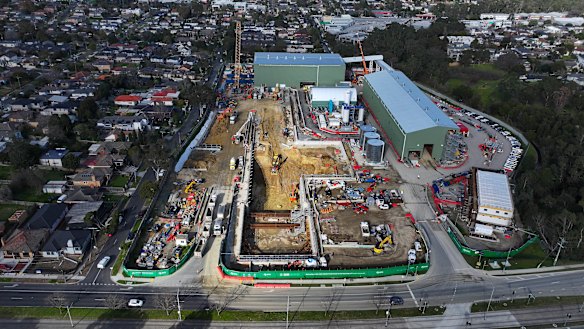
“Unfortunately, Victoria has engaged in some infrastructure projects, notably the Suburban Rail Loop, for which the benefits are significantly less than the costs,” he said.
“Reprioritising towards those projects with a benefit cost ratio greater than one would help Victoria’s economic position.”
The survey also showed strong support for either reducing the size of the Victorian public service or restraining public sector wages growth. Figures released last week showed that since 2014, when Labor took office, public sector wages only in Queensland had grown faster than those in Victoria.
The NSW government has pledged to keep net debt under 15 per cent of state economic output. Many economists believe such a set target should be adopted by Victoria.
Uwe Dulleck, from the Crawford School of Public Policy in Canberra, cautioned that while spending cuts were necessary, they would hurt the economy in the short term.
“Major repair can only be achieved with major cuts in infrastructure investments, which will have negative impact on the local economy, and a restructure of the public service (again, it has an impact on the local economy),” he said.
“Thus, the balance between raising revenue and reducing expenditure is needed.”
Apart from cuts, the economists largely agree there is scope for major tax reform with the number one item a shift from stamp duty on property sales to a broad-based land tax. Such a proposal was rejected by the Andrews government.
Lisa Magnani, the head of Macquarie University’s economics department, said the next government should examine the state’s entire tax system, starting with its stamp duty system.
“With one of the highest state debts in Australia, Victoria’s budget position is vulnerable to the negative effects of rising interest rates,” she said.
“Victoria would benefit from a full review of its tax structure to possibly find new sources of revenues (particularly those with progressive features, such as taxes on high-income recipients and wealth owners).”
Victoria University senior economist Janine Dixon said making the state more attractive to investors would go a long way to improving the budget.
“Making Victoria an attractive place to invest would be a good start, and fits well with making sure Victoria’s considerable workforce, particularly in the outer suburbs, is well connected to employment opportunities. Addressing crime would also give potential investors more confidence,” she said.
While most economists believed budget cuts were a priority, some argued the new government should put its attention into other areas.
Julie Toth, from the Committee for the Economic Development of Australia, said while budget repair was important in the long term, it was not the most urgent financial priority.
She said it was more important that public services and infrastructure kept pace with Victoria’s growing population and that there was support for the state’s most disadvantaged and vulnerable residents.
“Economic and social inclusion matters for everyone. We all feel the impact of ineffective safety nets and support services, directly and indirectly. This will become more urgent if unemployment rises, as is widely forecast over the next two to three years,” she said.
Apart from spending cuts and tax reforms, the surveyed economists backed changes including a reduction in free services or universal concessions, introduction of road user charges and broadening of the payroll tax base.
 Shane Wright is a senior economics correspondent for The Sydney Morning Herald and The Age.Connect via X or email.
From our partners
Disclaimer : This story is auto aggregated by a computer programme and has not been created or edited by DOWNTHENEWS. Publisher: www.smh.com.au