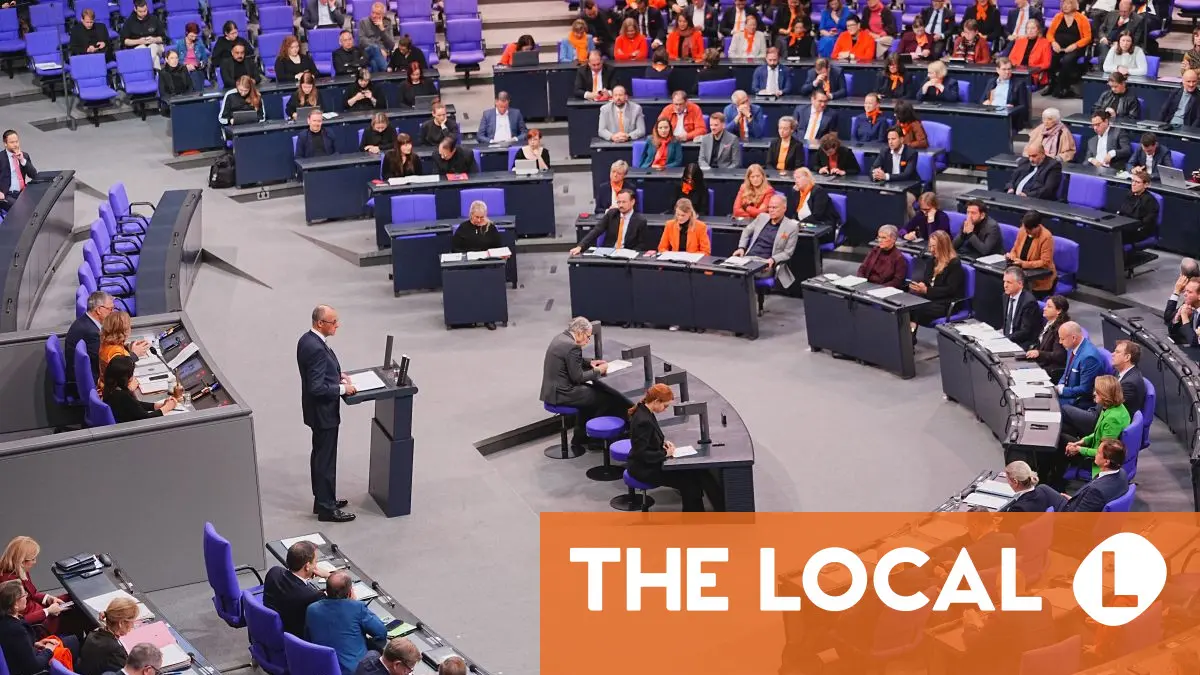
The age of spending “on everything” is over. On Wednesday, Chancellor Friedrich Merz of the CDU defended Germany’s 2027 budget, which is marked by record borrowing and heavy defence spending.
“We will no longer be able to afford, out of taxpayers’ money, everything we have grown all too accustomed to for all too long,” Merz told the Bundestag during the so-called General Debate.
The chancellor also warned against any weakening of support for Ukraine. The opposition, meanwhile, accused the government of “chaotic” and unserious budgeting.
Germany found itself “geopolitically, technologically and demographically in a difficult position as a country”, Merz said during his speech, and the budget was “an accurate reflection” of that.
He conceded that the process of drawing up the budget “certainly doesn’t deserve a beauty prize”. But Germany, he said, had underinvested in external security and infrastructure in the past, and had neglected social reforms. That was now being put right.
The special borrowing now needed for defence and infrastructure would “limit our room for manoeuvre in the coming years to an extent that many have yet to truly grasp”, Merz said. “We no longer have the money for everything.”
The general debate is the high point in the final deliberations on the draft budget of Germany’s CDU/SPD coalition for 2027. It provides for record spending of 560.9 billion euros next year, with borrowing also set to rise: net borrowing in the core budget is planned at almost 123 billion euros.
Formally, the debate concerns the Chancellery’s budget, but the several-hour session is routinely used as an opportunity for broad attacks on the governing coalition’s policies.
READ ALSO: German government reaches agreement on record €560.9 billion budget
Tino Chrupalla, leader of the opposition and co-leader of the far-right AfD parliamentary group, used his speech to launch a direct assault on Merz, who would “go down in the history books as the chancellor of Germany’s insolvency”.
Pointing to a total of 210 billion euros in new debt, Chrupalla accused the coalition of being addicted to spending. He claimed it was plugging holes in the budget “with thoroughly indecent tricks” and “bypassing parliament”. Chrupalla called on “all the other parliamentary groups” to join the AfD in bringing a judicial review challenging the constitutionality of the budget.
Chrupalla also criticised military and financial support for Ukraine. While the temporary cut in electricity tax would save a family barely 100 euros a year, he said, Ukrainian President Volodymyr Zelensky was “walking out of the Chancellery with a 200-million-euro cheque after just one afternoon here in Berlin”.
Heidi Reichinnek, who leads the Left Party’s parliamentary group, accused the government of drawing up a federal budget “at the expense of the majority”.
“Militarisation and limitless rearmament on the one hand, brutal social devastation and an orgy of cuts on the other,” she said. Anyone expecting “a will to shape the country” or “even the faintest hint of social policy” from the coalition was, “quite honestly, beyond help”.
READ ALSO: Electricity tax cut for all German households back in place for 2027
Merz turned to critics “from the far right and the far left” who claim too much money is being spent on Ukraine. He warned against letting support wane for the country attacked by Russia. Moscow wanted “more than Ukraine. And anyone who fails to grasp that either doesn’t understand this world or is pursuing entirely different aims”.
Thorsten Frei (CDU), who leads the conservative parliamentary group, described the 140 billion euros earmarked for security and defence as a “central message of this budget”. “We want to be strong so that, in the end, we never have to use that strength.”
The Greens backed the defence spending and aid to Ukraine. The idea that money was being “thrown after” Ukraine was “absurd”, said parliamentary group leader Britta Haßelmann.
But she called the way the budget had come about unserious, citing the “fussing around” over the electricity tax cut as “typical” of a chaotic and contradictory process. Merz had repeatedly promised the cut, which is initially planned for just one year.
Matthias Miersch, who leads the Social Democrats (SPD) in parliament, called it a “tremendous achievement” to have closed a 34-billion-euro hole in the budget. Given the budgetary squeeze, he reiterated his party’s call for a heavier burden on large companies.
Disclaimer : This story is auto aggregated by a computer programme and has not been created or edited by DOWNTHENEWS. Publisher: thelocal.de