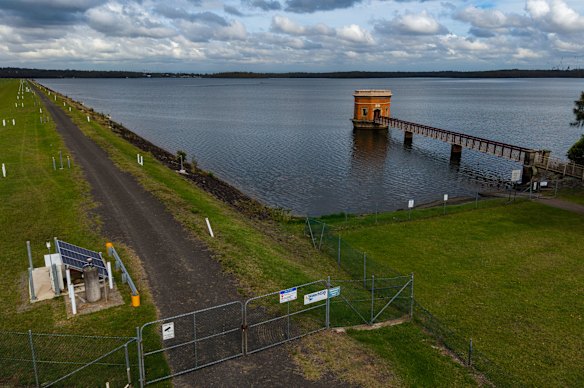

A major western Sydney reservoir that NSW Labor promised to open for swimming by mid-2023 remains shut to the public amid debate over whether opening it would risk the city’s drinking water.
Then-opposition leader Chris Minns, alongside future water minister Rose Jackson, announced before the March 2023 state election that his party would open up the Prospect Reservoir – the huge water reserve about 30 minutes west of Parramatta – by the middle of that year.
It would allow western Sydney residents access to a clean body of water without having to travel east.
NSW Labor promised it would conduct a “rapid feasibility study” about turning the man-made body of water – which was constructed in 1886, before Warragamba Dam in 1960 – into a public beach.
But that study has taken much longer due to protracted discussions about the viability of turning a key source of Sydney’s drinking water into a swimming spot. Three summers on, it’s still shut.
Nick Ryan, a co-founder of the Active Rivers Collective, a group pushing to bring more inland beaches to Sydney’s west, said about 1.6 million people lived within a 25-minute drive of the reservoir.
“That’s the population of South Australia. It’s Sydney’s biggest and best located swimming pool.
“Beaches and places to swim are social infrastructure that help knit communities together, give people somewhere to go, somewhere to exercise, somewhere to feel a sense of belonging and pride. People in western Sydney deserve to be allowed to access their own waterways.”
The government has experienced pushback from some water-quality experts who have warned about risks to the quality of Sydney’s water supply. Stuart Khan, a water quality researcher at Sydney University, said the 50,000 megalitre reservoir was “still a very important part of our drinking water supply system”, given its role in storing water from the Upper Nepean and Warragamba dams.
“It takes one person with diarrhoea to have a faecal accident in that water, and you’ve suddenly got a real contamination risk for Sydney’s drinking water,” he said. “We try to keep risks [in water quality management] below one-in-a-million. So it’s not necessarily a high risk, but it certainly starts to push us up.”
But there’s another risk missing from the equations of those against opening up the site for swimming, said Western Sydney University water quality researcher Ian Wright. Growing numbers of people in the west are suffering from heat stroke and heat stress.
“I think it’s a crisis,” he said. “I work in western Sydney, and [the region] is so poorly served by safe recreational opportunities [for swimming]. It’s $8 to $10 a swim at a public pool. It’s hideously expensive. If you live on the coast or watch the groups of nippers on the weekend who can swim for free, they’re fit and active, but it’s different out west. And I reckon that sucks.”
It was fair to tip the scales of risk in favour of helping residents deal with the heat in a region that can record, in the heat of summer, some of the hottest temperatures in the world, he said.
Jackson said the government was committed to creating more “urban swimming spots across western Sydney”, but did not repeat a promise to open Prospect Reservoir. Her office declined to provide the feasibility report it had commissioned, saying it was cabinet-in-confidence.
“We’ve already made a range of new swim spots available including Pondi, Putney Beach and Bedlam Bay, and have completed a detailed feasibility study that looked at options for opening up Prospect Reservoir,” she said.
“The report shows Prospect Reservoir has untapped potential but also many complex challenges to development, the most obvious being it forms a major part of Sydney’s drinking water supply.
“As the community would understand, this work takes time to get right. We are now weighing up the pros and cons of each option for Prospect Reservoir while continuing to look at other potential swim sites across western Sydney.”
The discussion comes as Penrith Beach reopens for the summer. The small lake, which opened for its third year on Friday, is a remediated quarry on land owned by a group made up of three construction material companies: Boral, Holcim and Heidelberg Materials.
The state government is spending $5.2 million over two years to open the site.
The cost pales in comparison to the hundreds of millions of dollars required to refurbish Sydney’s string of ageing aquatic centres.
“It’s way cheaper for the government to establish places to swim along rivers and lakes than it is to build 50 new aquatic centres,” Ryan said.
 Anthony Segaert is the Parramatta bureau chief at The Sydney Morning Herald. He was previously an urban affairs reporter.Connect via X or email.
From our partners
Disclaimer : This story is auto aggregated by a computer programme and has not been created or edited by DOWNTHENEWS. Publisher: www.smh.com.au