
For many farmers, the day stretches well beyond daylight. Water has to be released into the fields after sunset, pumps need checking at odd hours, and narrow paths through crops must be crossed when the ground is hard to read. In those moments, a snake hidden in grass or near a bund can turn a routine task into an emergency.
India sees around 46,000 snakebite deaths every year, along with 1.4 to 2.8 million non-fatal cases, according to the Indian Snakebite Project. It also notes that 82 to 97 percent of these deaths happen outside hospital, which shows how closely snakebite is tied to rural life and the distance between a bite and medical care. India is home to about 350 kinds of snakes, and around 10 percent of them are venomous, which makes quick warning and quick treatment especially important.
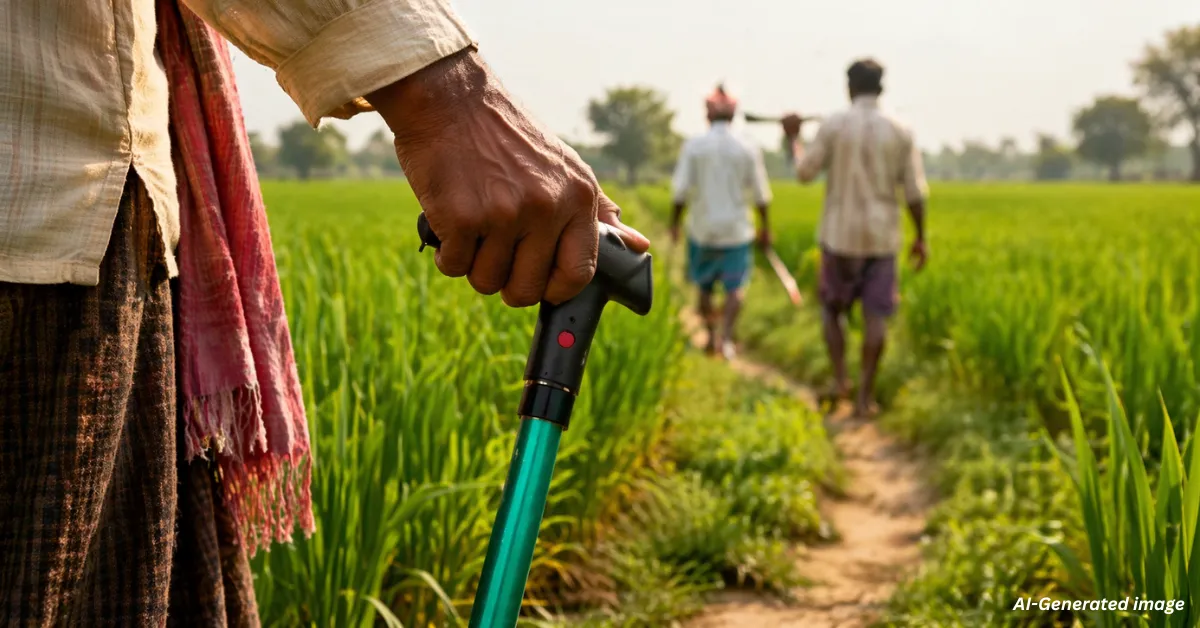
That is where the Kisan Mitra Chhadi comes in. Presented as an Indian state-backed agricultural safety project, this stick is meant to help farmers sense danger before they walk right into it. It looks like an ordinary walking stick, but it carries sensors inside and works like an early-warning tool for people in fields, forest edges, and low-light spaces.
How the stick is used in the field
The way it works is fairly simple when you picture it in a farmer’s hand. The stick is placed on the ground, a button is pressed, and the device starts scanning the area around the user. If it picks up signs linked to a snake or another reptile, the stick sends out a strong vibration. That vibration is the warning. It tells the person holding it to stop, step back, and change direction.
This is where the two distance figures connected to the stick make more sense. One part of the system works in a closer zone of about 5 to 15 metres. That is the area around the farmer where the device looks for danger. The second part is the alert range, which is said to reach up to 100 metres. So the stick senses danger in the nearby space and then pushes the alert farther out.
What exactly is the stick picking up?
The stick is built to watch for signs that could point to a reptile’s presence. One of those signs is infrared radiation variation. In simple terms, that means the sensors are trying to notice changes in heat patterns around the device. Snakes are ectothermic animals, which means their body temperature changes with the environment instead of staying constant like humans. That can create a different thermal signature in the surroundings.
/filters:format(webp)/english-betterindia/media/media_files/2026/04/16/5-2026-04-16-15-26-18.png)
The stick also pays attention to how a snake moves and sounds. The ‘International Journal of Scientific Research and Engineering Development’ shows that these systems are built using Internet of Things (IoT) technology, with small processors like Arduino or Raspberry Pi inside.
The sensors look for patterns such as the slow, sliding movement of a snake across the ground, which creates low, steady vibrations, or even the sharp sound of a hiss. When one of these patterns is picked up, the system quickly reacts. A small circuit inside the device completes, triggering an alert such as a vibration or sound. I
How the alert gets processed so quickly
Inside the stick, tools like Arduino and Raspberry Pi help process what the sensors pick up. These are small computing platforms often used in compact devices that need to react quickly. In this case, the sensors collect information from the surroundings, the onboard system reads that information, and the stick responds by triggering a vibration alert almost immediately.
According to the study ‘Smart IoT-based Snake Trapping Device for Automated Snake Capture and Identification’, published by the National Institutes of Health (NIH), the ‘Smart Stick’ uses passive infrared sensors and ultrasonic sensors. Put simply, one sensor looks for changes in heat, while the other watches distance, movement, and space around the device. Together, they help the stick judge whether something in the area needs attention.
/filters:format(webp)/english-betterindia/media/media_files/2026/04/16/4-2026-04-16-15-26-18.png)
The study also explains how these systems work in more detail. The stick uses passive infrared (PIR) sensors to notice heat patterns and ultrasonic sensors to track movement and distance around it.
Snakes are cold-blooded, so their body heat and movement show up differently from the surroundings. The device picks up these differences and reads them as signs of a possible presence.
In more advanced versions, an AI layer helps the stick tell the difference between a real threat and everyday movement, like grass shifting or a small animal passing by. This means the alert is triggered only when there is a strong sign of a snake nearby, reducing false alarms and making the warning more reliable for someone working in the field.
In some setups, once the signal is confirmed, a circuit closes and creates an on-site response such as a buzzer. It can also send a notification to a mobile device. In the Kisan Mitra Chhadi, the most immediate signal is the strong vibration felt through the stick itself.
Why this matters beyond the warning
The value of a tool like this lies in timing. For a venomous snakebite, the golden window for treatment can be very short. A few seconds of warning before stepping closer can matter greatly, especially for someone working far from immediate medical help.
The idea also carries another benefit. A stick that helps a person spot danger and move away can reduce panic and reduce the chance of a snake being killed on sight. That matters because snakes play an important role in farms by controlling rodent populations. Safe detection and safe trapping can protect people while also leaving room for conservation. It can even support venom collection for antivenom production and pharmacological research.
In the end, the Kisan Mitra Chhadi turns a familiar object into something far more useful in a risky moment. A farmer places it on the ground, presses a button, waits for it to scan, and gets a warning through the hand before danger comes too close. For anyone crossing a dark field after sunset, that small pause can mean everything.
Disclaimer : This story is auto aggregated by a computer programme and has not been created or edited by DOWNTHENEWS. Publisher: thebetterindia.com






