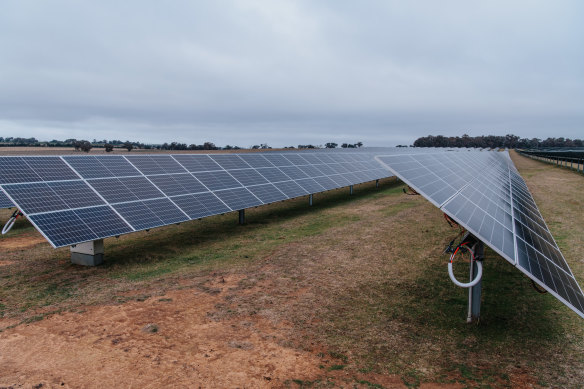

The state government’s flagship $1 billion renewable energy investment fund is yet to invest a single dollar, almost three years since Labor took office.
The Energy Security Corporation (ESC) offers investments between $25 million and $150 million to get renewable projects off the ground, prioritising short- to long-term energy storage projects to capture excess solar and wind power.
The government is under pressure to deliver results on its renewables strategy amid concerns over Australia’s energy security, after conflict in the Middle East sent fuel prices to record highs and spiked demand for diesel.
Touted during the election campaign as a much-needed intervention to fill the gap where the private sector was reluctant to invest, three years on, the ESC is still negotiating with potential projects.
In a September 2025 media release titled “the need for speed in energy infrastructure investment”, chief executive Paul Peters said the corporation’s role was “to say yes where others hesitate”.
“There is much to do and we’re working with urgency because the challenge is not just building a new system, it’s doing so at speed and scale while maintaining reliability,” Peters said.
Department secretary Anthony Lean told a budget estimates hearing in February the corporation was in discussions “with a number of potential projects” but had yet to close any deals.
The $1 billion sits in a dedicated investment trust, where it is earning returns for the government. So far, $20.9 million has been withdrawn to create an operating balance and cover expenses incurred while setting up the agency.
The corporation was a major election commitment of the Minns government, which then took more than a year to introduce a bill to parliament to actually create the agency.
The Energy Security Corporation Bill passed parliament in June 2024. Its board wasn’t appointed until July 2025 – a timeline Greens MP Abigail Boyd said wasn’t good enough.
“It took them a year to put legislation together, it then took them another year to even set up a board. We’re now three years in and they’ve failed to spend a single cent on accelerating investment in renewable energy. It’s hard to see this as anything other than a sham at this point,” Boyd said.
Last year The Australian Financial Review reported the corporation was aiming to finalise its first investment by the end of 2025.
Peters told this masthead he instead expects the ESC to announce their first investment by the end of the current financial year, subject to approvals.
“Priority areas include storage in the Sydney-Newcastle-Wollongong region to support reliability ahead of coal retirements, long-duration storage across NSW, and solar-battery hybrid projects where targeted capital can help projects reach final investment decision sooner,” he said.
The ESC co-invests with the private sector, meaning projects have to line up other finance before they can finalise an agreement with the government-backed fund, Energy Minister Penny Sharpe said.
“The ESC has been fully stood up and is in active negotiations with a strong pipeline of NSW projects,” she said, promising investments would be made this year.
The Morning Edition newsletter is our guide to the day’s most important and interesting stories, analysis and insights. Sign up here.
 Jessica McSweeney is a reporter at The Sydney Morning Herald covering state politics and urban affairs.Connect via email.
From our partners
Disclaimer : This story is auto aggregated by a computer programme and has not been created or edited by DOWNTHENEWS. Publisher: www.smh.com.au