
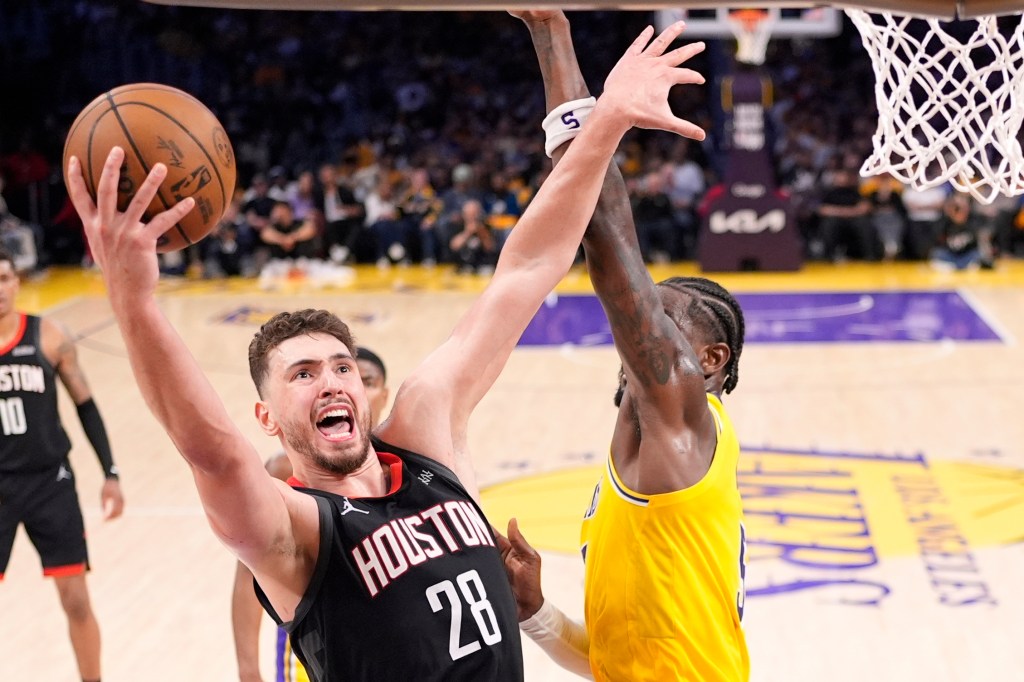
One of the biggest questions entering the Lakers-Rockets first-round playoff series was how the Luka Doncic- and Austin Reaves-less Lakers would generate quality offense against the Rockets’ defense that ranked sixth during the regular season.
But for at least one night, the Lakers flipped the script on the Kevin Durant-less Rockets with suffocating defense en route to a 107-98 victory in Game 1 on Saturday to take a 1-0 lead in the best-of-seven series.
The Lakers limited the Rockets to 37.6% shooting from the field, the worst opponent shooting percentage against the Lakers in the playoffs since April 28, 2023, when the Grizzlies shot 30.2% in Game 6 of the 2023 first-round series.
The Rockets shot 40% on 2-pointers in Game 1, which was just the third time this season between the regular season and playoffs that Houston shot 40% or worse on 2s.
“We did a good job of contesting those 6- to 8-foot shots without fouling,” coach JJ Redick said. “Using our length. [Deandre Ayton] Jaxson [Hayes], [LeBron James], Rui [Hachimura], [Jarred Vanderbilt], all those guys, Jake [LaRavia].”
The Lakers’ defensive success started with limiting Alperen Sengun, the Rockets’ All-Star center and second-leading scorer behind Durant, who became the focal point after Durant’s absence due to injury was announced 90 minutes before tipoff.
“I don’t think it affected our mentality,” Redick said. “This is all we’ve talked about for two months: Our playoff mentality; you can’t worry about who’s in or out of the lineup. It’s our game plan, it’s our standards, it’s how we play. And we’ve built toward that. Our guys just responded well and met the moment.”
Sengun, who averaged 20.4 points on 51.9% shooting and a career-high 6.2 assists during the regular season, had 19 points and six assists in Game 1. He shot 31.6% (6 of 19) from the field against the Lakers.
At the center of the off night from Sengun, and the Lakers’ defensive success, was Ayton, their starting big man who not only had a 19-point, 11-rebound double-double but was also the primary defender on Sengun.
Ayton matched Sengun’s physicality, contributing to Sengun shooting 4 of 11 from the field when he was Sengun’s primary defender.
He consistently beat Sengun to his spots, absorbed contact and contested Sengun’s attempts inside the 2-point arc.
“Just getting a contest is super important,” Redick said.

Ayton also had strong moments as a defender in drop coverage, using his 7-foot, 252-pound frame to make passing lanes or shot opportunities more challenging to take advantage of, and as a switch defender, especially in the second half against Reed Sheppard.
Sheppard, who had 17 points on 6-of-20 shooting to go with eight assists in Game 1, shot 0-for-3 from the field when Ayton was his primary defender.
And with Ayton on the floor, the Lakers closed out defensive possessions better, which was especially important against a Rockets team that led the league in offensive rebounding the previous two regular seasons and grabbed 21 offensive boards for 23 second-chance points Saturday.
The Lakers had a 67.4% defensive rebounding rate with Ayton on the floor, which was still a poor mark, compared with a 36.8% defensive rebounding percentage when Ayton wasn’t on the court — meaning the Rockets grabbed an offensive rebound on two-thirds of their misses when Ayton was on the bench.
“He was great on both ends,” Redick said of Ayton. “Again, we’re at our best when he’s playing at a high level.”
But defending Sengun wasn’t a one-player job.
Hayes also limited Sengun to 1-of-6 shooting when he was the primary defender.
The Lakers had early success with their greens against Sengun — overloading the strong side of the floor to deter a post-up. Two of his three turnovers came after the Lakers deployed the defensive coverage on Sengun’s post-ups.
“They [did] the same thing they did during the season: They flooded, forcing me baseline and bring help from the baseline,” Sengun said. “I just got to find the open shot. I got to be more aggressive and attack quicker.”
Sengun added: “I didn’t want to play much post-up because they were flooding. I like the elbow actions. They can’t do that from there. I just got to make those shots. If I make those shots, nothing would’ve worked.”
Sengun had success against the Lakers’ greens as the game progressed, and he was more patient with his decision-making on post-ups.
“He understands, and we understand, they’re going to flood,” Rockets coach Ime Udoka said. “And we need to be a little more patient with that. Two of his three early turnovers were kind of rushing it. Just gotta invite that, face up and survey. Don’t go away from being a facilitator in the post.
“At times, guys get discouraged if they take away a certain thing, and that can be beneficial for us. We don’t want as much isolation on the perimeter, where they’re loaded up. Invite the doubles like we have all year. What we drill behind it, we should get decent shots out of it as long as we don’t turn it over.”
The Lakers’ frontcourt wasn’t alone in its high-level defensive performance.
Four of the Rockets’ top-four scorers (Sengun, Sheppard, Amen Thompson and Jabari Smith Jr.) shot worse than 40% from the floor.
“We had a thing out there with togetherness,” Ayton said. “And we just stayed as a unit on the defensive end.”
Disclaimer : This story is auto aggregated by a computer programme and has not been created or edited by DOWNTHENEWS. Publisher: nypost.com



