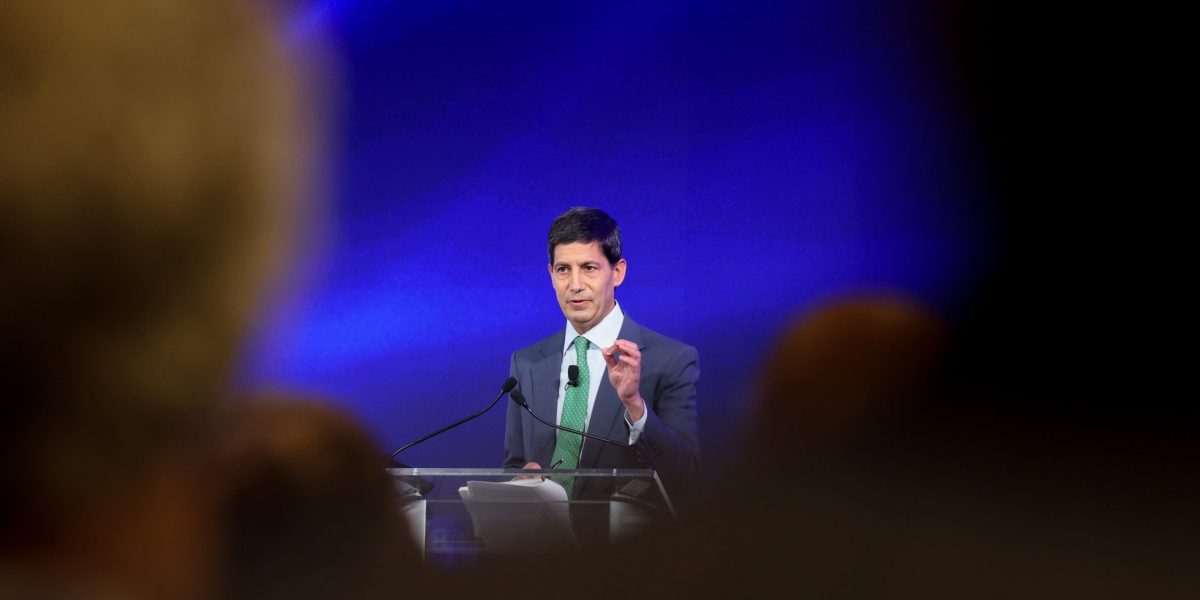
At 10 a.m. tomorrow morning, Kevin Warsh’s public campaign to lead the Federal Reserve begins. So far, markets, policymakers, and economists have only been able to speculate as to Warsh’s outlook and approach. But this week, for the first time since President Trump confirmed his nomination, his ideas will be laid out in the open for the Senate Banking Committee to pick through.
Chief among the concerns will be what—if anything—Warsh has promised the White House. Amid concerns over the independence of the central bank (a notion Warsh has repeatedly stated he believes is of the utmost importance), officials will be keen to understand how the would-be chairman will balance his dovish rate sympathies with today’s inflationary economic outlook.
Trump has made it clear that only an individual willing to lower rates faster than current chairman Jerome Powell would secure his support. However, data is stacking up against the argument for lowering, with inflation increasing in the latest CPI reports as a result of supply strains on oil and gas. Inflation now sits above 3%, well ahead of the Fed’s mandated target of 2%.
So how might Warsh justify a dovish stance on the base rate without seeming to disregard the Fed’s priorities in favor of appeasing the White House? One potential argument is, you zoom out. You remember the Fed doesn’t have a dual but a triple mandate, and you look at economic conditions in totality.
In theory, the short-term interest rate set by the Federal Open Market Committee informs borrowing rates: To lower it is to stoke economic activity by making loans cheaper—be it for business investment, consumer spending or mortgages.
In reality, the short-term rate has become unhitched from the interest offered in the real economy. As Morgan Stanley observed in October, despite a cutting cycle, “the spread between mortgage rates outstanding and new mortgage rates is over 2%, the highest in 40 years, indicating that more cuts may be necessary to spur housing activity.”
Longer-term yields (and thus, rates), by contrast, are relatively elevated in 2026. These rates are set by markets, reflecting investors’ expectations on inflation, growth, and the supply of government debt. Recently, both 10-year and 30-year Treasury yields have moved higher (though not above historical norms), representing a quiet tightening of financial conditions in the real economy across mortgages, corporate borrowing, and equity valuations.
If Warsh were to argue that tightening on the long end of the curve could be offset by reductions on the shorter end, he could cite a recent example: The tightening has become more pronounced in recent months following the U.S. and Israel’s attacks on Iran. The 10-year Treasury was sitting at around 4% in early February, and spiked to 4.44% by the end of March. The 30-year has been similarly elevated: From 4.63% in early February to 4.9% at the time of writing.
Given those longer-dated rates feed directly into the real economy, a dovish central banker may advocate for a cut to the base rate—not to stimulate demand outright, but to prevent an unintended squeeze driven by the bond market itself, even if cuts at the short end cannot fully counteract tightening further along the curve.
Neatly, the argument also ties in with the Fed’s oft-forgotten third aspect of the mandate. FOMC member Stephen Miran, during his confirmation with the Senate Banking Committee last year, recalled the Federal Reserve Act of the 1970s: “Congress wisely tasked the Fed with pursuing price stability, maximum employment, and moderate long-term interest rates.” If market-driven rises at the long end tighten conditions, that presents a policy problem in itself, with an argument for cuts on the short-end offsetting any squeeze, to keep borrowing costs broadly stable.
The balance sheet argument
A further economic exercise in mental acrobatics comes from Warsh’s outlook on the balance sheet. Warsh wants to reduce the balance sheet, currently standing at $6.7 trillion, and conveniently delivers another neat argument for rate cuts without raising alarm bells over questions of Fed independence.
As Professor Yiming Ma, of Columbia University’s Business School explained in a conversation with Fortune in February: “People often think: ‘Oh, economic conditions, inflation expectations, and unemployment are determining interest rates,’ and the size of the balance sheet is like whatever.
“But in practice, hiking interest rates is [economic] tightening, and reducing the size of the central bank’s balance sheet is also a form of tightening [because it also raises rates]. And it’s hard to estimate the extent of that interaction, but you can think broadly that if the size of the Fed’s balance sheet is smaller, there is less liquidity in the system, and that is going to reduce inflationary pressure. So in a way, one can afford a lower interest rate with a smaller balance sheet.”
This potential stance isn’t an argument that can be brought into play immediately, despite pressure from the White House to cut rates sooner rather than later. But Warsh’s tenure at the Fed would, if confirmed, last beyond the current administration: His dovish leanings may go beyond the current outlook, remaining a feature of the next Fed era.
Disclaimer : This story is auto aggregated by a computer programme and has not been created or edited by DOWNTHENEWS. Publisher: fortune.com