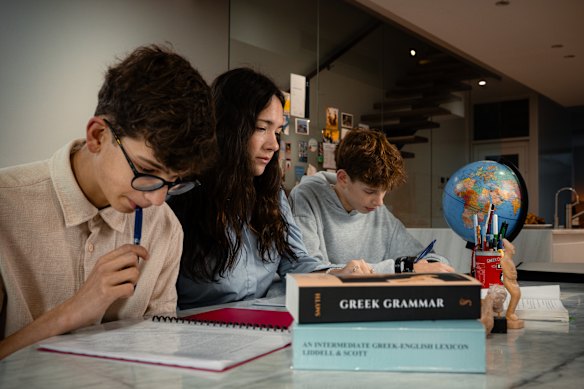

For Victorian pupils eager to study classical Greek, the path forward is a lone odyssey through the wine-dark sea, as one of the state’s final strongholds of the subject is closing its books after nearly 150 years.
Xavier College in Kew confirmed this week it will end its 147-year tradition of offering the subject due to low enrolments, but insisted it would leave the door open for future students.
“While Xavier has a long history of teaching classical Greek, enrolments have not been historically consistent,” a spokesman for the school confirmed to The Age.
Though the four Xavier College students undertaking the subject in years 9 and 10 this year will not be able to study the subject at VCE level, the school insisted they “have not closed the door to classical Greek if student interest grows”.
Through Greek Community of Melbourne Schools, students from different years across the state are learning the subject.
This includes 14-year-old Atticus Iliou Horn, who is taking classes privately through the organisation, and said he was drawn to the subject as he wanted to try something new.
“I think it’s a shame it may not continue, since I really enjoy the subject,” he said. English and modern Greek have inherited many aspects of classical Greek, he added.
His friends Peter Sofiadellis,14, and Zoe Kalanis, 15, agreed.
“We should motivate more students to do the subject, and whether that’s scaling or promoting the subject in better ways, taking the subject out of VCE isn’t really the answer,” Sofiadellis said.
For Kalanis, studying classical Greek helps her understand her place in the world.
“It’s important to understand the world we live in, and ancient Greek is super-duper helpful to understand, you know, the roots of our languages and deepen our connection to our own mother country and language,” she said.
Despite being a “silent” language that no one speaks, “it’s still very much alive in what I’m saying right now”, Kalanis said.
Though classic works like The Odyssey are reserved for university, high school students learn texts from Herodotus and Aristophanes.
Teacher Miltiadis Paikopoulos said it is unfortunately one of those subjects that “a lot of people assumed would be around forever … but it’s had these chronic problems” of low enrolment for a long time.
According to figures from the Victorian Curriculum and Assessment Authority (VCAA), which develops and carries out the state’s curriculum and exams for year 11 and year 12 students, only three students were enrolled in classical Greek for year 12 last year, compared with seven in 2024, and 12 students in 2023.
Paikopoulos said for the subject to survive, the VCAA needed to amend its exams and there needed to be more promotion of the benefits of the language.
“The skills you learn from classical Greek, the standards that it imposes on students, they flow through to all of the other subjects,” he said.
“Studying ancient Greek text within the historical context also gives students something like an advantage of studying other VCE subjects, like ancient history,” he said.
Another problem was, he believed, many students did not know the subject existed.
“In other words, it’s a problem with accessibility.”
The issue is further complicated by the fact that Victoria’s exam materials are shared with the NSW Education Standards Authority (NESA), which has said it may discontinue courses.
“If the course numbers increase above 15, the discontinuation process will pause,” the NESA website reads. However, if student enrolment numbers fall below 15, courses are expected to cease by 2030.
Victoria has one of the largest subject offerings in the country, with 116 topics that students can complete as part of the Victorian Certificate of Education, including more than 45 languages.
The resources required to maintain so many subjects has been identified as a major issue for the authority as part of a review into the VCAA.
“Many of the challenges in the VCAA can, in part, be traced back to the complexity of managing such a large range and number of subjects, all requiring a significant base workload,” governance expert Dr Yehudi Blacher found in the report published last year.
Start the day with a summary of the day’s most important and interesting stories, analysis and insights. Sign up for our Morning Edition newsletter.
 Caroline Schelle is an education reporter, and joined The Age in 2022. She previously covered courts at AAP.Connect via X or email.
From our partners
Disclaimer : This story is auto aggregated by a computer programme and has not been created or edited by DOWNTHENEWS. Publisher: www.smh.com.au