
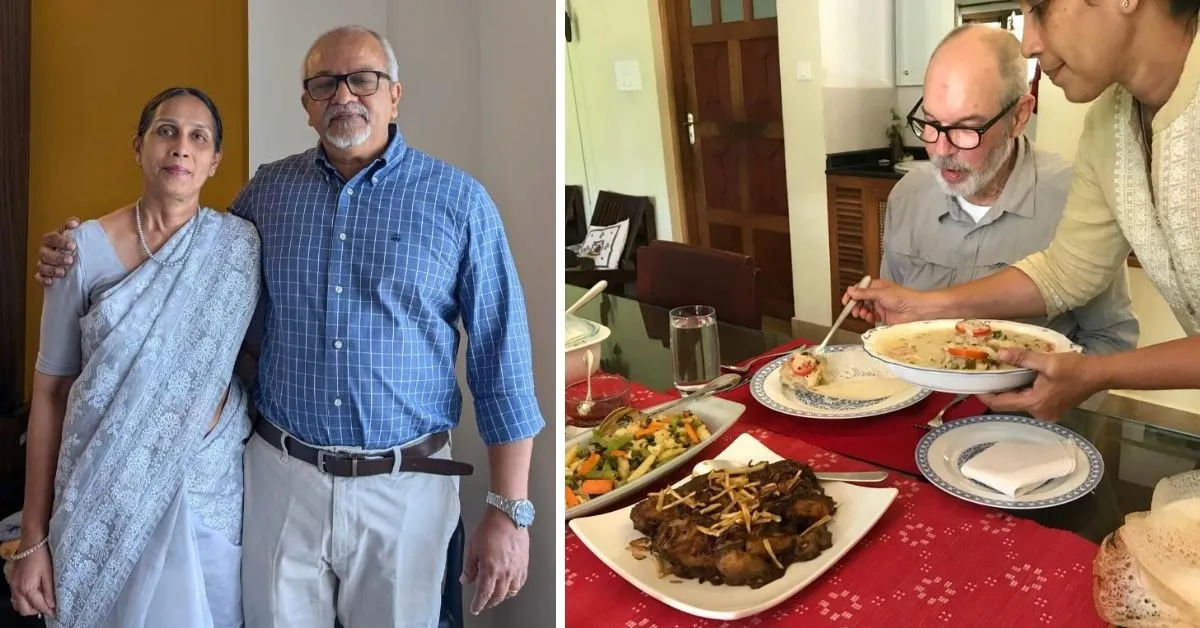
When was the last time a vacation felt like reliving a childhood adventure?
Your next trip to the Kuruvinakunnel Tharavadu homestay in Kerala’s Kottayam is bound to feel like it.
For one, you can spend time poring over a family genealogy chart that the host, Louis Kuruvilla (62), maintains, going right back to 1770.
When you aren’t doing that or feasting on typical Kerala specialities, you can take a torch down to the underground cellars where dried pepper continues to be stored, just as it was, centuries ago, in this 400-year-old home.
The people of the Edamattom village have always looked at the home and its surrounding 15-acre rubber estate as a living relic, a timekeeper of the town’s changing facade and habits. Louis explains that the Kuruvinakunnel ancestors were early agriculturalists who ventured deep into the Western Ghats, cultivating pepper. He will regale you with these stories over some piping hot tea and quintessential Kerala snacks.
Louis’ Kuruvinakunnel Tharavadu homestay is part of Raahghar, a collective that connects travellers with handpicked homestays across India. Its founder Mayuresh Bhat (47), insists, “This is the magic of a homestay. There is always a story.”
Many homestays, one mindset
When I catch up with Mayuresh over a call, he’s just returned from a trip to Ooty. And while his vacation was filled with a myriad of experiences, the highlight, he says, was his stay at the Red Hills Nature Resort, another one of Raahghar’s homes.
“It wasn’t just about the ambience or the food or the views. The highlight is always the people,” he explains, going on to add that he sees Raahghar as “matchmakers for discerning travellers and handpicked homestays across India”.
For a homestay to be included under the collective, Mayuresh says a sense of warmth must be evident in every detail — across aesthetics, food, and design — ensuring that each space offers a sense of belonging alongside a stay.
He underscores this with an example: “While I was at the Red Hills Nature Resort, Vijay (the host) served me Varkey biscuits and then went into great detail about them: their origin and their history. I thought to myself, if he is bothering to be so detailed about the biscuits he is serving, how much more attention to detail must he be paying to every corner of his home and ensuring guests a good experience?”
A home between forests and tea gardens
Another storyteller can be found in Lingesh Kalingarayar (42), a farmer turned wildlife enthusiast and birdwatcher.
/filters:format(webp)/english-betterindia/media/media_files/2026/04/06/homestays-2-2026-04-06-18-37-04.jpg)
A host at the Sheikalmudi Bungalow in Valparai, Tamil Nadu, Lingesh is only too happy to retell the story of the home and the surrounding tea gardens. “The home was built in 1928 and used by the managers of the plantations as a residence. Eventually, it was converted into a homestay for tourism,” he begins.
Enveloped by 5,000 acres of plantation, the home finds itself sandwiched between the Anamalai Tiger Reserve in Tamil Nadu’s Western Ghats and the Parambikulam Tiger Reserve in Kerala. And it is within this oasis that Lingesh has found his calling in wildlife conservation. When he isn’t taking guests around the property, encouraging them to spot different bird species, he is dissecting the land’s anatomy. He regards the trees as old friends whom he has spent time understanding.
/filters:format(webp)/english-betterindia/media/media_files/2026/04/06/homestays-3-2026-04-06-18-38-44.jpg)
When you tire yourself out from walking the many acres of the plantation, you can feast on mudavattukal kilangu soup (soup made from oak leaf fern tuber, often referred to as ‘vegetarian mutton leg soup’) and coconut souffle.
Having lived across so many homestays — both while building Raahghar and even before that, during his travels — Mayuresh says he now finds himself missing the stories behind each meal when he stays at a hotel. “I can’t do buffets anymore,” he laughs, adding that even if it is a dosa(crepe made of lentils), it has to be preceded by a story of how it travelled to his plate.
Because homestays are architectured with stories
Travel is in Mayuresh’s blood.
His father helmed ‘Anubhav Vacations’, the parent company of Raahghar, which has been crafting travel experiences in India and abroad since 1981. But then the pandemic changed how the world began seeing travel. “People started exploring regions like Malabar in Kerala, Kinnaur in Himachal Pradesh, and Bundelkhand in Uttar Pradesh. One challenge stood out: finding accommodation that matched the richness of these places,” Mayuresh explains.
He adds, “We started looking at India through its regions instead of its states. And when you start doing that, you shift your gaze from hotels to homestays. That’s how Raahghar started: to promote regional travel.” With 61 homestays across 15 states, Raahghar wants to put India on the map when it comes to pairing culture with travel.
/filters:format(webp)/english-betterindia/media/media_files/2026/04/06/homestays-4-2026-04-06-18-45-40.jpg)
But aside from the logistical aspects, Raahghar is the result of a childhood sentiment. Mayuresh explains, “When I was as little as three years old, and my father was hosting guests, he would put me to work too. I was little, so the servers would hoist me up on their shoulders, and I would try to carry the plates (with help).”
A little Mayuresh would love feeling like he was doing his bit. Then he’d sit and listen intently to tourists sharing their stories.
Today, decades later, nothing has changed.
And it’s always the homestay hosts who have the best tales, he deduced.
For instance, Louis’ favourite tale to tell is one that he often heard from his father about their ancestral home, which is now the Kuruvinakunnel Tharavadu homestay. “There was a time when the roofing was wood, a mud layer in between, and palm leaves. My father would tell me about how the mud layer insulated the home in cases where thieves would start a fire on the roof to drive the people out of the home and rob it.”
Having returned to India in 2010 from Kuwait, where he was an IT manager, he is now passionate about preserving this ancestral home. “My ancestors were engaged in pepper plantations. We are very passionate about the land and follow a farm-to-table approach. We grow rubber, cacao, pineapple, rambutan, vanilla, and garden orange on our farm,” Louis explains.
/filters:format(webp)/english-betterindia/media/media_files/2026/04/06/homestays-1-2026-04-06-18-33-58.jpg)
He adds that they are also making sustainable modifications on the land — for instance, installing a solar plant and a treatment system for kitchen waste.
I ask him about how the association with Mayuresh and Raahghar happened. “Mayuresh was driving by and decided to stop by and see the home,” he says.
That’s all it took? A visit and a gut feeling? I ask Mayuresh.
“And the sense that you’ve stepped into your home away from home,” he replies.
All pictures courtesy Raahghar
Disclaimer : This story is auto aggregated by a computer programme and has not been created or edited by DOWNTHENEWS. Publisher: thebetterindia.com







