At the Houston headquarters of Cheniere Energy, America’s biggest producer of liquefied natural gas, the phones have been ringing incessantly since the war with Iran erupted eight weeks ago.
Countries cut off from their usual supply of gas from the Middle East have been scrambling for alternative supplies, and most see the US as the only possible source of help.
“We are trying to do whatever we can do,” Jack Fusco, Cheniere’s chief executive, said at an industry conference in March. “We are going to try to get as many molecules as we can to those countries in Asia that really need it.”
The phone calls point to another tectonic shift in global energy markets. Each successive shock, from Russia’s invasion of Ukraine in 2022 to the US intervention in Venezuela and now the conflict in the Gulf, has both disrupted longstanding flows of oil and gas and reinforced the appeal of US energy, which is not only abundant but geopolitically secure.
Even as the latest war pushes up petrol prices at home, Donald Trump has highlighted the upside. “When oil prices go up, we make a lot of money,” he said.
For US energy companies, the windfall is already visible. US crude exports surged to a record 5.2mn barrels a day last week, up by more than 1mn barrels on the previous week, as buyers in Europe and Asia rushed to secure supplies lost from the Gulf.
Earlier this month, more than 65 empty supertankers were heading to the US to load crude, according to data research group Kpler — almost triple the number in the week before the war began on February 28 and well above last year’s daily average of 28. The number of empty tankers bound for the US to fill up with crude oil, refined fuels and other petroleum products was also at an all-time high.
In April, more than a third of Europe’s jet fuel is expected to come from US refineries, roughly double the level in January, according to Kpler, which tracks shipments. Rystad Energy estimates that higher prices could boost cash flows at US oil companies by $63bn this year if crude remains near $100 a barrel.
While there is a rush in the short term for oil and fuel, in the long term the US gas industry is likely to get a bigger boost. Just as Europe pivoted away from Russian gas towards US liquefied natural gas (LNG) after 2022, Asia may now do the same away from the Gulf.
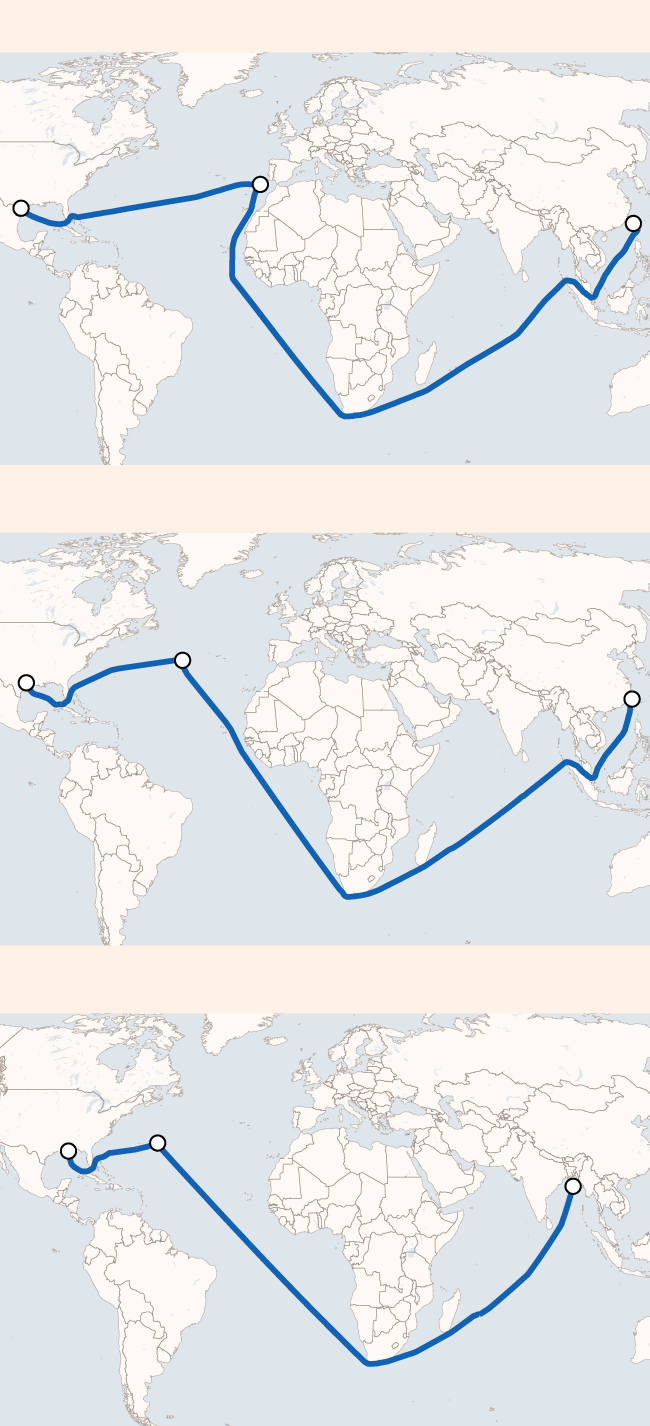
Before the war, the region sourced more than a quarter of its LNG from the Gulf, and about 40 per cent of its oil. Since the Iran conflict began, at least 13 LNG tankers initially bound for Europe have been rerouted to Asia, most of them having set off from the US. Buyers are scrambling for supplies after the war choked off shipments through the Strait of Hormuz.
The waterway remains all but frozen; on Thursday, Trump ordered the US Navy to open fire on any boat laying mines in the strait.
Several LNG tankers were re-routed after the conflict began
#g-lng-tankers-apr22-box ,
#g-lng-tankers-apr22-box .g-artboard {
margin:0 auto;
}
#g-lng-tankers-apr22-box .g-artboard {
display: none;
}
#g-lng-tankers-apr22-box p {
margin:0;
}
#g-lng-tankers-apr22-box .g-aiAbs {
position:absolute;
}
#g-lng-tankers-apr22-box .g-aiImg {
position:absolute;
top:0;
display:block;
width:100% !important;
}
#g-lng-tankers-apr22-box .g-aiSymbol {
position: absolute;
box-sizing: border-box;
}
#g-lng-tankers-apr22-box .g-aiPointText p { white-space: nowrap; }
#g-lng-tankers-apr22-S {
position:relative;
overflow:hidden;
}
#g-lng-tankers-apr22-S p {
font-family:var(–o3-font-family-metric,”metric 2 VF”),Arial,sans-serif;
font-weight:regular;
line-height:19px;
height:auto;
opacity:1;
letter-spacing:0em;
font-size:16px;
text-align:left;
color:rgb(0,0,0);
text-stroke:initial;
-webkit-text-stroke:initial;
-moz-text-stroke:initial;
paint-order:normal;
font-variant-numeric:normal;
font-variant-position:normal;
text-transform:none;
padding-bottom:0;
padding-top:0;
mix-blend-mode:normal;
font-style:normal;
position:static;
text-shadow:initial;
filter:none;
}
#g-lng-tankers-apr22-S .g-p0 {
font-weight:700;
height:19px;
}
#g-lng-tankers-apr22-S .g-p1 {
font-weight:700;
height:19px;
text-stroke:2px #FFF9F5;
-webkit-text-stroke:2px #FFF9F5;
-moz-text-stroke:2px #FFF9F5;
paint-order:stroke fill;
}
#g-lng-tankers-apr22-S .g-p2 {
font-weight:400;
height:19px;
text-stroke:2px #FFF9F5;
-webkit-text-stroke:2px #FFF9F5;
-moz-text-stroke:2px #FFF9F5;
paint-order:stroke fill;
}
#g-lng-tankers-apr22-S .g-p3 {
font-weight:700;
height:19px;
text-align:right;
text-stroke:2px #FFF9F5;
-webkit-text-stroke:2px #FFF9F5;
-moz-text-stroke:2px #FFF9F5;
paint-order:stroke fill;
}
#g-lng-tankers-apr22-S .g-p4 {
font-weight:400;
height:19px;
text-align:right;
text-stroke:2px #FFF9F5;
-webkit-text-stroke:2px #FFF9F5;
-moz-text-stroke:2px #FFF9F5;
paint-order:stroke fill;
}
#g-lng-tankers-apr22-S .g-p5 {
font-weight:700;
line-height:20px;
height:20px;
}
#g-lng-tankers-apr22-S .g-p6 {
font-weight:400;
font-style:italic;
height:19px;
text-align:center;
}
#g-lng-tankers-apr22-S .g-c0 {
font-weight:700;
}
@media (max-width: 539.98px) {
.g-artboard#g-lng-tankers-apr22-S { display: block; }
}
#g-lng-tankers-apr22-M {
position:relative;
overflow:hidden;
}
#g-lng-tankers-apr22-M p {
font-family:var(–o3-font-family-metric,”metric 2 VF”),Arial,sans-serif;
font-weight:regular;
line-height:19px;
height:auto;
opacity:1;
letter-spacing:0em;
font-size:16px;
text-align:left;
color:rgb(0,0,0);
text-stroke:initial;
-webkit-text-stroke:initial;
-moz-text-stroke:initial;
paint-order:normal;
font-variant-numeric:normal;
font-variant-position:normal;
text-transform:none;
padding-bottom:0;
padding-top:0;
mix-blend-mode:normal;
font-style:normal;
position:static;
text-shadow:initial;
filter:none;
}
#g-lng-tankers-apr22-M .g-p0 {
font-weight:700;
height:19px;
}
#g-lng-tankers-apr22-M .g-p1 {
font-weight:400;
height:19px;
text-stroke:2px #FFF9F5;
-webkit-text-stroke:2px #FFF9F5;
-moz-text-stroke:2px #FFF9F5;
paint-order:stroke fill;
}
#g-lng-tankers-apr22-M .g-p2 {
font-weight:400;
height:19px;
text-align:right;
text-stroke:2px #FFF9F5;
-webkit-text-stroke:2px #FFF9F5;
-moz-text-stroke:2px #FFF9F5;
paint-order:stroke fill;
}
#g-lng-tankers-apr22-M .g-p3 {
font-weight:700;
line-height:20px;
height:20px;
}
#g-lng-tankers-apr22-M .g-p4 {
font-weight:700;
height:19px;
text-stroke:2px #FFF9F5;
-webkit-text-stroke:2px #FFF9F5;
-moz-text-stroke:2px #FFF9F5;
paint-order:stroke fill;
}
#g-lng-tankers-apr22-M .g-p5 {
font-weight:700;
height:19px;
text-align:right;
text-stroke:2px #FFF9F5;
-webkit-text-stroke:2px #FFF9F5;
-moz-text-stroke:2px #FFF9F5;
paint-order:stroke fill;
}
#g-lng-tankers-apr22-M .g-p6 {
font-weight:400;
font-style:italic;
height:19px;
text-align:center;
}
#g-lng-tankers-apr22-M .g-p7 {
font-weight:700;
height:19px;
text-align:center;
text-stroke:2px #FFF9F5;
-webkit-text-stroke:2px #FFF9F5;
-moz-text-stroke:2px #FFF9F5;
paint-order:stroke fill;
}
#g-lng-tankers-apr22-M .g-c0 {
font-weight:700;
}
@media (min-width: 540px) and (max-width: 939.98px) {
.g-artboard#g-lng-tankers-apr22-M { display: block; }
}
#g-lng-tankers-apr22-full-L {
position:relative;
overflow:hidden;
}
#g-lng-tankers-apr22-full-L p {
font-family:var(–o3-font-family-metric,”metric 2 VF”),Arial,sans-serif;
font-weight:regular;
line-height:19px;
height:auto;
opacity:1;
letter-spacing:0em;
font-size:16px;
text-align:left;
color:rgb(0,0,0);
text-stroke:initial;
-webkit-text-stroke:initial;
-moz-text-stroke:initial;
paint-order:normal;
font-variant-numeric:normal;
font-variant-position:normal;
text-transform:none;
padding-bottom:0;
padding-top:0;
mix-blend-mode:normal;
font-style:normal;
position:static;
text-shadow:initial;
filter:none;
}
#g-lng-tankers-apr22-full-L .g-p0 {
font-weight:700;
line-height:20px;
height:20px;
}
#g-lng-tankers-apr22-full-L .g-p1 {
font-weight:700;
height:19px;
}
#g-lng-tankers-apr22-full-L .g-p2 {
font-weight:700;
height:19px;
text-stroke:2px #FFF9F5;
-webkit-text-stroke:2px #FFF9F5;
-moz-text-stroke:2px #FFF9F5;
paint-order:stroke fill;
}
#g-lng-tankers-apr22-full-L .g-p3 {
font-weight:400;
height:19px;
text-stroke:2px #FFF9F5;
-webkit-text-stroke:2px #FFF9F5;
-moz-text-stroke:2px #FFF9F5;
paint-order:stroke fill;
}
#g-lng-tankers-apr22-full-L .g-p4 {
font-weight:700;
height:19px;
text-align:right;
text-stroke:2px #FFF9F5;
-webkit-text-stroke:2px #FFF9F5;
-moz-text-stroke:2px #FFF9F5;
paint-order:stroke fill;
}
#g-lng-tankers-apr22-full-L .g-p5 {
font-weight:400;
height:19px;
text-align:right;
text-stroke:2px #FFF9F5;
-webkit-text-stroke:2px #FFF9F5;
-moz-text-stroke:2px #FFF9F5;
paint-order:stroke fill;
}
#g-lng-tankers-apr22-full-L .g-p6 {
font-weight:700;
height:19px;
text-align:center;
text-stroke:2px #FFF9F5;
-webkit-text-stroke:2px #FFF9F5;
-moz-text-stroke:2px #FFF9F5;
paint-order:stroke fill;
}
#g-lng-tankers-apr22-full-L .g-p7 {
font-weight:400;
font-style:italic;
height:19px;
text-align:center;
}
#g-lng-tankers-apr22-full-L .g-c0 {
font-weight:700;
}
@media (min-width: 940px) and (max-width: 1179.98px) {
.g-artboard#g-lng-tankers-apr22-full-L { display: block; }
}
#g-lng-tankers-apr22-full-XL {
position:relative;
overflow:hidden;
}
#g-lng-tankers-apr22-full-XL p {
font-family:var(–o3-font-family-metric,”metric 2 VF”),Arial,sans-serif;
font-weight:regular;
line-height:20px;
height:auto;
opacity:1;
letter-spacing:0em;
font-size:16px;
text-align:left;
color:rgb(0,0,0);
text-stroke:initial;
-webkit-text-stroke:initial;
-moz-text-stroke:initial;
paint-order:normal;
font-variant-numeric:normal;
font-variant-position:normal;
text-transform:none;
padding-bottom:0;
padding-top:0;
mix-blend-mode:normal;
font-style:normal;
position:static;
text-shadow:initial;
filter:none;
}
#g-lng-tankers-apr22-full-XL .g-p0 {
font-weight:700;
height:20px;
}
#g-lng-tankers-apr22-full-XL .g-p1 {
font-weight:700;
height:20px;
text-stroke:2px #FFF9F5;
-webkit-text-stroke:2px #FFF9F5;
-moz-text-stroke:2px #FFF9F5;
paint-order:stroke fill;
}
#g-lng-tankers-apr22-full-XL .g-p2 {
font-weight:400;
height:20px;
text-stroke:2px #FFF9F5;
-webkit-text-stroke:2px #FFF9F5;
-moz-text-stroke:2px #FFF9F5;
paint-order:stroke fill;
}
#g-lng-tankers-apr22-full-XL .g-p3 {
font-weight:700;
height:20px;
text-align:right;
text-stroke:2px #FFF9F5;
-webkit-text-stroke:2px #FFF9F5;
-moz-text-stroke:2px #FFF9F5;
paint-order:stroke fill;
}
#g-lng-tankers-apr22-full-XL .g-p4 {
font-weight:400;
height:20px;
text-align:right;
text-stroke:2px #FFF9F5;
-webkit-text-stroke:2px #FFF9F5;
-moz-text-stroke:2px #FFF9F5;
paint-order:stroke fill;
}
#g-lng-tankers-apr22-full-XL .g-p5 {
font-weight:400;
font-style:italic;
height:20px;
text-align:center;
}
#g-lng-tankers-apr22-full-XL .g-c0 {
font-weight:700;
}
@media (min-width: 1180px) {
.g-artboard#g-lng-tankers-apr22-full-XL { display: block; }
}
Clean Mistral
Feb 21
Departs US
for Europe
Apr 6
Arrives in
Taiwan
Mar 4 Changes
course to Asia
Elisa Ardea
Atlantic
Ocean
Indian
Ocean

Clean Mistral
Feb 21 Departs
US for Europe
Apr 6 Arrives
in Taiwan
Mar 4 Changes
course to Asia
Elisa Ardea
Atlantic
Ocean
Indian
Ocean

Elisa Ardea
Clean Mistral
Feb 21
Departs US
for Europe
Mar 4 Changes
course to Asia
Apr 6
Arrives in
Taiwan
Indian
Ocean
Atlantic
Ocean

Clean Mistral
Elisa Ardea
Feb 21
Departs US
for Europe
Mar 4 Changes
course to Asia
Apr 6
Arrives in
Taiwan
Indian
Ocean
Atlantic
Ocean
“If you are a European or Asian utility and you are signing 20-year contracts, surety of delivery is super important,” says Paul Gooden, head of natural resources at investment manager Ninety One. “Mentally, this has changed the mindset of consumers. You will see a growing desire to sign up US LNG because it is seen as geopolitically safe.”
The White House is treading a delicate political line: the rush for US energy and high international prices are lifting profits for producers, but also pushing up costs for American consumers ahead of midterm elections in November where Republicans are facing a fight to hang onto both houses of Congress. Petrol prices in the US are now averaging above the politically sensitive threshold of $4 a gallon.
The administration is betting that prices will ease when the war with Iran ends. But the broader reordering of trade flows could endure, reinforcing the US position at the centre of the global energy system.
This is what Trump promised when he returned to the White House last year. He pledged to usher in an era of “American energy dominance”, with supercharged fossil fuel production, lower domestic prices and higher exports of what he previously described as “freedom molecules” around the world. “Energy security,” he said, would “help our country compete with hostile foreign powers.”
“Energy is the core of American dominance,” says Andrejka Bernatova, an energy investor based in Houston. “Here is a country that actually has energy resources and is continuing to be proactive in securing more energy resources. Asia and Europe do not have that advantage.”
America’s evolution into an oil and gas superpower long pre-dates Trump. It was built over two decades through technological innovation, large-scale investment in pipelines and infrastructure and supportive policies under Democratic and Republican presidents alike.
In the mid-2000s, the US needed to rely on imports for 60 per cent of its oil. By 2019, oil imports had fallen by a third as hydraulic fracturing and horizontal drilling unlocked vast domestic shale oil and gas reserves, unleashing domestic production and helping turn the US into a net total energy exporter.
The shale boom delivered cheap oil and gas to power the US economy, and also changed US foreign policy, giving it the leeway to target countries such as Iran, Russia and Venezuela with sanctions.
China and India have been key destinations for sanctions-hit oil
Million barrels


Graphic: Stacked area charts (2013–2025) show Russia, Iran and Venezuela’s sanctioned oil exports heading mostly to China and India, the main buyers.
Harold Hamm, founder of Continental Resources and a close ally of Trump, argues that the shale revolution his company helped pioneer has made the US “totally independent”.
With more gas than its domestic pipelines could handle, the US also began building multibillion-dollar export terminals to supercool methane into LNG; the first cargo sailed from Cheniere Energy’s Sabine Pass terminal on the Gulf of Mexico coastline in Louisiana in 2016. Within seven years the US had overtaken Australia and Qatar as the world’s largest exporter of the fuel.
The change in LNG flows around the world in the past decade
Gross export, million tonnes LNG
Today, US energy is embedded in global supply chains in ways that would have been unthinkable a generation ago. A decade ago, Europe imported almost no oil and gas from the US. Last year, it got about 15 per cent of its petroleum oil and over half its LNG from the US .
The US now wants to almost double its LNG export capacity again in the next five years, and the White House has been pushing countries around the world to commit to buying more. Asia, which traditionally relied on nearby sources of gas, including Australia, the Middle East and Russia, has been a particular target, with Japan signing a number of long-term contracts for gas and expressing interest in one of Trump’s pet projects, a $44bn plan to ship LNG from Alaska to Asia.
Under the terms of the US-EU trade deal, member states will buy $750bn in American energy by 2028-29.
“It is clear that the place to invest in energy in the world, not just for American companies, but for European companies, is here in the United States. I think in the long term that is good for world energy stability,” says Mike Sommers, chief executive of the American Petroleum Institute, an industry group.
“You know what’s going on in the Middle East with Qatar is another example of why you want to get your LNG from a country that you know has a safe, stable supply.”
Sommer’s optimism is tempered by concerns that the US, which has reversed course under Trump to boost oil and gas and cut investment in renewables, could flip again under a future Democratic administration. In October, the head of Shell in the US, Colette Hirstius, warned that such uncertainty was “very damaging”. Last month at CeraWeek, the largest oil and gas conference in the US, several executives warned that chaotic policymaking had created instability, price volatility and the spectre of recession.
America’s growing leverage over the global oil system is underscored by Washington’s recent foreign policy gambits. In January, the US overthrew Venezuela’s authoritarian leader Nicolás Maduro, citing access and control of the nation’s vast reserves as a key motivation. The US coastguard and navy pursued and seized several tankers, as part of operations to secure 50mn barrels of Venezuelan oil. Partly as a result, China’s supply of Venezuelan oil was severely disrupted.
In the long term, as US shale reserves become more expensive to recover and production threatens to plateau, having control over Venezuelan oil will be a strategic boon, says Bernatova, the energy investor. “Having a presence in the country will be very beneficial [to US companies and interests],” she says, although she adds that even if shale production slows, the US still has sizeable oil reserves and has always been able to outpace declines by introducing new extraction technology.
For now, US companies are struggling to keep up with demand. New oil and gas projects take years to bring online. The US government estimates that the country’s production will only rise by 340,000 barrels a day over the next 12 months. Shale operators, who can ramp up their production the fastest, are wary of boom turning to bust, with the president often stating that he wants oil prices to fall to a level that would make many of their cost-intensive projects uneconomical.
“Washington continues to call for more drilling, while simultaneously signalling they want oil back at $60 as soon as possible. You cannot send both signals at once and expect capital to respond,” says Kirk Edwards, president at Latigo Petroleum, an independent producer based in Texas’s prolific Permian Basin.
Other countries are also well-placed to benefit from higher prices, particularly western hemisphere states that are increasing their supply the fastest, such as Brazil, Canada and Guyana.
“Any country that’s in the position of boosting supply is going to try and boost supply. Even countries that are looking to decarbonise are still going to try and produce more oil and gas,” says Ira Joseph, senior research associate at Columbia University’s Center on Global Energy Policy. “When you have $100 oil, it incentivises drilling.”
But the chaos caused by the Iran war is unlikely to benefit the oil and gas industry in the medium to long term.
Energy-importing countries face sharply higher costs, with some rationing fuel amid shortages. Sustained high petrol prices could boost electric vehicle adoption, benefiting China, which has rapidly scaled exports of low-cost EVs and flooded global markets. A prolonged disruption to Middle East energy supplies could speed up a structural shift in global energy systems away from oil and gas, according to energy research group Wood Mackenzie.
The latest in a series of energy shocks has governments around the world wondering how they can build up domestic energy sources and move away from fossil fuel imports.
“The lessons from history are that shocks about energy security leave scars,” says Spencer Dale, BP’s former chief economist. “I’m always struck that the share of oil in global energy peaked in 1973, after the oil crisis, and never came back.”
Dale says Europe, which was wounded by its former reliance on Russia for its gas, would worry about being too reliant on US LNG, especially after US officials weaponised energy in trade discussions last month.
He suggests Europe could prioritise gas pipelines from north Africa or boost supplies from Central Asia, and that countries could loosen regulations to make their domestic refineries more competitive to ensure they have enough fuel.
Governments are also likely to boost any domestic sources of energy, including coal, nuclear and in particular renewables while also promoting electrification and efficiency. In that scenario, US oil and gas would get “a bigger piece of a smaller pie”, says Kingsmill Bond, an analyst at energy think-tank Ember.
The trend is already visible. In the three years after the full-scale invasion of Ukraine, the EU’s rollout of solar and wind accelerated threefold, according to Fatih Birol, head of the International Energy Agency. EU gas use remains below pre-invasion levels.
That comes on top of years in which China has built a renewable industry no other country can match, bolstering its energy security and giving it a stranglehold on clean tech supply chains.
“The discussion about renewables has shifted rapidly from climate and emissions to how they can benefit energy security,” says Daniel Yergin, vicechair of S&P Global and author of The Prize: The Epic Quest For Oil Money & Power.
Yergin argues that price spikes — such as the ones set off by Trump’s war on Iran and Putin’s war on Ukraine — “are very disruptive economically and politically. They destroy demand and force fuel switching by customers.”
The full-scale invasion of Ukraine in February 2022 meant people were finally willing to pay a premium on energy security, he says. “That changed it, and this situation in Hormuz has really changed it too.”
Additional work by Jana Tauschinski
Oil and gas tanker location and destination data are from Kpler. The map shows the latest position for vessels with an active AIS signal on April 19–20, filtered by minimum capacity thresholds: crude tankers of at least 50,000 deadweight tonnage (DWT); oil product tankers of at least 55,000 DWT; oil and chemical tankers of at least 40,000 DWT; LNG carriers of at least 150,000 cubic metres; and LPG carriers of at least 50,000 cubic metres. Net fossil fuel import data by country are based on Ember analysis of the IEA World Energy Balances 2023.
Disclaimer : This story is auto aggregated by a computer programme and has not been created or edited by DOWNTHENEWS. Publisher: ft.com