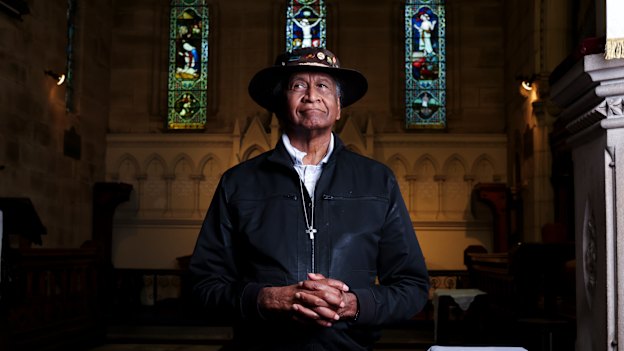
In the confusing and distressing hours after he was booed at the Anzac Day dawn service in Martin Place, Uncle Ray Minniecon’s phone lit up with two important calls.
The first was his granddaughter, furious about what the softly spoken Sydney elder had been subjected to. The second was from the actor and television presenter Ernie Dingo. “He’s a good man, a good brother,” Ray says of his long-time friend. “He was worried about me, which meant a lot. Ernie has seen a lot of racism in his time, too.”
Uncle Ray and I are talking at a Glebe cafe the morning after the morning before. He’s in good spirits but seems to be holding back the true hurt of what he has just been through. More than 24 hours have passed since the 75-year-old pastor was heckled by a group of loudmouths while delivering the Acknowledgement of Country, shocking much of the nation. In that moment, Minniecon’s dignity shone through; he took a beat when the booing began but continued with his speech honouring Australia’s war dead. Despite his stoicism – and the loud applause by the vast majority of the crowd when he finished – the scene was and is painful to watch.

It was not just disrespect but outright racism. “It came from a very dark space,” Ray says. “And what really cuts for me is that it was at a sacred place during a sacred ceremony. But that is what our people often have to deal with. For some of us, it was just another Saturday in Sydney.”
Saturday was Ray’s first time delivering the dawn service Acknowledgement of Country, taking over from Uncle Harry Allie, who had done it for the past decade but couldn’t in 2026 due to age and ill health. Minniecon was the perfect stand-in given his lifetime of community service and close ties to the Australian Defence Force.
Minniecon is no military outsider, serving for two years as a driver in the Citizens Military Forces of the 51st Battalion, Royal Queensland Regiment. His grandfather, Private James Lingwoodock, was a member of the 11th Light Horse Brigade during World War I, and his brothers, Sonny and Phillip, served in Vietnam. During one march in Sydney, a woman tipped a bucket of white paint over Sonny.
Meanwhile, Phillip came back from service “a bit damaged”. Before Phillip was due to return to Australia, he met the man who would replace him in the unit as a forward scout. The man was soon killed, and was on the same flight back to Australia as Phillip. “But only one of them was in a body bag, and Phillip felt very guilty about that,” Minniecon recalls.
Despite spending decades in Sydney as a pastor, activist, community organiser and elder, Minniecon is perhaps not as widely recognised as he should be.
Federal cabinet minister Tanya Plibersek has known Ray and his wife, Sharon, for years, and is not short of praise for the couple, and disdain for the “dickheads” who booed him. “He’s such a beautiful, gentle man,” Plibersek tells the Herald. “So modest, kind and respectful.”
When a constituent recently contacted the Sydney MP’s office about a bad experience with the Commonwealth’s Stolen Generations redress scheme, the first person she called was Ray. “Because I knew Ray would sit with him and take the time and support him through it in the most practical and most loving way. That’s the sort of work he and Sharon do every day. You would not be able to count the number of people that they have helped in their lifetime.”
Plibersek was sitting in the crowd when the booing rang out and is deeply angry. “Most of the Australian community don’t see this sort of organised racism,” she says. “It’s not directed at us, so we don’t see it.
“But the fact that this happened on Anzac Day I hope is a wake-up call. Just because it’s not directed at you every day doesn’t mean it’s not happening in our community every day.
“There’s really something about three generations of his family having served that adds to the level of disgustingness of the behaviour at the dawn service. I would be amazed if any of those people booing him have ever lifted a finger to help their country.”
Minniecon was born in the Queensland city of Bundaberg in 1949 and has three heritages: Kabi Kabi nation on his father’s side and Goreng Goreng on his mother’s. His grandfather was taken from Ambrym Island in Vanuatu as part of the so-called blackbirding trade.
Uncle Ray still remembers his parents telling him to run for his life should the police or government officials arrive in a black car seeking to take him away. Each time the cars arrived, he would hear women screaming to their children to run into the bush and hide. One day, some nearby children were happily playing; the next, they were gone.
His sustained work with members of the Stolen Generations forms a core part of his decades of service in Sydney as an Anglican Church pastor and elder. One of his biggest achievements is co-founding the annual Coloured Diggers March in Redfern on Anzac Day which commemorates Aboriginal and Torres Strait Islander people who served in overseas conflicts.
“He is so committed to the service of others,” says Gamilaroi journalist and former Today presenter Brooke Boney. Of Saturday’s ugly scenes, Boney is scathing: “This is the best country in the world, not least because it’s home to the oldest continuing culture of anywhere in the world. If your choice is to boo its survival and those who are brave enough to serve to protect it, you are not only a fool but also a coward.”
Minniecon was instrumental in the creation of Yininmadyemi – Thou didst let fall, the large standing bullets in Hyde Park which form a memorial to Indigenous service members. He founded Scarred Tree Ministries in Glebe and was a driving force in the 2007 creation of the Gawura School at St Andrew’s Cathedral School. He has been involved in climate change activism, suicide prevention and the COVID-19 vaccine rollout.
“He does all this on the smell of an oily rag,” says Julie Leask, a professor of public health at the University of Sydney who has been friends with Ray and Sharon Minniecon for 15 years via St John’s Church Glebe. “He’s very generous with his time and very under-resourced. He carries his challenges with enormous grace and humour.
“There’s a justifiable anger that you would often expect from First Nations people because of all the injustices that have been committed against them. But what I notice about Uncle Ray is that he has a real desire to see justice prevail by bringing black and white together. He has is always looking at new ways of thinking. But he does it with this enormous grace.”
Former NSW minister Victor Dominello got to know Minniecon between 2011 and 2015 while the then Liberal MP held the Aboriginal and veterans affairs portfolios. Asked about Minniecon’s contribution to Sydney, Dominello replies: “The booing he faced on Saturday was disgraceful. Heckling a man who has actually served in our defence forces on Anzac Day reveals a profound ignorance of his personal military service and his lifelong dedication to Indigenous Diggers.”

Similar booing occurred in Perth and at the Shrine of Remembrance in Melbourne in a seemingly coordinated attempt to disrupt proceedings. In Sydney, a 24-year-old man was arrested over the Martin Place incident and charged with committing a nuisance at a war memorial.
Department of Veterans’ Affairs advice is to include Acknowledgement of Country of between two and five minutes in any Anzac Day service.
When I ask Minniecon what he thinks of the view that an Acknowledgement of Country absolutely has a place at events such as the dawn service but may be overused in other environments such as workplace meetings, he has little sympathy.
“It matters because it’s a way of acknowledging land rights, and whose land we are on,” he says. “We don’t have any significant way of acknowledging that – no treaty, for example. So this is the closest we can get to our history and rights being acknowledged, so that is something important and not to be taken lightly.”
At this point, his phone rings. He looks at the name that flashes up and says to me “stolen generations”, as if to explain why he must interrupt our breakfast to take the call. The person on the other end has clearly contacted him to see how he’s doing. “I am fine, thank you for asking,” he says to the caller. “But more importantly, how are you?”
The conversation says a lot about the way many people care for Minniecon, and where his true focus is and always has been: on others, not himself.
Start the day with the most important and interesting stories, analysis and insights in our Morning Edition.newsletter.
Disclaimer : This story is auto aggregated by a computer programme and has not been created or edited by DOWNTHENEWS. Publisher: www.smh.com.au