
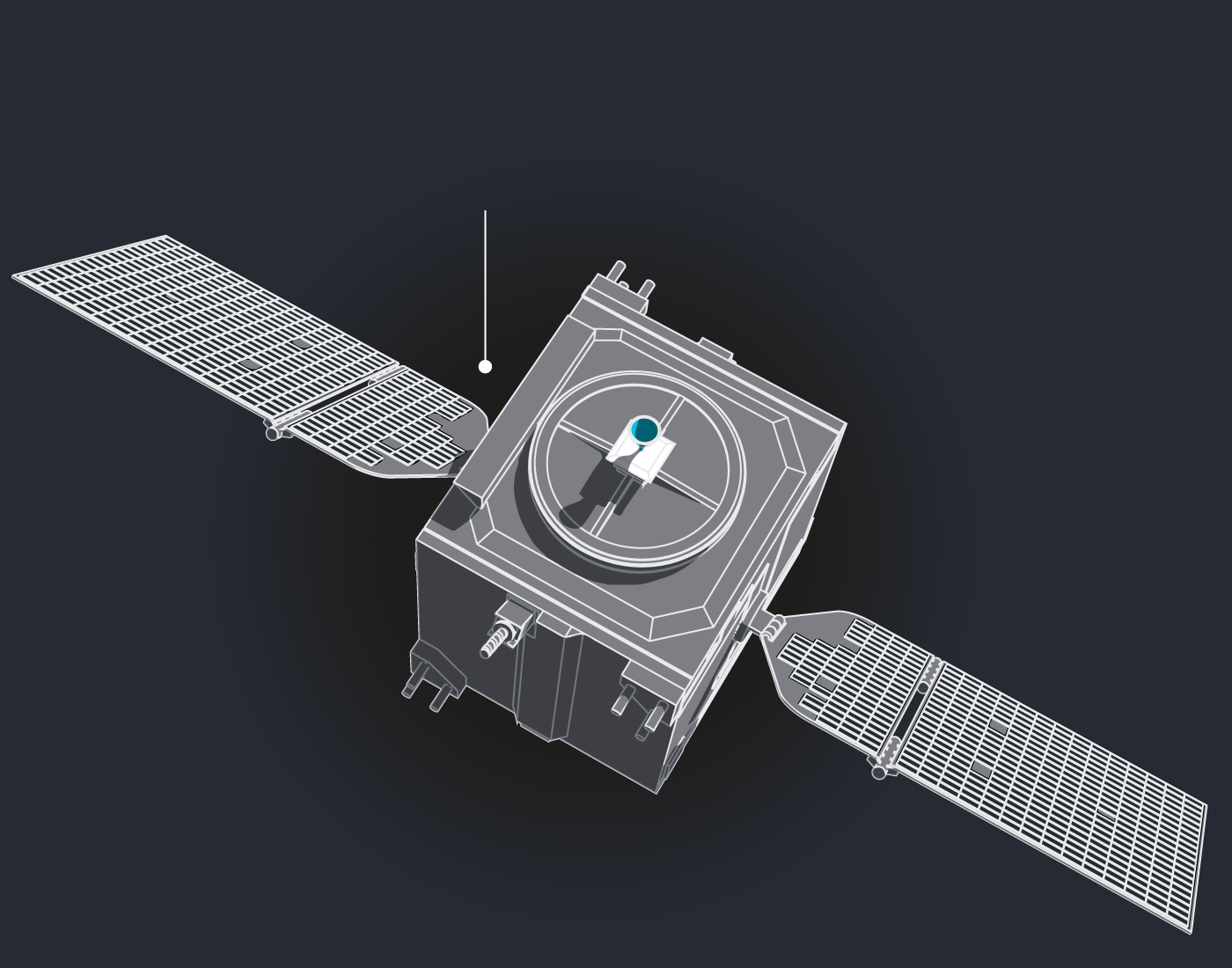
Over the past few years, a growing number of satellites from China, Russia and the US have inspected one another in ways that could also be used to attack enemy assets in orbit.
Space powers need to master such “proximity operations” in case systems malfunction. But the same capability that enables one satellite to inspect another could damage or disable it — and the US has classed a number of Chinese manoeuvres as “dogfighting in space”.
Combat in Earth’s orbit is no longer the stuff of fiction.
Textbooks for Chinese military officers and nearly 100 papers by scholars linked to the People’s Liberation Army reviewed by the FT reveal how the force thinks it would fight a space war. From capturing satellites and striking targets on Earth to overtaking Starlink, the material provides the clearest view yet of China’s strategy for conflict in orbit.
“Looking up at the skies today, we see that space is already shrouded in the smoke of potential conflict,” Chinese military expert Jiang Lianju wrote in a 2024 textbook. “[The] potential for high returns — the ability to control Earth by controlling space — represents a powerful strategic and military incentive. Therefore, the development of space warfare capabilities has become a focal point of the arms race.”
The mounting tension in space was illustrated by the encounter between USA 324, the American monitoring satellite, and its Chinese counterparts last April, which gave the US a close look at a strategic rival seeking to surpass Washington’s capabilities.
The two Chinese satellites, TJS-16 and TJS-17, are officially used for communications testing but are also suspected of surveillance — just one of the capabilities worrying the US.
Beijing’s development of jammers, lasers and satellites capable of pulling other objects into a “graveyard orbit” far beyond Earth were cited by General Chance Saltzman, head of the US Space Force, in testimony last year to the US-China Economic and Security Review Commission, which reports to Congress on relations between the two countries.
“Space is a warfighting domain, not a collection of supporting activities,” Saltzman added in the US’s first Space Force doctrine.
The force frames its own manoeuvres as defensive. But the technical attributes of satellites such as USA 324 are inherently dual-use — as are China’s equivalents. As mistrust between Washington and Beijing deepens, that blurs the line between routine operations and what is known as counterspace activity — moves to disrupt or destroy an adversary’s assets in space.


Graphic: A triptych of images showing the launch
Chinese public statements do not spell out military goals in the domain as bluntly as the US’s — Beijing’s 2022 white paper on its space programme emphasises the country’s peaceful approach. But the papers by PLA-affiliated scientists reveal a research and development push in many of the technologies needed for military operations in space. PLA textbooks also discuss in striking detail how China might fight an orbital war.
A doctrine shaped by vulnerability
Fears about the weaponisation of space can be traced back to the development of intercontinental ballistic missiles in the 1950s, which travel through space on their way to a target.
As early as 1996, General Joseph Ashy, the then commander-in-chief of the North American Aerospace Defense Command and Air Force Space Command, said: “It’s politically sensitive, but it’s going to happen . . . we’re going to fight in space.”
Thirty years on, the US and China are in a race to prepare for such a conflict. Both are motivated by the fear that a single strike in space could shut off the central nervous system their economies and militaries rely on.
Communications, power grids, navigation systems and financial markets would all collapse without signals relayed by satellites. Equally, modern militaries rely heavily on space for command and control, communications and missile targeting.
Under the US’s Joint All-Domain Command and Control concept, data from sensors across the country’s forces is supposed to be shared over a single network, with intelligence, surveillance and reconnaissance satellites playing a key role. That raises the risk that a targeted strike could cripple its surveillance and command systems.
Howard Wang, a researcher at the Washington-based think-tank Rand, says the core concept of the PLA’s strategy is to strike key nodes in an adversary’s network to “paralyse” decision-making across the chain, from collecting and transmitting data to analysing and acting on it.
China’s drive to build up its military capacity in space also comes from a sense of threat. The country’s space programme is an attempt to counter what it sees as the US’s military advantage in the domain, just as it modernised and expanded its nuclear arsenal partly out of fear that it could be neutralised by US missile defence.
In a 2021 submission to the UN, the Chinese government said the “weaponisation” of space and an arms race in orbit were “becoming more prominent and pressing”. It accused “a certain country” of pursuing military superiority in space and said the US was accelerating “the building up of a combat system in outer space in a bid to get ready for a space war”.
China has been developing its own capabilities in response.
In January 2022, China’s Shijian-21 satellite — officially launched to test capabilities to remove debris — used a robotic arm to tow a defunct Beidou navigation satellite into graveyard orbit. US generals were alarmed by Beijing’s ability to seize a satellite in geostationary orbit (GEO) — some 36,000km from Earth — and to dispose of it several hundred kilometres above that.
A year later, the US Office of the Director of National Intelligence warned that such displays “prove China’s ability to operate future space-based counterspace weapons”.
In 2024, five Chinese experimental satellites, three of the Shiyan-24C type and two others called Shijian-6 05A and B, conducted a series of close-range manoeuvres — the behaviour the US likened to dogfighting.
Data from Comspoc, a space analytics company, shows another test in June, when two Chinese satellites took part in a “rendezvous operation” in GEO that may have been the first of its kind.
Such breakthroughs are the tip of the iceberg. In its quest to surpass the US in space, China is harnessing the full power of its military, industry and academia.
The US was developing advanced counterspace weapons during General Ashy’s tenure in the 1990s. But the days of Washington’s uncontested leadership in the domain are long over.
Universities and institutes with links to the PLA are involved in a relentless research effort into military-use space technology. The papers reviewed by the FT cover topics ranging from attacking enemy satellite systems to quantum-based unbreakable communications.
In multiple PLA-affiliated studies, researchers describe efforts to develop tools for on-orbit servicing, including refuelling systems and multi-arm spacecraft able to capture moving targets. Such capabilities can keep satellites in service longer and enable evasive manoeuvres. They can also be used against an adversary’s space assets.
On-orbit multi-arm spacecraft
In 2022, researchers from two PLA-affiliated universities simulated a spacecraft with multiple arms capturing a moving target, using a game theory model to ensure the arms did not collide
;
In theory, no satellite would be beyond China’s reach, regardless of its distance from Earth.
A first Chinese anti-satellite missile test in 2007 paved the way to a ground-based system for targeting satellites in low Earth orbit (LEO) — the region of space less than 2,000km from Earth. US military officials say the PLA is already using the system in training and cite intelligence suggesting that China aims to field similar weapons to reach GEO.
Beijing is also refining space-based assets that can identify targets on Earth with greater precision than before.
In a development watched warily by the Pentagon, China is stepping up its research into satellite sensing and positioning — technologies that enable anti-ship missiles to track targets. This is central to Beijing’s efforts to restrict US naval freedom of movement in the Indo-Pacific, which it sees as its sphere of influence.
China is now able to survey the region from 36,000km away. It is the only country that operates a synthetic aperture radar — a technology that creates high-resolution images of the Earth’s surface through the use of radar pulses — from GEO satellites.
That system provides persistent, all-weather, day-and-night imaging, allowing Beijing to monitor Indo-Pacific naval movements, says Brien Alkire, a researcher at Rand, helping it build a picture of US force posture in the region and hold “naval assets at risk at long ranges”.
Last June, China launched Zhangheng-1 02, a satellite the country’s National Space Administration said was intended to enhance the detection of natural disasters. Such systems can also analyse electromagnetic signals to identify enemy forces, avoid interference between friendly systems and disrupt an adversary’s electronic warfare.
China is constructing spaceports on artificial islands in Shandong province


Graphic: Four satellite images from April 2022 to February 2026 show the expansion of the sea spaceport in Shandong, with new areas formed by dredging sand and mud from the surrounding seabed.
Western analysts warn that Beijing is also racing ahead in satellite-based communications.
China’s rapid progress was reflected in a recent experiment with quantum key distribution — a technology based on quantum physics that militaries hope will enable unbreakable data transfers.
In March 2025, the Chinese Academy of Sciences said a team from several universities had achieved a “world-first breakthrough”: a real-time quantum link between a microsatellite and a mobile ground station.
Anatomy of a space war
Like the US Space Force, the PLA sets out two key missions for space operations: protecting its own space assets, which it needs for everything from communications to navigation, and threatening its adversary’s space infrastructure.
Introduction to Space Operations, the 2024 textbook, says the primary mission of space operations is to support joint warfare across land, sea and air, while also highlighting space as the ultimate domain for strategic deterrence — more flexible and reliable, faster and more efficient even than nuclear deterrence.
“An asset that moves in space at high velocity can threaten any ground, naval or air target, conduct global attacks and therefore has a true global reach and global combat capability,” writes Jiang, the text’s author.
He adds that without space superiority, there can be no superiority in any other sphere of warfare.
A practical example comes in Space Strategy Assessment, another PLA textbook, which states that China aims to control near space — the upper reach of the atmosphere just below outer space — to overcome the defences of the second island chain, a reference to the islands of Japan, Taiwan and the Philippines.
The first and second island chains in the western Pacific are central to China’s military concerns


Graphic: Map of the Western Pacific highlighting the “first” and “second” island chains as strategic barriers to China’s expansion. The first island chain runs from Japan through Taiwan and the Philippines to Malaysia, enclosing the East and South China Seas. The second island chain extends further east from Japan through Guam to Palau in the Pacific Ocean. Countries labeled include China, Japan, Taiwan, the Philippines, Malaysia, and Indonesia, along with surrounding seas
A further book, Research on Future Near Space Combat Applications, written by two professors at the PLA’s Air Force Engineering University, outlines ambitions for space systems that enable continuous surveillance, rapid attacks, near-space defence and long-range transport covering the “second island chain and the strategic depth of surrounding countries”.
The second island chain also includes the US territory of Guam and several US-affiliated island states and territories in the western Pacific that form a natural barrier to Chinese expansion.
But any space conflict might start far above such traditional flashpoints on Earth.
The PLA envisions successive stages of space warfare that would mirror its broader military strategy. These would begin with deterrence operations — publicising capabilities, deploying space weapons or repositioning satellites, and space exercises.
Wang at Rand says Chinese thinking on escalation is shaped by a desire to achieve objectives while “reducing the adversary’s incentive to respond”, favouring attacks on orbital nodes over strikes that would cause casualties.
Research papers recommend disrupting enemy communication and command systems with cyber and electronic attacks or limited “deterrent strikes” with offensive weapons on space targets to force a foe to back down in a crisis. At this stage, the PLA must avoid striking the “core of the core” of enemy operational systems such as command nodes to prevent inadvertent escalation.
The next stage would be a space blockade — a stratagem that Jiang, the author of Introduction to Space Operations, says is “fast and convenient”, since “space is an open domain”.
Such blockades could include special forces infiltrating ground bases to damage control centres, radars or power and refuelling infrastructure.
Tactics range from jamming and cyber attacks to using weapons such as lasers and particle beams, which can be operated from the ground, air or space. “Once the enemy’s space systems are hit with these, they lose the ability to provide data to their ground, naval, air and other forces,” one textbook says.
Chinese forces could also capture, disable or destroy satellites using dedicated spacecraft, as well as space mines. Debris could be weaponised, turning the orbital environment into an instrument of attack.
PLA experts even discuss manipulating the weather to prevent enemy launches or intercepting rockets outside Earth’s atmosphere. “Since the spacecraft has not yet separated from the rocket, the vehicle is relatively slow, large and clearly discernible, making it extremely easy to intercept with a space-based anti-satellite weapon,” one textbook says.
According to PLA strategists, if an enemy fails to back down in the face of space deterrence and blockade operations, China should launch offensive moves. The aim would be to “destroy the enemy’s space combat capabilities in order to gain control of the space domain”.
PLA experts describe tactics ranging from clogging satellite antennas by spraying aerosols to hitting spacecraft with high-velocity interceptors and electromagnetic railguns. Targets would be either directly rammed or destroyed with a dense cloud of metal particles created by a nearby warhead explosion.
Military authors highlight the potential of spaceplanes, shuttles and space stations for combat missions. Spacecraft operated by an on-board crew are seen as particularly valuable as they are more agile than systems reliant on ground stations.
At this stage, nothing would be off limits, and the boundaries between space and other theatres quickly blur. Textbooks list everything from enemy satellites to military bases, nuclear weapons sites and information and energy infrastructure as targets for assault.
At the far end of this logic lies the prospect of direct attacks on Earth from space. “Control of the skies grants freedom of action on the ground, naval, and air battlefield,” writes Jiang.
One proposed method is orbital bombardment systems — similar to intercontinental ballistic missiles, but placed in LEO and equipped with boosters to help evade detection. Such “highly mobile spacecraft” would serve as “key platforms for space weapons” with “tremendous potential for military applications”, the authors of one PLA text say.
But Wang cautions that space-based strikes on Earth are unlikely to offer significant advantages over conventional ground-based attacks given their cost and complexity.
Safety in numbers
Taken together, the PLA research reveals a force vying for control of space to protect the nervous system of modern warfare, but also to beat the US’s capabilities for a potential conflict in orbit.
In this race, the most immediate area of competition is LEO, which has been transformed by Elon Musk’s Starlink.
Saltzman of the US Space Force said last year that since its space architecture was designed for a benign environment, its orbits are predictable and satellites defenceless. “It is not hard to pick them out as targets. That gives the offence an advantage, that gives an incentive to strike first, and we have to try to deny that.”
He added that by using “hundreds of satellites” in LEO to warn of incoming missiles instead of “just a few” in GEO, the US can “change the targeting calculus for an adversary”.
US efforts to seek safety in numbers — combined with the now-mature capability of Musk’s Starlink constellation — have alarmed the PLA. A more dispersed network of US satellites would blunt China’s strategy of “system destruction warfare”, which seeks to defeat the enemy by taking out the central nodes on which its systems depend.
China, as worried as the US about the vulnerability of its space assets, has come to the same conclusion: to put a rival on the back foot, it needs more satellites in orbit. This focus on resiliency is fuelling the bilateral space race.
Researchers at China’s Academy of Military Science have argued that Starlink’s satellite network has reshaped LEO into an important sub-domain. In a PLA Daily article last June, two academics from Space Engineering University in Beijing went further, describing SpaceX, Starlink’s parent company, as an integral part of US military use of space.
Western experts suggest China’s concerns about the military implications of private space technologies developed in the US may be overstated.
The PLA’s threat perceptions are “inflated by its tendencies to exaggerate and catastrophise US capabilities, leading to assessments and potential responses that prepare for the worst possibilities even before evidence indicates such”, a study by Rand concluded last March.
Beijing views LEO as crucial space real estate for building satellite constellations in a zero-sum competition with the US.
In an article in the People’s Daily, the Chinese Communist Party’s newspaper, last July, Tian Qingfeng, deputy director of the military-civil fusion centre at Northwestern Polytechnical University, noted that the International Telecommunication Union allocates orbital frequency resources on a ‘first-come, first-served’ basis, requiring launch within 14 years. This, he wrote, would “force Chinese commercial space companies to accelerate their launch schedules”.
In a sign of the scale of its ambition, China plans to deploy more than 37,000 new satellites between 2024 and 2030. Tian wrote that the goal is to secure capacity for between 60,000 and 100,000 LEO satellites.
But numbers are only one aspect of resilience. While LEO constellations are relatively easy to build, they are more vulnerable to ground-based anti-satellite weapons, prompting the PLA, like the US Space Force, to spread assets across harder-to-reach orbits.
The cost of producing and launching Chinese satellites also remains much higher than it is for SpaceX. This has alarmed the country’s space experts and focused Beijing’s attention on building a supply chain that will enable it to overtake the US company.
As part of its bid to make satellite launches easier, faster and cheaper, Beijing has expanded its Wenchang spaceport on the southern island of Hainan in recent years and developed sea launch platforms in Shandong province.
Wenchang spaceport on Hainan expanded with three new launch pads


Graphic: Satellite images of Wenchang spaceport in Hainan from February 2022 and March 2026, showing an increase from one launch pad to four.
Chinese strategists say Beijing’s space push is still playing catch-up with the US. But the PLA has high hopes it will overtake its rival on many of the space technologies it believes will be the most powerful in military history.
The two professors from the PLA Air Force Engineering University write that the technological complexity of some space-based weapons means their use in real war conditions may be a long way off. But, once they start to be applied in combat, “they will revolutionise space warfare”.
The professors add that these weapons could be used to attack targets on Earth “at extremely short notice, retreat to a safe space once the attack is completed, and carry out new missions”.
That is far from the only vulnerability exposed by the space arms race. Wang at Rand warns that even limited disruption can have “cascading effects”, given satellites’ role in underpinning countries’ economies and militaries. The Chinese textbooks’ descriptions of possible escalation also lay out the risks that jousting in space could quickly lead to far graver consequences.
“We are in a domain where nobody has ever fought a war before,” says a western military official. “The potential for things going wrong very quickly is immense.”
Satellite ephemerides data provided by Comspoc and Spaceflux. Historical launch and orbital data provided by Space-Track. Visuals were created for conceptual accuracy, but 3D models and points are not always to scale. Altitudes, when relevant, are to scale relative to the size of the Earth.
Additional work by Jana Tauschinski and Ian Bott
Disclaimer : This story is auto aggregated by a computer programme and has not been created or edited by DOWNTHENEWS. Publisher: ft.com



