
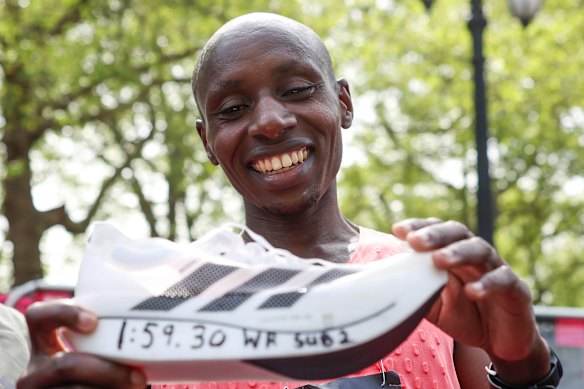

On Sunday morning in London Sabastian Sawe got up, had two slices of bread with honey and a cup of hot tea for breakfast. He put on his $700 shoes and went out and made history.
He not only broke the world marathon record – records are broken weekly and often pass with little more than an appreciative, respectful nod – but he broke a time threshold considered impassable. Less than two hours to run a marathon? The world gasped. And his shoe company cried out in delight.
Not all records are created, or broken, equally. Some carry a mystique beyond the event and the sub-two hour marathon is that.
When Roger Bannister broke four minutes for the mile he changed the idea of human possibility. Now, a 15-year-old boy has done it.
Usain Bolt’s time of 9.58 for the 100m still stands as its own testament to his imperiousness as an athlete.
And now there is Sabastian Sawe. What he did in London on Sunday, streaming down The Mall in front of Buckingham Palace to become the first person to break two hours for the marathon in race conditions was of the same awe-inspiring level as Bannister and Bolt. What he, like Bannister, did was to redefine the possible.
It took no time for someone else to follow in his path and break two hours. Just 11 seconds to be precise. The second placegetter in the race, Yomif Kejelcha, running his first marathon, also broke two hours.
For context, the 30-year-old Kenyan did pretty much what Bannister did … 26 times in a row. He averaged four minutes per mile for 26 successive miles. That pace which is hard to comprehend, so put it this way: try running 100m in 17 seconds, then do it 422 consecutive times. That is what Sawe did: he ran 17 seconds per 100m for 42 kilometres.
There are two natural reactions to a marathon record being broken: cynicism about drugs in the body. And suspicion about shoes on the feet.
Sawe knew this. So he embraced both prejudices. First he, and his sports company, were determined to do everything to prove he was clean.
He took the unusual move of not only volunteering, but requesting more regular drug tests, asking the Athletics Integrity Unit to test him as many times as possible. In competition, out, at home, overseas, middle of the night, whenever and wherever you want, test me, he said. Which they did. Last year he was tested 25 times in two months ahead of the Berlin marathon.
“The main reason was to show that I am clean, and I am doing it the right way,” he said at the time.
Adidas, his shoe and clothing company, paid $50,000 to the AIU to fund any extra tests the doping body wanted to conduct on their athlete.
The German company knew they had someone special. They also knew they had something special to put on his feet.
Super shoes, make no mistake, have revolutionised the sport. Would he have broken two hours wearing a pair of Dunlop volleys? Probably not. Would Bolt have run 9.58s on a cinder track? No. Does it matter?
The late Kelvin Kiptum’s previous world record of 2:00:35 was set in 2023, wearing an earlier iteration of a super shoe, a Nike version, so there is a modern parity there.
Sawe’s 1:59:30 time was more than a minute quicker than Kiptum’s record. Sawe and Kejelcha were both wearing the same type of adidas shoe, the previously unreleased ultra-light Adios Pro Evo 3. At US$500 ($700) they are the first super shoe that weighs less than 100 grams.
Tigst Assefa, who broke her own world record in the women’s race when she ran 2 hours 15 minutes and 41 seconds, was also wearing the adidas shoes.
The Nike Vaporfly released in 2017 was the first of the so-called super shoes, using different foam and carbon plates in the sole, which has prompted a jump in the number of distance records broken.
It has also ignited an arms race for footwear. All the main brands now have a version.
Hellen Obiri, who had twice won the Boston marathon, won the New York marathon last year wearing the ON Cloudboom Strike. The US$330 ($460) shoes are made by a robot using spray-on technology. They have no laces and are more like socks on foam with carbon plates.
Obiri was runner-up to Assefa in London. Adidas beat ON. In fact, Adidas seemed to beat everyone. Four of the five fastest times at the London marathon, watched live in the streets of London by 800,000 people (yes, you read that correctly) were wearing adidas.
It all seems a bit technological and overblown marketing just for a pair of runners until you consider the US market for sportswear alone last year tipped over $8 billion.
Nike had spent millions manufacturing the right shoe and conditions for Eliud Kipchoge to attempt to break two hours in 2019. He did. But he did it with a pacers and in rare conditions so it was never recognised as a record. Sawe did it in a race and has the record. To borrow from the swoosh company, Sawe just did it.
Sawe’s coach Claudio Berardelli was not trying to diminish the competitive edge of the shoes – adidas would surely be glad of that – but also credited the effect of carbohydrate gels from company Maurten that he slurped down during the race.
“There is no doubt we are in the new era of marathon running because of the shoe and proper fuelling,” he told The Guardian.
“So we are super-glad to adidas and Maurten. They have come to Kenya so many times to support us, because all of us realise that Sabastian was not just a good one, but he’s a special one.
“Definitely physiologically, Sabastian has to be a good one. But all the pieces come together perfectly, because of his attitude, because of his character. I’m still in the process of discovering who Sawe is. He is an exceptional human being. He has such a positive energy, but he’s so humble at the same time.”
Indeed, this is the main point: the shoes, the gel, didn’t do the running. Roger Federer’s racquet needed Roger on the other end. The super shoes are more akin to modern cricket bats, the ball goes further, but you have to know how to hit it.
Making his effort more remarkable was that London is a flat course but not normally considered to be as quick as Boston and Chicago.
“We said it was a day for records, but I don’t think in our wildest dreams we could have foreseen this,” said Steve Cram, the former 1500m world champion and record holder, commentating the race.
“I’ve never seen anything like that. What a finish. That you would say is unbelievable – but we have just seen it happen. None of us ever thought we would see that, especially in London. I’m lost for words. Roger Bannister broke the four-minute mile. People thought no human being could run that for the mile but he did.”
We know what we just Sawe.
News, results and expert analysis from the weekend of sport sent every Monday. Sign up for our Sport newsletter.
 Michael Gleeson is an award-winning senior sports writer specialising in AFL and athletics.Connect via X or email.
From our partners
Disclaimer : This story is auto aggregated by a computer programme and has not been created or edited by DOWNTHENEWS. Publisher: www.smh.com.au


