
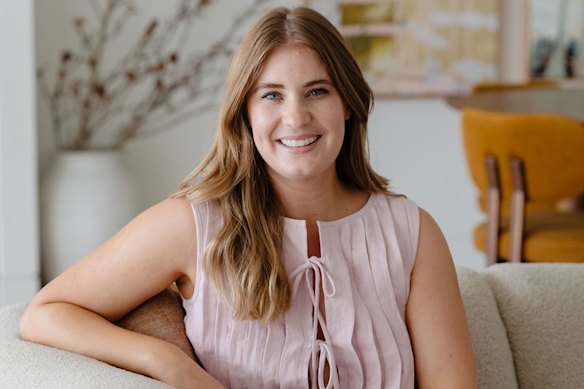

First home buyer Jess Ricci worked three jobs and put every spare dollar towards her house deposit.
The 31-year-old wanted her money to go as far as possible, and thought she was giving herself a leg up by participating in the government’s superannuation saver scheme. But an error on an online tax form – made by the Australian Taxation Office’s autofill function – meant she lost a hard-earned $2300 instead.
Strict rules around withdrawals from super funds mean even though a mistake was identified, the decision is final and Ricci has not been able to get the money back.
“It’s really kind of screwed me over,” the partnership manager said.
“The cost of building has become incredibly expensive compared to what it was. Every dollar really does count.”
The Coalition-era first home buyer super saver scheme allows participants to make voluntary contributions to their super to be withdrawn later for a deposit. Contributions are taxed at a lower rate than income tax, therefore boosting savings.
More than 50,000 people used the scheme in the 2024-25 financial year, and more than $300 million was released from super funds to first home buyers.
Ricci said she made her first $15,000 contribution post-tax, and did not fill out a notice of intention to claim a tax deduction on the contribution. When she applied for a determination to assess how much she was entitled to, the form was autofilled by the ATO. The contribution was misclassified as concessional, meaning it was subject to a 15 per cent tax rate, even though Ricci had already paid income tax on the money.
Ricci submitted the autofilled form, not realising the error. It meant the $15,000 contribution was taxed twice – a combined rate above the highest possible marginal rate.
That’s the point at which she lost $2300.
She said as a first home buyer, it was unreasonable to expect she could correct the tax office.
“I guess I had a lot of faith [in] the ATO. Like they would have all of the correct information.
“I thought, this scheme is targeted at me. I am their demographic: young, first home buyer. It should be set up to support me and to help me walk through it. I think there should be an inherent assumption that I’ve never been through this process before.”
When she contacted the ATO, she said she was left feeling embarrassed, and eventually filed a complaint frustrated with the lack of recourse.
An ATO spokesperson said participants in the first home buyer super saver scheme (FHSS) were given warnings throughout the process to check the accuracy of prefilled data.
The spokesperson said participants could request extra determinations, including to correct any mistakes, after which the agreed funds were released. The release could also be amended or cancelled before a person received their pay-out, they added.
“Where an individual has made an error but has already been paid an amount … the legislation provides no mechanism for the ATO to correct the individuals’ release,” the ATO spokesperson said. “Individuals can only receive a single release through the FHSS scheme.”
Tax Ombudsman Ruth Owen said the rules around withdrawing from a superannuation fund were strict because it was a major financial decision.
“Accessing your super for your first home feels like an exciting decision to make, but fully understanding the tax consequences of that because it’s a one-off decision that can’t be reversed, is really important,” Owen said.
“Proceed with caution is the most important piece of advice that I would give anybody thinking about that.”
The ombudsman said while the ATO’s website was usually clear, there was always room for improvement.
“We’re really looking for the ATO to communicate as clearly and straightforwardly as possible in layman’s terms, and to really flag early on in any engagement with taxpayers if there’s going to be a decision that can’t be reversed.”
Ricci, who lives in Melbourne, said she did not want to scare others off the scheme. But she did want more education around the specifics worked, so others did not find themselves in the same position.
“I feel like I have a reasonable level of financial literacy, and I still ran into this problem,” she said.
“I would hate for somebody to be a first home buyer, to not be able to make that money up and then not be able to build their house or buy their house because there’s just no way for them to access those funds.”
Cut through the noise of federal politics with news, views and expert analysis. Subscribers can sign up to our weekly Inside Politics newsletter.
 Brittany Busch is a federal politics reporter for The Age and Sydney Morning Herald.Connect via email.
From our partners
Disclaimer : This story is auto aggregated by a computer programme and has not been created or edited by DOWNTHENEWS. Publisher: www.smh.com.au


