
PA Images via Getty Images
David Attenborough, who will celebrate his 100th birthday next Friday, was at lunch at the Garrick Club in London’s theatre district with Kenneth Clark when he launched into a conversation that would enrich us all.
This was in 1966 when Attenborough was just 40. He had been appointed controller of (then named) BBC2, the new BBC television station, which had a remit to broadcast programs of “depth and substance” alongside the public broadcaster’s flagship, BBC1.
Clark, more properly Sir Kenneth, was 62 and already famous as an art historian and the former director of Britain’s National Gallery. Even those of us who have not lunched in a London gentleman’s club can picture the scene at the Garrick that day. Photos suggest an interior of claret-red carpets and walls where claret-faced men dined in appropriate company at the sort of dark wooden tables that are inherited rather than purchased.
It was not then clear to the world what TV programming of depth and substance might be, but Attenborough had an idea, one that might make full use of the colour televisions that were just becoming commonly available.
Attenborough proposed that Clark should write and host a program charting the history of Western art, philosophy and architecture. He should make it as long as he thought necessary and distress the BBC’s budget as much as he saw fit. It should be visually arresting, it should be beautiful, it should dig deeply into big ideas. According to Sir Kenneth’s biographer, James Stourton, the old man was at first sceptical, “munching his smoked salmon rather apathetically” until perked up at Attenborough’s use of the word “civilisation”.
The series they created, Civilisation, was 12 hours long, filmed over three years in 117 locations across 13 countries. Though criticised even upon its release for its reflexive elevation of Western culture – and for Sir Kenneth’s tendency towards pomposity – it was received as a dazzling achievement in an emerging medium, the first example of what we now call landmark television.
But Civilisation did more than that. Rather than being an artifact of elitism it took its subject and its viewers seriously. It proved Attenborough’s sense that if complicated ideas were presented well they would prove as transfixing for a mass audience as they were within Britain’s grand institutions, within the confines of public schools, ancient universities and learned societies.
Without Civilisation we would not have had the other triumphs of documentary making that followed. We would not have had The Ascent of Man, written and presented for BBC2 by the Polish-British philosopher Jacob Bronowski, nor would we have thrilled to Robert Hughes’ fabulous Australian rumble as he unpicked the history of modern art over eight hours in The Shock of the New. The new form echoed across the Anglosphere, paving the way for Ken Burns to lay out America’s bloody modern history in two great series The Civil War and The Vietnam War.
Arguably, it would be perfected in Attenborough’s own masterpiece, Life on Earth.
Beauty and truth
Attenborough was born a century ago to a middle-class family of an academic bent in Middlesex. He studied geology and zoology at Cambridge as World War II ended and when he began a career at the BBC in 1952 he was, according to his autobiography, discouraged from pursuing on-air roles because his teeth were too big. Nonetheless, he rose through the organisation, notably commissioning the series Song Hunter, which saw the ethnomusicologist Alan Lomax tracking down traditional folk musicians across Britain and Ireland in order to preserve a culture that was rapidly being lost.
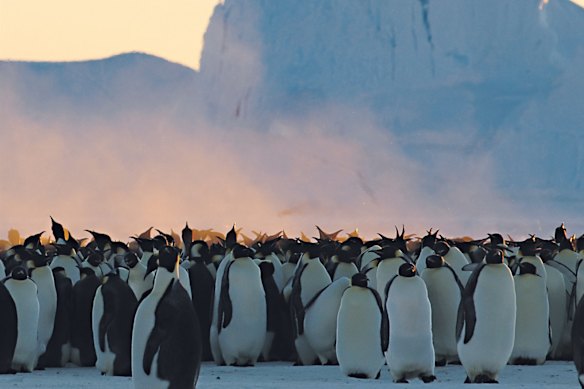
But of the hundred odd documentary movies and series Attenborough has made or contributed to, none would be as loved as Life on Earth. Shot over three years in more than 100 countries at a cost of over £1 million an episode, the series became famous not just for the scope of its ambition, but for its near-irrational meticulousness. One cameraman famously spent hundreds of hours in a Chilean jungle with his lens focused on a Darwin’s frog, which incubates its young in its mouth, charged with capturing the moment it spat them out.
Most of all it is famous for Attenborough himself and what his collaborator, film director Keith Scholey, calls his “appropriate awe” for the world he was bringing to us. On screen Attenborough never sought to make himself the focus, rather casting himself as an attendant to the creatures he was introducing. This only made his audience love him more.
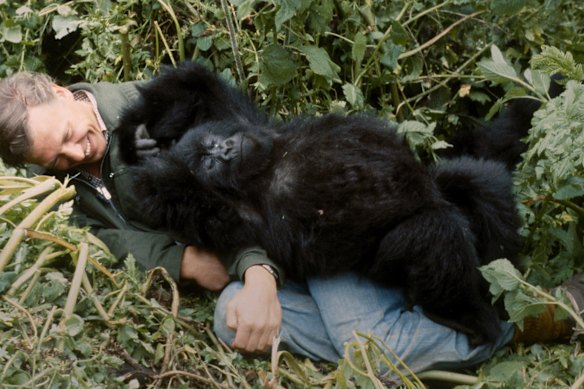
In Life on Earth’s most famous scene Attenborough reclines in a Rwandan jungle, whispering a commentary about the life of the mountain gorillas behind him. A juvenile tumbles out the leaves and sprawls across his chest. Its mother grips Attenborough’s head with a single hand and looks into his eyes. Some sort of understanding passes between them. Despite the danger, Attenborough’s delight at the moment bursts from the screen.
“I dream about it,” he later recalled. “I mean it was [the most] breathtaking experience that anybody could possibly want who’s interested in the natural world.”
With the success of Life on Earth, which 500 million people would eventually watch, Attenborough, already a keen amateur natural historian, dedicated the rest of his life to natural history filmmaking.
Despite this Attenborough is not without environmental critics, who lament that having created the long-form documentary he failed to use it in defence of a planet that was being ravaged by reckless resource extraction and climate vandalism.
The climate issue
In 2018 The Guardian’s George Monbiot called it a betrayal. “I have always been entranced by Attenborough’s wildlife programmes, but astonished by his consistent failure to mount a coherent, truthful and effective defence of the living world he loves,” he wrote. “His revelation of the wonders of nature has been a great public service. But withholding the knowledge we need to defend it is, I believe, a grave disservice.”
Last year the conservationist and BBC producer Martin Hughes-Games told me that Attenborough’s documentaries had perpetrated a dangerous fraud. “I worked in the BBC natural History Unit for well over 20 years, so I speak with some authority,” he said. “I wonder if you have visited these rapidly shrinking parks and reserves yourself? The idea that there are still wild places, teeming with wildlife on our battered little planet is a travesty.”
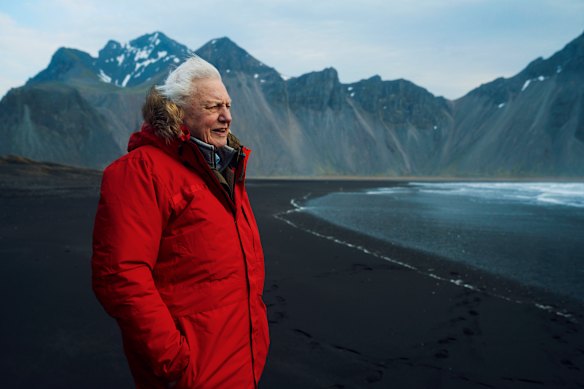
Attenborough did not directly address climate change in his documentaries until 2006, with Are We Changing Planet Earth? and Can We Save Planet Earth? This was almost a decade after the world negotiated its first climate treaty, the Kyoto Protocol, and almost two decades after the NASA scientist James Hansen gave his devastating congressional testimony warning the world that the danger had arrived.
Scholey, who once ran the BBC’s natural history unit, believes his reticence on climate was born of a determination to protect what he knew was a powerful and important voice. For Attenborough to speak out, he says, the science had to be settled. He had to protect his authority.
Last year, the two men made Ocean, a film which assails the destructive practices of industrial fishing. Audiences wept at cinema screenings. Monbiot described it as the film he had waited his entire working life to see. The powerful global fishing industry, however, did not make a peep – such is Attenborough’s authority.
“Taking on the trust of the word of David Attenborough is a difficult thing to do,” says Scholey. “There is no way we could have done that film without David. Where would we have got funders to come in to fund it? Would we have got broadcasters to come in and show it, would we have got distribution? No, no, no. It all falls down to one very humble man.”
The Australian scientist, environmentalist and author Tim Flannery first met Attenborough by chance at Sydney airport in 1984 when he was on his way to PNG for a field trip early in his career. The young scientist approached Attenborough as a fan and the two have been friends since.
He believes that those challenging Attenborough on climate are not only wrong, but miss the point. By introducing mass audiences to the staggering beauty of the world, its pristine environments and the creatures that live in them, he asserted their inherent value.
Attenborough came of age in a time when the natural world was simply a landscape of resources to be pillaged. More than any other single person, says Flannery, he helped change that perception. His films and voice has not only made the work of climate activists and environmentalists easier, it has made it possible.
In 2015, the BBC director general handed Jonty Claypole, a former BBC arts director who now lives in Sydney, a difficult brief – he was to produce Civilisations, not so much a sequel to BBC2’s most famous series, but a revisitation.
Claypole wrote to Attenborough, who did not use email, to seek his imprimatur, and was duly invited to tea at Attenborough’s home in southwest London. The two sat and talked for two hours in the folly Attenborough had built in his back garden to house his vast collection of curiosities and books.
“It is not so much a library as the visual or architectural expression of his brain,” says Claypole. “It’s on two floors. One floor is for culture and anthropology to cultures of the world, and his interest in culture is truly global. The other is the natural world.”
Attenborough offered his support and advice, and went on to publicly endorse what had become a controversial project at its launch. The moment was significant, says Claypole, because the BBC2 has been shaped in Attenborough’s image.
“I think every controller of BBC2 after him saw themselves continuing Attenborough’s legacy. The character and face of the channel has gone through many changes, but it’s always hung on to the Attenboroughness of it.“ With Attenborough’s support the critics were quieted, and the series went on to success.
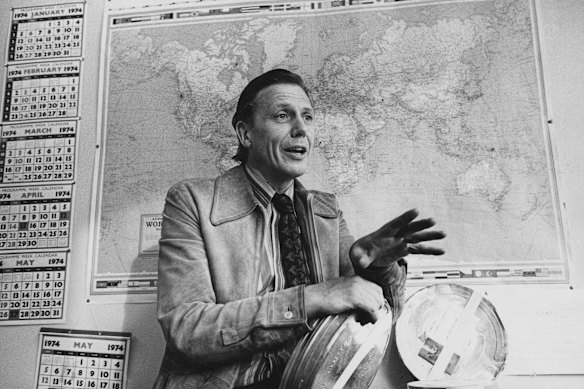
Claypole notes that Attenborough has done far more than make nature films. As a young executive, he commissioned Monty Python’s Flying Circus. His realisation that white tennis balls could not be seen on colour screens is the reason modern balls are bright yellow.
“I think, in a funny way, Attenborough’s greatest contribution to culture and to broadcasting isn’t the nature program, per se. That is one expression of his bigger vision, which was the idea of informative, educational and yet irresistible, spectacular, and entertaining television that people anywhere could watch in their homes and expand their minds.”
In his 90s Attenborough somehow drifted beyond the status of national treasure to become something like a seer or a prophet, says Claypole. Having never engaged in political debate he came to exist on a plane somewhere above rebuke.
In an age of cynicism, Attenborough has become the face of unvarnished enthusiasm. The television, which he proved could serve as a device of elevation and wonder, is now commonly choked with betting ads and reality TV, but Attenborough remains at work. His most recent documentary, a reflection on his time with the gorillas in Rwanda aired on Netflix this month.
“David Attenborough is not just a natural historian,” says Claypole. “He’s a kind of enlightenment figure. He wants to see how nature and culture and anthropology and humanity all connect
“That was seen as very old-fashioned in the 1970s and 80s … but at a moment when the world is facing really serious environmental catastrophes, at the time when we’re seeing that you cannot isolate nature, you cannot look at nature without looking at the human societies that inhabit it and exploit it and damage it, that idea … has not only become fashionable again, it’s become timely, and it’s become urgent as well.”
Get to the heart of what’s happening with climate change and the environment. Sign up for our fortnightly Environment newsletter.
Disclaimer : This story is auto aggregated by a computer programme and has not been created or edited by DOWNTHENEWS. Publisher: www.smh.com.au


