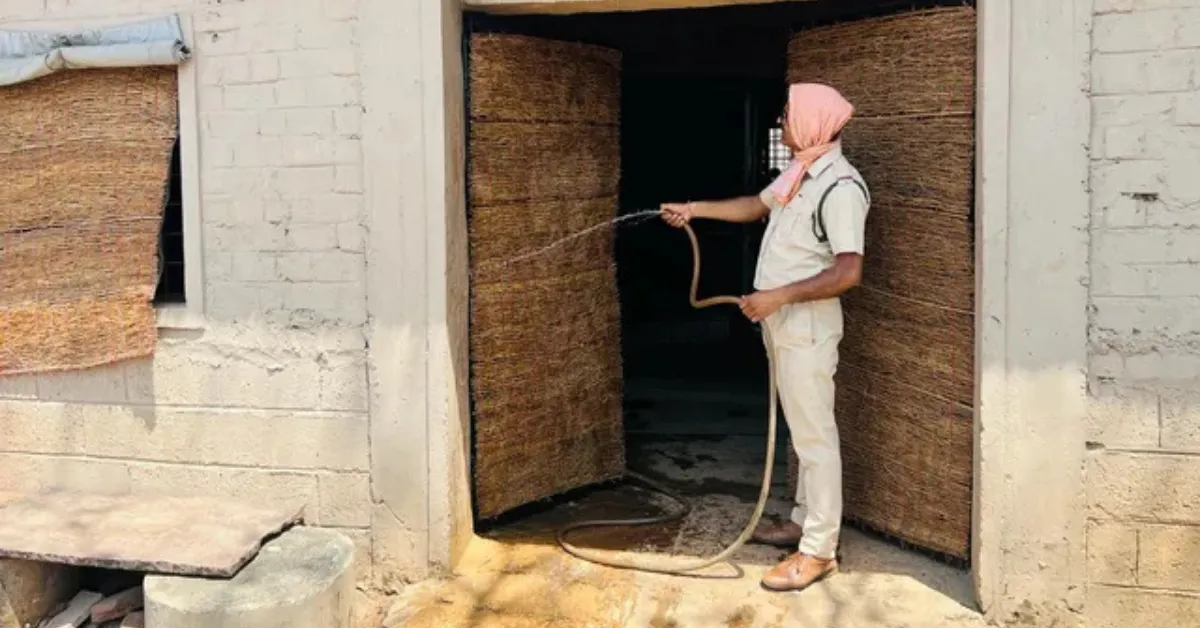
The afternoon sun doesn’t just shine in an Indian summer — it blazes overhead. Terrace floors burn, curtains trap heat, and ceiling fans whirl helplessly, pushing around warm air. In cities, air conditioners hum through the day, sending electricity bills soaring as temperatures climb past 40°C.
Cooling today feels like a battle — one fought with machines, sealed windows, and rising energy costs.
But step into an older Indian home, and the story begins to shift — from artificial cooling to something far more sustainable and intuitive.
The air feels cooler, softer. A faint earthy fragrance lingers as a breeze passes through damp khus mats hanging by the windows. In the courtyard, thick mud walls quietly keep the harsh heat at bay.
There’s no loud machinery here — just thoughtful design, natural materials, and a deep understanding of how to work with nature, not against it.
Photograph: (Local Samosa)
Today, as India braces for harsher summers each year, these time-tested solutions are finding renewed relevance. But what exactly makes khus mats and mud homes so effective? The answer lies in simple yet powerful science.
The cooling magic of khus mats
Walk into a home fitted with khus (vetiver) mats in peak summer, and the first thing you notice isn’t just the drop in temperature — it’s the scent. Khus roots, woven into thick curtains or screens, are naturally porous and fibrous. When water is sprinkled or dripped over them, they transform into a natural cooling system.
The science behind this lies in evaporative cooling. As hot air passes through the damp khus mats, the water within them absorbs heat and evaporates, cooling the air entering the room, much like how sweating cools the human body.
What makes khus particularly effective lies in its roots. Vetiver, a perennial bunchgrass native to India, has a dense, fibrous root system that grows vertically — sometimes reaching depths of up to 10 feet.
These roots are harvested, cleaned, and dried before being woven into durable mats and curtains. Their tightly packed structure not only retains moisture for longer periods but also allows air to pass through efficiently, making the cooling process more effective.
/filters:format(webp)/english-betterindia/media/media_files/2026/04/22/khus-mats-2026-04-22-18-04-36.png)
Historically, khus mats weren’t just a rural solution; they were used across royal palaces and everyday homes alike, valued for their ability to withstand intense tropical heat without deteriorating. Over time, they became a quiet staple of Indian summers.
But Khus does more than just cool. Its dense root network also acts as a natural air filter, trapping dust and impurities. The result is air that is not only cooler but cleaner, carrying a subtle earthy fragrance, something no mechanical cooling system can quite replicate.
Mud homes: Nature’s thermal insulators
If khus mats work at the surface, mud homes go deeper. Traditional mud houses, found across rural India and in regions worldwide, are built using a mix of soil, clay, and organic materials like straw.
At first glance, they may seem simple, but their design is rooted in a sophisticated understanding of thermal physics.
/filters:format(webp)/english-betterindia/media/media_files/2026/04/22/mud-homes-2026-04-22-18-05-54.png)
Mud walls are thick and dense, which gives them a property known as high thermal mass. This means they can absorb heat slowly during the day and release it gradually at night. Instead of allowing outdoor heat to rush indoors, these walls delay and dampen the heat transfer.
In practical terms, this creates a natural temperature balance:
-
During the day, interiors remain significantly cooler despite intense sunlight.
-
At night, as temperatures drop outside, the stored heat is released, keeping the indoors comfortable.
Additionally, mud is a poor conductor of heat. Unlike concrete, which heats up quickly and radiates warmth into interiors, mud resists rapid temperature changes. This helps maintain a steady, pleasant indoor climate without artificial cooling.
There’s also a humidity advantage. Mud walls can absorb excess moisture from the air and release it when the air becomes dry, acting as natural regulators of indoor humidity, a crucial factor in comfort during Indian summers.
Why these traditions still matter
In an era dominated by air conditioners and rising electricity bills, khus mats and mud homes offer more than nostalgia; they offer solutions.
/filters:format(webp)/english-betterindia/media/media_files/2026/04/22/mud-homes-2026-04-22-18-07-55.png)
Both systems rely on passive cooling, meaning they work with natural processes rather than against them. They consume little to no energy, reduce carbon footprints, and are accessible to a wider population.
As cities grow hotter due to concrete-heavy construction and shrinking green cover, these traditional methods remind us that cooling doesn’t always need to come at an environmental cost.
Architects and designers today are revisiting these ideas, blending them with modern materials to create climate-responsive homes. Even small adaptations, like installing khus screens, improving ventilation, or using natural building materials, can make a noticeable difference.
As another intense summer sets in, perhaps the way forward isn’t entirely new. Sometimes, it lies in rediscovering what has quietly worked all along — keeping homes cool and the planet just a little bit healthier.
Sources:
‘The ancient material that cools homes’: by Isabelle Gerretsen for BBC, Published on 6 July 2022.
‘Natural AC at home: How khus curtains can keep your house cool during extreme heat’: by The Times Of India, Published on 14 April 2026.
‘The Aromatic Roots Indians Turn to for Cooling Relief’: by Sushmika Pathak for Reasons to be cheerful, Published on 14 July 2025.
Disclaimer : This story is auto aggregated by a computer programme and has not been created or edited by DOWNTHENEWS. Publisher: thebetterindia.com