
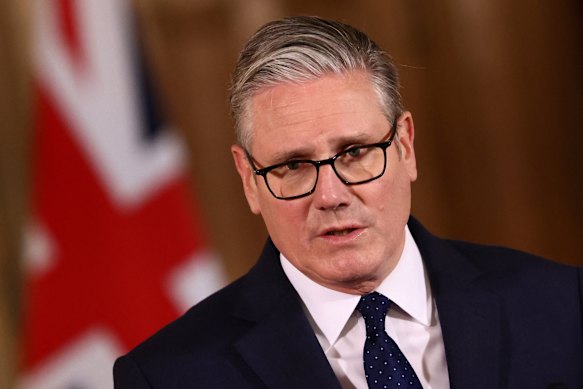

London: A desperate leadership contest is raising the stakes in elections across Britain that could throw the government into turmoil and confirm a seismic shift among voters who have given up on the nation’s two major parties.
The latest forecasts suggest the elections on Thursday will punish Prime Minister Keir Starmer and his Labour government by slashing support for the party in local councils, as well as in the parliaments of Scotland and Wales.
The trends put populist conservative Nigel Farage on track to make big gains with his Reform UK party, but the elections will also reveal whether the Greens can eclipse the right by scooping up voters who desert Labour.
Fearing the worst, some Labour insiders are agitating for a leadership spill to topple Starmer as soon as possible, although the three main putative challengers have yet to declare their intention to seek the job.
Voters have rejected Starmer and Farage in recent surveys on their favourability, in findings that highlight the disaffection with politics and the fragmentation of the electorate.
While 69 per cent of voters had an unfavourable view of Starmer in the latest survey by polling firm YouGov, 65 per cent had the same dim view of Farage.
Conservative Party leader, Kemi Badenoch, is in a stronger position on some measures this year and is viewed unfavourably by only 50 per cent of voters.
And Greens leader Zack Polanski, who was roundly criticised last week for appearing to criticise police who arrested a man alleged to have stabbed two Jewish men on a London street, is viewed unfavourably by just 34 per cent of voters.
The council elections are central to the fortunes of UK political parties because they give thousands of party candidates a stepping stone to higher office, while measuring support for the parties in each local area.
The economy, immigration and taxation are among voters’ top concerns, with just 16-17 per cent of Britons believing Labour is doing a good job in these areas, according to YouGov. Starmer has also been embroiled in a scandal over his 2024 appointment of disgraced former minister Peter Mandelson as ambassador to the United States.
Labour insiders confirmed their anxiety about the upcoming results by briefing the media over the weekend about their ambitions to replace Starmer once the dust clears at the end of this week.
Under Labour rules, challengers require 20 per cent of the votes from sitting MPs to force a spill, which means a candidate would need the backing of 81 of the 403 party members in the House of Commons.
Supporters of Health Minister Wes Streeting claimed on the weekend that he already had this bloc behind him, although they said this in anonymous briefings to the British media that could not be verified.
Another potential candidate, Greater Manchester Mayor Andy Burnham, is not in parliament but is said to have support to replace a sitting Labour MP and pursue the leadership in Westminster. Supporters of Starmer on a peak Labour committee blocked Burnham from returning to the House of Commons earlier this year, but they appear to be reconsidering their stance.
A third candidate, former deputy prime minister Angela Rayner, was described in weekend media reports as undecided about whether she would run for the top post.
The eruption of new leadership speculation highlighted the Labour disunity in the final stage of the May 7 election campaigns, worrying MPs.
“I don’t think many Labour colleagues will appreciate coming back from a day canvassing for Thursday’s elections to see energy being wasted on leadership speculation,” said Luke Akehurst, the Labour member for North Durham, in a social media post.
Akehurst’s constituency is in the north-east of England, where Reform UK is projected to pick up council seats at Labour’s expense.
About 5000 council seats are up for election. In one sign of the powerful backlash against Labour, an analysis of multiple polls found the party would lose more than half of all its councillors across all local governments.
The analysis, by independent site PollCheck, estimated Labour would shrink from 2307 to 1110 councillors. The Conservative Party was expected to fall from 1230 to 707 positions.
The Greens would make big gains, swelling from 183 to 689 seats on the same projections.
If the polls are proven correct, however, the biggest winner would be Farage and Reform UK, which would vault from 69 to 1421 seats and take control of dozens of local councils – buttressing its claim to be a party of government at the next general election.
Farage is expected to make significant gains in the English Midlands around cities such as Birmingham and Coventry, where the cost of living and the tough jobs market have fomented discontent with Labour.
The influx of migrants into regional cities has turned Farage into a popular figure among voters who like his pledges to turn away asylum seekers and increase the barriers to people coming into the country. At the same time, voters who reject his hard line on migration appear to have lifted the Greens in areas that leaned towards Labour in the past.
Labour’s vote share is projected to fall by 30 percentage points in Birmingham from the last local elections in 2022, according to YouGov.
The same surveys suggested the Greens had 19 per cent of the vote in Birmingham, 24 per cent in Coventry and 19 per cent in Wolverhampton.
Reform UK is set to edge ahead of all other parties in more than a dozen local councils across the West Midlands, with 45 per cent of the vote in Cannock Chase, a council area north of Birmingham.
The elections on Thursday will not change the composition of the national parliament, which is not due to go to a general election until 2029. Wales will elect its parliament, the Senedd Cymru, and Scotland will decide its parliament, which is based in the Holyrood area of Edinburgh.
Wales appears set to deliver a humiliating defeat to Labour that might drive the party out of power there for the first time since the national assembly, later called the Senedd, was established in 1999.
Farage has a chance of securing power for Reform UK in Wales, even though his party had only two seats in the Senedd before this election.
His chief rival for power is Welsh nationalist party Plaid Cymru, which describes itself as centre-left and is evenly matched with Reform UK in the latest polling.
A survey by YouGov released on April 22 found Reform UK and Plaid Cymru were on track to win 37 and 36 seats respectively. Because each party needs 49 seats to form government, the polling results have heightened expectations that Plaid Cymru would negotiate with Labour and the Greens to control the assembly.
Scottish voters appear likely to keep the Scottish National Party in power, confirming John Swinney as first minister, although support for the centre-left party has dipped over the past two years.
The most recent Ipsos survey showed the SNP had 39 per cent of the vote at the end of March, compared to 15 per cent for Labour and the same for Reform UK. The Greens had 7 per cent.
Get a note directly from our foreign correspondents on what’s making headlines around the world. Sign up for our weekly What in the World newsletter.
 David Crowe is Europe correspondent for The Sydney Morning Herald and The Age.Connect via X or email.
From our partners
Disclaimer : This story is auto aggregated by a computer programme and has not been created or edited by DOWNTHENEWS. Publisher: www.smh.com.au


