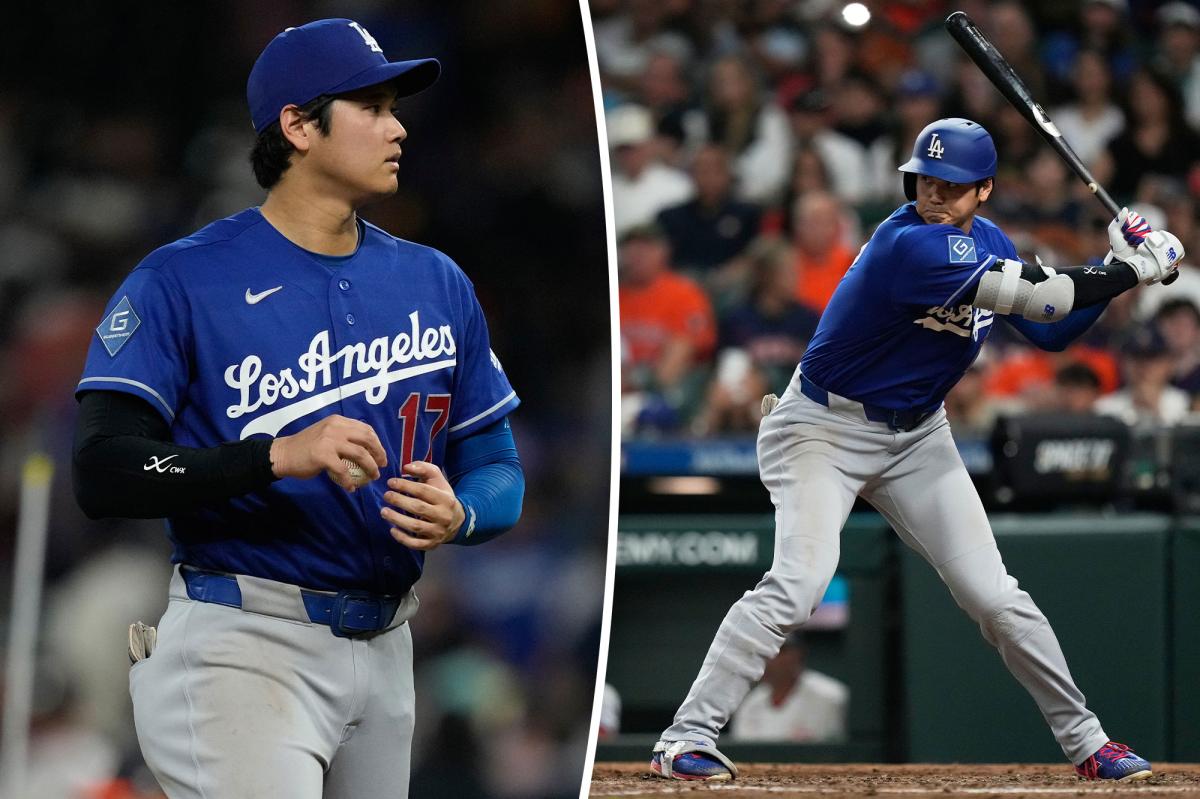
HOUSTON — Three hours before first pitch Monday, Shohei Ohtani had already put in a full day’s work.
Mired in a 0-for-14 slump entering this week’s series against the Astros, Ohtani got out on the field early at Daikin Park, taking not only rare on-field batting practice but an elongated session that included 55 swings.
A little while later, he reemerged from the clubhouse wearing both his full uniform and pitcher’s mitt, heading down to the bullpen for some touch-and-feel throws the day before he was scheduled for his next start on the mound.
By the time it was all done, he returned to his locker, plopped down in his chair, and allowed himself one brief moment to seemingly catch his breath.
Only then did he begin the rest of his preparation for that night’s game.
In case anyone forgot, the challenge of a full-time two-way role — even for Ohtani and his near-superhuman capabilities — is not for the faint of body, mind or heart.
The four-time MVP has done this all before, of course, largely excelling in both his pitching and hitting duties over three seasons with the Angels from 2021–2023, as well as in his return from a second career Tommy John surgery at the end of last year with the Dodgers.
But as the first month of this season showed, the re-acclimation process hasn’t been as seamless as anticipated.
Which, by the end of Monday night, had led to another twist in his usage.
Before Monday’s game, Dodgers manager Dave Roberts said he was planning to have Ohtani serve as DH when the 31-year-old took the mound on Tuesday — a one-time formality that has now become a start-to-start question.
After the team’s 8–3 win over the Astros, however, Roberts announced he had reversed course and was going to have Ohtani just focus on pitching — marking the third time in his last four outings the two-way star has been limited to just a single job on the mound.
In the intervening hours, Ohtani’s offensive slump had only worsened, suffering a fifth-straight game without a hit (making him 0-for-17 in that span) despite walking twice and driving in a run.
Roberts insisted the decision was “definitely not [based on] results,” and instead driven by his reading of Ohtani’s “body language and just watching the player.”
Still, he added: “Just kind of seeing how it’s playing out, I think it’s best for everyone.”
The good news for the Dodgers: Ohtani has been superb on the mound, earning National League Pitcher of the Month recognition on Monday after going 2–1 with a 0.60 ERA in his first five pitching starts of the year.
That, Roberts noted, has far and away surpassed the team’s expectations.
The problem is that, to this point, it seems to be coming at least partially at the cost of his hitting, where he now has a .240 batting average, .814 OPS and just six total home runs (including one in his last 20 games).
“I guess what he’s done the past couple years,” Roberts said, “you sort of get use to.”
Last week, Roberts and others around the team first began highlighting the inevitable correlation.
Ohtani himself even conceded to the increased difficulty of managing a two-way role, acknowledging that this year’s task has been a “balancing act” with his workload and time management.
“It is easier to maintain something good [offensively] when things are going well,” he said through interpreter Will Ireton. “But when things are not going well, it’s not easy in the sense that I have to make sure that I’m healthy and not overdoing it in terms of repetition.”
According to hitting coach Aaron Bates, Ohtani has still taken a similar number of daily swings in the cage as he had the past couple seasons, when he combined for 109 home runs and a .296 average while focusing almost exclusively on hitting.
But, his “attention span is probably split” in a way it wasn’t before, Bates added, amplifying the challenge of snapping out of what is now his longest slump as a Dodger (he’s batting just .203 in his last 20 games overall).
That’s what made Monday’s intensive batting practice session so notable, as the slugger sought a “different backdrop” to try and get his recently pull-happy swing back to “the big part of the park,” Bates said.
Unsurprisingly, Ohtani put on a show. He hit numerous second-deck blasts to right field. He hit one so far the other way it landed on the stadium train tracks in left.
Come the game, however, the results still didn’t translate –– bursting Roberts’ optimistic pregame hope that “most of the times when he does this, it works.”
This doesn’t mean the Dodgers are considering larger changes to Ohtani’s usage plan this year.
While the search for two-way equilibrium is tricky, it nonetheless remains “doable,” Roberts insisted.
“He’s going to DH a lot. He’s going to pitch a lot,” the manager said. “Now, how best we preserve him and keep him strong and healthy is the question.”
On Monday, the answer meant a heavy pregame workload for Ohtani, followed by an unexpected change in his near-term usage.
For now, such trade-offs might be necessary while he looks to rediscover his swing while also maintaining his pitching dominance.
“Is he going to go 50-50? No,” Roberts said. “But he is still going to be a very, very productive offensive player.”
Download The California Post App, follow us on social, and subscribe to our newsletters
California Post News: Facebook, Instagram, TikTok, X, YouTube, WhatsApp, LinkedIn
California Post Sports Facebook, Instagram, TikTok, YouTube, X
California Post Opinion
California Post Newsletters: Sign up here!
California Post App: Download here!
Home delivery: Sign up here!
Page Six Hollywood: Sign up here!
Disclaimer : This story is auto aggregated by a computer programme and has not been created or edited by DOWNTHENEWS. Publisher: nypost.com