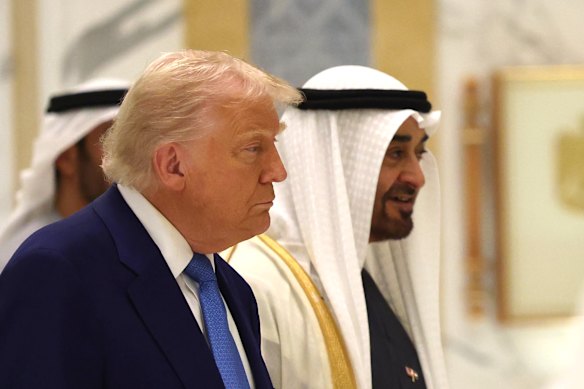
The United Arab Emirates’ decision to leave the Organisation of Petroleum Exporting Countries on May 1 exposes long-running dissatisfaction inside the group about its direction under the leadership of Saudi Arabia. It also advances Donald Trump’s goal of weakening the powerful oil bloc.
The departure reflects the UAE’s own interests as well as its alignment with the United States. Along with Saudi Arabia’s potential funding cut to LIV Golf, it shows that the emerging regional order will be more transactional and less concerned with soft power.
The UAE was the third-largest producer inside OPEC, which it joined in 1967. OPEC expanded in 2016 when oil prices tumbled, thanks to significant increases in US shale oil production. The group formed OPEC+ with 10 other oil-producing countries including Russia, the world’s third-largest oil producer. OPEC+ sets quotas, or production targets, for each of its members. Quotas are calculated based on members’ production capacity, oil reserves, past production levels and intense behind-the-scenes negotiations.
In recent years, the UAE had invested heavily in infrastructure to increase its fossil fuel production as well as its midstream and downstream capacity. It wanted higher quotas to recoup its investments. At one point, up to a third of its pumping capability was unused, resulting in disputes that culminated in a public clash with Saudi Arabia in July 2021. It’s not the first country to be upset with Saudi Arabia’s leadership of OPEC; Indonesia left in 2016, Qatar in 2019, Ecuador in 2020 and Angola in 2023.
The UAE timed its announcement well. The supply crunch caused by the Persian Gulf crisis means its withdrawal won’t increase oil price volatility, because the closure of the Strait of Hormuz means it can’t export more oil yet, and the market was undersupplied anyway. The closure had forced regional producers including Saudi Arabia and Iraq to slash production.
The UAE also approached US Treasury Secretary Scott Bessent to discuss currency swap lines, which would give it inexpensive access to US dollars. Currency swaps would allow the UAE central bank to support its currency or shore up its foreign reserves if foreign investors withdrew their money following Iranian attacks on its financial centre, Dubai. The US Federal Reserve used swap lines during the 2008 financial crisis and the COVID-19 pandemic to protect the currency of its favoured central banks.
The UAE’s request was tentative and precautionary, not formal, but the US may be favourably disposed to help. It can let the UAE temporarily exchange its holdings of Treasury securities for US dollars through a repurchase agreement program administered by the Federal Reserve Bank of New York, the most influential of the 12 regional Federal Reserve banks.
The US recognises that the UAE’s defection weakens OPEC, which is Donald Trump’s goal as well. It has no intention of putting the UAE in a position where it runs short of dollars and has to use Chinese yuan for oil sales and other transactions. Trump wants the dollar to remain the supreme global currency with a near-exclusive use in oil transactions. It helps, too, that an investment entity linked to the UAE’s National Security Adviser, Sheikh Tahnoun bin Zayed al-Nahyan, bought a 49 per cent stake in Donald Trump’s crypto venture, World Liberty Financial, for $US500 million just before the January 2026 inauguration.
The UAE has a strong commitment to countering political Islam, sharing this objective with India and Israel. It is a key partner in I2U2, the partnership with India, Israel, and the US that connects the Mediterranean Sea and the Middle East to the Indian Ocean and the Indo-Pacific region, thereby linking up with Australia’s own foreign policy stance. The UAE is pro-Israel, pro-US and hosts large US forces at al-Dhafra Air Base. It remains a key partner in the Abraham Accords, a signature Trump initiative in 2020-2021 that formalised relations between Israel and three other Arab countries, Bahrain, Morocco and Sudan. When it came under Iranian missile attack, Israel sent it an Iron Dome missile defence battery with interceptors and several dozen operators. The UAE became the first country other than Israel and the US to use the system.
Although the UAE acted principally in its own interests, the effect strengthens Donald Trump’s campaign to weaken the energy cartel. Venezuela, now under the government of Delcy Rodriguez, could defect as well, if the opposition party comes to power at the next election. Trump’s upending of established arrangements in Latin America and the Middle East is behind both developments.
For its part, Saudi Arabia continues to insist on OPEC+ quotas to support an oil price that helps its national budget and development goals. Although it is the largest economy in the region, its larger population and less diversified economy means that its per capita GDP is much lower than the UAE’s (US$35,000 versus US$50,000). It has signalled a wider pullback on investments that seek to increase its cultural influence, such as investing in sporting events, in favour of investments that provide monetary returns.
Saudi Arabia’s Public Investment Fund bought a majority stake in English football club Newcastle United in 2021. It has also invested in boxing, wrestling, motorsports, tennis and eSports events, with an estimated involvement in 346 direct or indirect sports sponsorships and investments. It will host the soccer World Cup in 2034. Now, however, it is reassessing its support for the lucrative LIV golf competition, whose 54 holes rather than the traditional 72 were reflected in its Roman numeral-derived name. Saudi Arabia has decided to treat its sports holdings as investments that need to make a return. Soft power is less relevant in a me-first transactional world. So is anything resembling solidarity with other Gulf states.
Trump looks at the UAE with appreciation – and perhaps some wistfulness. The UAE is ruled by autocratic billionaires, not unlike his business partners. They just happen to wear long white robes rather than suits. And they don’t have to fight the midterm elections in November.
Professor Clinton Fernandes is in the Future Operations Research Group at UNSW. His latest book is Turbulence: Australian Foreign Policy in the Trump Era.
The Opinion newsletter is a weekly wrap of views that will challenge, champion and inform your own. Sign up here.
 Professor Clinton Fernandes is part of University of NSW’s Future Operations Research Group which analyses the threats, risks and opportunities that military forces will face in the future. He is a former intelligence officer in the Australian Army.
From our partners
Disclaimer : This story is auto aggregated by a computer programme and has not been created or edited by DOWNTHENEWS. Publisher: www.smh.com.au