
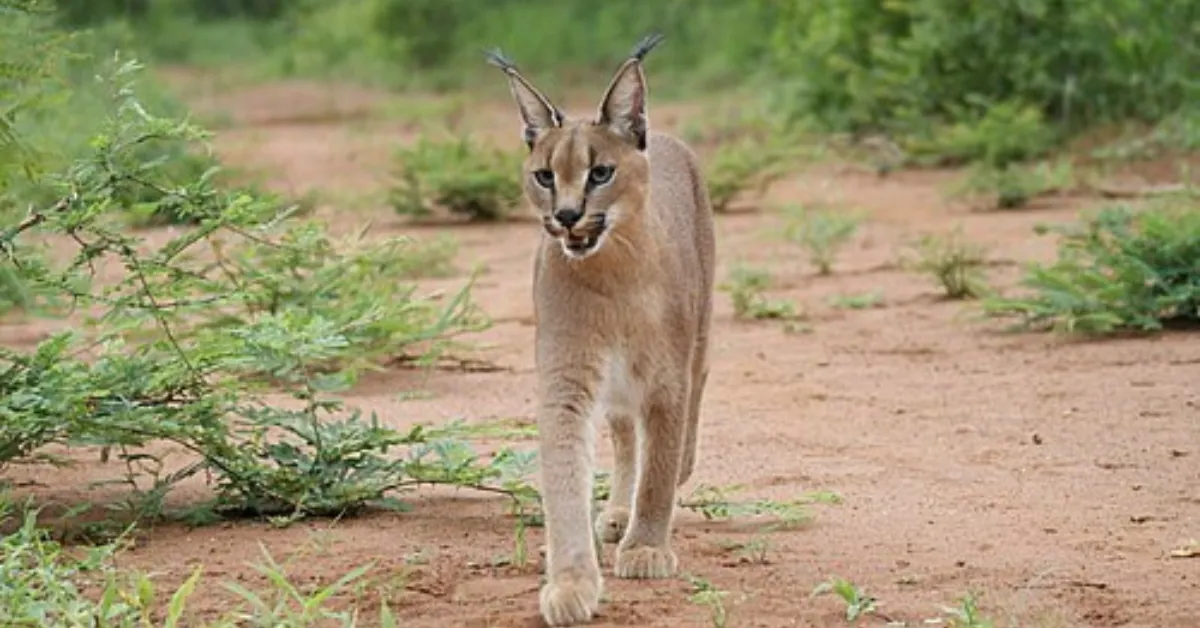
Across western India, the caracal, once widespread across its dry landscapes, is now close to local extinction.
But the good news is that recent findings in Rajasthan have confirmed the presence of a breeding population.
In the Thar, where survival is already calibrated to scarcity, the stress was visible in the thinning margins for species that have long lived at the edge.
Among them was the caracal.
Known locally as Siyahgosh, or ‘black ear’, the elusive wild cat has moved so quietly through India’s ecological memory that, until recently, its near-disappearance went largely unnoticed.
Now, with climate pressures mounting, India has made a decisive move: a first-ever national masterplan to bring the species back from the brink.
At the centre of that plan is Rajasthan.
A fragile presence, finally confirmed
Fresh field evidence has confirmed what conservationists had only hoped for: the caracal persists in the dunes of Shahgarh Bulge and Ramgarh in Jaisalmer.
More importantly, it is not just surviving, but breeding.
Radio-collaring studies conducted along the India–Pakistan border have, for the first time, documented family groups.
For a species long thought to be functionally extinct in India, this changes the conversation.
Forest officials have verified at least three individuals in the region. It is a small number, but enough to shift policy from speculation to strategy.
The breakthrough has fast-tracked a structured conservation response.
Mapping survival: Two landscapes, one strategy
The national masterplan identifies two large landscapes in Rajasthan as critical to the caracal’s future.
The first is the Thar desert landscape, envisioned as a continuous corridor connecting Jaisalmer’s dunes with the Rann of Kutch. The goal is to restore ecological connectivity across arid terrain, allowing movement, dispersal, and genetic exchange.
The second is the Greater Ranthambore landscape, stretching across Ranthambore National Park, Dholpur, Karauli, and the Mukundra forests.
Unlike tiger-dominated reserves, these areas have relatively low densities of large predators such as tigers and leopards, reducing competition and predation risks for smaller carnivores.
Together, these zones offer the advantage of space.
For a species known to travel long distances, sometimes covering hundreds of square kilometres in desert ecosystems, fragmented habitats can be as dangerous as direct threats. The plan attempts to reverse that fragmentation.
Science steps in
The Salim Ali Centre for Ornithology and Natural History (SACON) will lead habitat mapping across India, extending the search beyond known pockets.
Researchers aim to answer a set of basic but urgent questions: Where do caracals still exist? Are they confined to forests, or are they adapting to scrublands and agricultural edges? What do they eat, and how do they move?
/filters:format(webp)/english-betterindia/media/media_files/2026/05/06/shutterstock_271081103_11zon-2026-05-06-04-11-27.jpg)
The study will focus on population estimation, habitat suitability, behavioural patterns, and human–wildlife interactions.
According to Wildlife Institute of India Director Gobind Sagar Bhardwaj, this marks the country’s first comprehensive, science-driven framework for the species. The emphasis is not only on data, but also on replacing anecdotal sightings with measurable patterns that can guide intervention.
A species that slipped through the cracks
The caracal (scientific namre: Caracal caracal) is a medium-sized, nocturnal predator, often called the “desert lynx” for its distinctive black-tufted ears.
But unlike true lynxes, it is more closely related to the African golden cat and the serval.
The species has lost over 90% of its historical range in the past century. Habitat loss, hunting, and the steady fragmentation of open landscapes have reduced it to isolated pockets in western India.
For years, its decline went underreported, partly because of its elusive nature, and partly because these habitats themselves were not systematically surveyed.
Recent on-camera sighting evidence has begun to change that. Sightings in areas such as the Mukundara Hills Tiger Reserve and Ramgarh Vishdhari suggest that the species may be moving beyond its previously recognised strongholds in Kutch and parts of Rajasthan.
But movement alone is not recovery.
The risks of being rare
For small, nocturnal carnivores, survival is often a matter of avoiding threats such as snares, road networks, feral dogs, and larger predators.
Caracals favour open forests and scrub habitats, landscapes that are increasingly intersected by roads and railways.
Dispersal, a natural behaviour for young males seeking territory or mates, becomes a gamble in such conditions. Without a viable population base, the chances of finding a mate remain low.
So, the current plan is not just about protecting a species; it is about restoring a landscape that has degraded over decades.
Continuous monitoring, including radio-collaring and camera trapping, is already offering insights into prey patterns, movement, and habitat use. These findings will shape future interventions, from corridor design to conflict mitigation.
For now, the presence of even a handful of caracals has created cautious optimism.
Sources
‘Caracal conservation gets national push:India rolls out first masterplan to save ‘Siyahgosh’; Rajasthan emerges as core stronghold’: By Bhaskar English, Published on 27 April 2026
‘Caracals comeback sparks hope in conservation’: By Arathi Menon, Published on 17 September 2025
‘Rare caracal spotted near India-Pakistan border in Thar desert’: By Nikhil Pandey, Published on 24 March 2026
Disclaimer : This story is auto aggregated by a computer programme and has not been created or edited by DOWNTHENEWS. Publisher: thebetterindia.com



