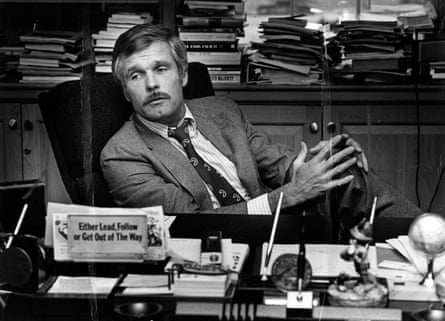
February, 1982. The startup cable news channel, CNN, is not yet two years old. It’s bleeding $2m a month. To help make payroll, owner Ted Turner, known as the “mouth of the south” for his brazen behavior, is cashing in krugerrands he’s got stashed in his private safe (concession sales from the Atlanta Braves help, too.)
ABC, one of the trio of broadcast networks he’d intended to run out of business, has just announced it plans to create a rival all-news service that, out of the gate, is sure to have more viewers (and certainly more resources). It’s so bad, Ted’s even considering an alliance with another network, that “cheap whorehouse”, CBS.
Then, Fidel Castro, avowed enemy of the United States, issues Ted a private invitation. He’s been pirating CNN’s signal down in Havana and, it turns out, he’s an OG fan.
“I just wanted to let you know that I think CNN is the most objective source of news,” read the missive, hand-delivered to Ted in his office in Atlanta by CNN’s lone field reporter at the time, Mike Boettcher, “and if you want to come down to Cuba …”
Ted’s businessman father raised him to revile communism. “The commies,” as Ed Turner called them, would invade the US and shoot anyone who had more than $50 on them. As a consequence, Ted never carries more than $49 in cash. A registered Republican, he’s fiercely patriotic.
But he’s no dummy. A world leader has invited him, a burgeoning mogul, to visit.
“Set it up,” he commands Boettcher.
Duck-hunting and cigar-smoking with Fidel was Ted’s first indication that this all-news channel he’d mortgaged himself to launch just might unify the world and bring peace to the planet. Before CNN’s debut, even he was skeptical about the idea.
“I hate the news,” he’d say. “The news is boring.” His skeptical ad salesmen worried: “Will we have to blow buildings up to fill the time?”
It wasn’t a passion for journalism that propelled Ted Turner to invest in the world’s first all-news cable channel. His co-creator, Reese Schonfeld, brought that to the table. Neither did CNN’s origins have to do with score-settling politics, like that which birthed Fox News Channel 16 years later.
No, at the start of his greatest invention, Ted Turner was simply looking to capitalize on the dazzling, newfangled cable-satellite technology that had catapulted his sleepy little independent station in Atlanta on to the national stage.
The fearless zeal with which he plunged into the venture was the same gumption that led him to become a wave-defying, award-winning yachtsman.
It’s hard for even those of us who were alive back at CNN’s dawn to remember that time, when the universe wasn’t wired for 24/7 everything – a time when “breaking news” was actually that. We can thank Ted Turner for turning on the TV spigot. When he first bought Channel 17 in 1970, he was appalled, insomniac that he was, that the station went dark after the late-night movie. All stations did. As prosaic as that seems today, keeping the lights on was the first act of his genius.
Buying a faltering baseball team and beaming it around the country was the next. In doing that, he created “America’s Team”.
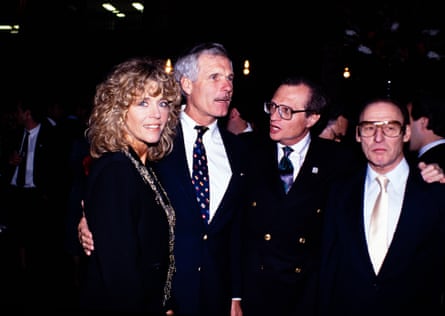
But no one knew on 1 June 1980, when CNN began beaming into a little over a million homes, that the channel derided at first as “Chicken Noodle News” would someday make or break presidents. Sway public opinion about wars and revolutions. Rivet the world to its seats when the space shuttle exploded, and a little girl got trapped in a well. Rile entire generations of helpless couch potatoes into hand-wringing helplessness and anxiety.
Over time, we learned not just to turn on the news at any hour of the day but to expect it delivered to us, on the toilet or on the airplane, instantaneously. And with each drip, we became further entertained – and paralyzed.
That unifying sense of a plugged-in, always-on world – one ruled by peace, goodwill and unity – revved up Ted’s poetic, romantic self. (A classics major at Brown University, he got thrown out for various antics like torching a rival’s homecoming display and harboring a girlfriend in his dorm room.) What he didn’t bargain for was how the unity that CNN initially brought could, when amplified by competition and revved up the internet, spin out of control.
How the news itself would go from the straight, somber reporting of facts to become a weapon.
It’s inevitable when a mogul dies for people to search for comparisons to contemporaries. As is always the case, alas, that’s so apples to oranges. Nothing about the moment in time that gave us the singular, brash, blustering sensation of Ted Turner, or the media empire he was able to create from the billboard company he inherited, is parallel to anyone or any entity today.
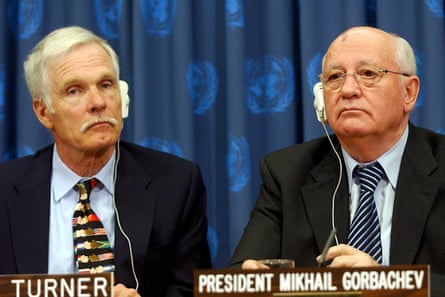
Imagine a modern titan posing in Fidel Castro’s office with a clunky video camera rolling, the analog equivalent of a selfie. Castro says directly into the lens, “We receive a very important service by the CNN.” Then, he as much as apologizes for “smuggling” the signal, adding, “One cannot smuggle the news. Space is universal and news is universal, too.”
Ted Turner believed those words so much he pushed executives back at CNN to run the tape of this endorsement from a “commie dictator”. The executives steadfastly refused. Exploiting this bizarre, stealthy meeting to advertise, a news network was gauche, and most certainly bad business. Chagrined, Ted went back to work, infused by the holy spirit of a meeting with an enemy become friend.
Just imagine what CNN, or any other network, would do with such footage today.
Lisa Napoli is the author of Up All Night: Ted Turner, CNN & the Birth of 24 Hour News
Disclaimer : This story is auto aggregated by a computer programme and has not been created or edited by DOWNTHENEWS. Publisher: theguardian.com