Yaoji Chaogan, a no-frills canteen next to Beijing’s historic Drum and Bell towers, once proudly displayed photographs of Joe Biden, who visited the restaurant when he was US vice-president in 2011. Biden’s visit went viral in China, with media praising his “noodle diplomacy” (one of the dishes that Biden ordered was zhajiang mian, a traditional style of Beijing noodles with bean paste).
But evidence of Biden’s visit was removed when the restaurant was redecorated a few years ago. A visit from a US leader is no longer something to boast about.
“If US politicians were really smart, they wouldn’t try to hold China back,” said Liu Cheng, 47, at the restaurant on Wednesday as he tucked into a lunch of steamed baozi and tofu skin salad.
Donald Trump arrives in Beijing on Wednesday to a China that has grown in confidence in the nine years since his last state visit, in 2017. Although the economy is struggling and wage growth has slowed – to less than 2% in real terms in Beijing last year – a bullish nationalism is on the rise. It is fanned by state propaganda and by the US’s apparent decline into chaos and dysfunction, including the fact that the country managed to elect a leader as unconventional and unpredictable as Trump.
Trump’s recent foreign policy gambles, from kidnapping the president of Venezuela to launching a war with Iran, have only served to reinforce the view among ordinary Chinese people that the US is a troublemaker.
The US president has lost his novelty value in China. Where he was once seen as an entertainer, he is now seen as a leader who could pose a real threat to Chinese interests, despite him having described Xi Jinping, China’s leader, as a “tremendous guy”.
Liu said whoever was US president, “it’s more or less the same for ordinary people like us. Before they take office, US presidents may say very extreme things, but once they are in office they have no choice but to face the reality of China’s existence.”
He said the US was struggling to accept the fact of China’s rise. The US “sees China has a threat … I think it will probably take about 10 years for the US to accept it”.
Liu Chunlei, a 36-year-old taxi driver, said the issue of Taiwanese independence was driving a wedge between the two superpowers. China claims Taiwan as part of its territory and is expected to push the US to soften its support for the self-governing island when Xi and Trump meet this week.
Still, Liu welcomed the fact Trump was willing to visit Beijing. “It will definitely help ease China-US relations a little … it shows that his attitude towards China is not hostile,” the driver said.
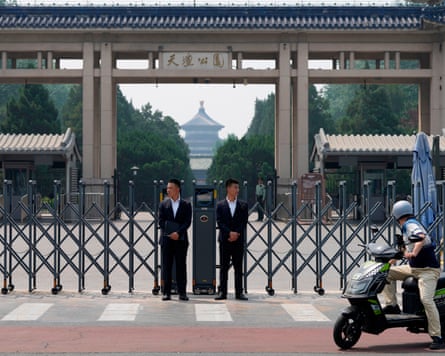
On the streets of Beijing there is heightened security to ensure everything runs as smoothly as possible. The Temple of Heaven, a religious complex dating from the Ming dynasty in the 15th century, has been closed to visitors since Tuesday before Trump’s planned tour on Thursday afternoon.
The temple is a significant monument in the history of Beijing and Washington. Henry Kissinger visited it on a secret visit to China in 1971, a trip that paved the way for the US and China to establish formal diplomatic relations.
One Chinese scholar in Beijing said this week Trump wanted to be seen, like Kissinger, as a trailblazer in US-China relations. But some ordinary Chinese were sceptical. On the social media platform Weibo, one user wrote: “There’s no point discussing anything with Trump. He’ll change his mind once he gets back. What he says in the morning can also change by the afternoon.”
Additional research by Yu-chen Li
Disclaimer : This story is auto aggregated by a computer programme and has not been created or edited by DOWNTHENEWS. Publisher: theguardian.com