Welcome to a new column I’m doing this season, where I take a bi-weekly look around Major League Baseball to fill you in on the league-wide trends, surging teams, and top individual performances. There will be some highlight clips, some criticisms, and some personal analysis of where I think the game is at and/or going. I hope that, if you’ve had a busy week or haven’t been able to watch as many games as you’d like, this article can be a great way to keep up with what’s happening in Major League Baseball.
So, let’s stop wasting time and dive right in.
Advertisement
⚾️ Baseball is back on NBC: MLB returns to NBC and Peacock in 2026! In addition to becoming the exclusive home of Sunday Night Baseball, NBC Sports will broadcast MLB Sunday Leadoff, “Opening Day” and Labor Day primetime games, the first round of the MLB Draft, the entire Wild Card round of the postseason, and much more.
The Kick-Changeup is the New “It” Pitch in Baseball
Two weeks ago, when I looked at how pitch mixes were expanding, I alluded to the increase in changeups that we’re seeing around the league. However, it’s not just changeups that are becoming popular; it’s the kick-changeup. While 2024 may have been the year of the sweeper, and 2025 was the year of multiple fastballs, 2026 is turning into the year of the kick-change.
As described in this video from Tread Athletics, a popular pitching lab, a kick change is a variation of a changeup that uses primarily a two-seam grip and some spike from a bent finger to create more depth than a normal changeup. The “kick” in kick-change refers to “kicking the axis of the ball down,” through pressure from the ring finger. The added depth generated on the kick-change means that you’re creating splitter-like movement on a pitch that has a changeup-like grip and spin. Because it has that down-and-in dive of a splitter, pitchers are more comfortable using it to same-sided hitters, which they weren’t with a traditional changeup, and you can see below just how big of an increase we’ve seen in right-handed pitchers throwing changeups to right-handed hitters. Much of that has to do with the increase in kick-changes.
Another reason the kick-change has become more popular is that it’s easy for supinators to use. As detailed in this video, supination is when a pitcher releases a pitch with their thumb pointing up at the sky, while pronation is when the thumb turns over to point more towards the ground. Most pitchers identify as either “pronators” or “supinators” based on what feels natural or physically possible with their wrist movement. If a pitcher is a pronator by nature, then it may be hard for them to throw a pitch like a sweeper, which requires supination. Meanwhile, supinators are generally more comfortable gripping the outside of the baseball and are better at throwing breaking balls.
Advertisement
As Davis Martin, an early-adopter of the kick-change, told FanGraphs in an interview back in 2024, “I’ve never been a pronator…Pronating is very unnatural for us from a physiological standpoint. I’m more of a supinator now than I was before surgery [in May 2023]. So, the kick change… basically, you kick the axis of the ball into that three o’clock axis…to get the depth that a guy who could pronate a changeup would get to. You’re not using a seam-shift method. You’re not truly pronating. It’s kind of this cheat to get to that three o’clock axis…If I had a normal [grip], it would be like a 12:45 rather than a three o’clock. The middle finger is the last thing to touch it, which spins it into that axis.”
In that same article, reliever Matt Bowman said that he classifies his version of the kick-change as a split-change and models it off what Kevin Gausman was throwing when he was with the Giants, which, when you look at pitch data, was actually classified just as a splitter. According to Bowman, that just comes down to how a pitcher sees his own pitch: “Splitters and kick changes exist on a very similar spectrum. You’ll see some things classified as splitters because someone calls it a splitter. Some will call it a split change, and some will call it a kick change. But how it’s coming off the hand is about the same.”
Why that classification is relevant is because Eno Sarris of The Athletic just released an article about the increase in splitter usage across baseball, and I have a strong suspicion that a lot of that increase is also due to the kick-change.
As the article states, “MLB pitchers are throwing almost three times as many splitters as they did when the league first started tracking pitch types. Eight pitchers are throwing a splitter that didn’t regularly throw last year, and 11 pitchers added the pitch last season.” There is some skepticism about a splitter because there has long been a perception that splitters lead to elbow injuries, but as Eno’s article mentions, “there isn’t much hard evidence for a link between throwing a splitter and suffering an arm injury at the major-league level.” Perhaps simply calling the pitch a changeup when introducing it to a pitcher reduces some of the stigma around the offering.
Advertisement
Whatever the case may be, the kick-change is becoming a bigger part of Major League Baseball, primarily for right-handed pitchers. At the end of the season, we should have a better idea of its larger impact, but it seems to be yet another way that pitchers are adding swing-and-miss to their arsenals and finding ways to attack same-side hitters down and inside instead of having to throw non-fastballs low and away so often.
Everybody Is a Closer
You’ve heard this before, but the era of teams having a locked-in closer is over. We’ve been trending that way for a long time, as the chart below shows, but that truth has never been as drastic as it was the first 29-games of this season.
If we expand that data out to include stats from the beginning of this season through May 12th, 118 different pitchers have gotten a save in the first 42(ish) games of the season. By this point last season, 100 different pitchers had earned a save. In 2024, it was 98 pitchers in the same number of games. If you wanted to have fun and go back a decade from there to 2014, 67 pitchers had recorded a save in the league’s first 42 games of the season.
Advertisement
This, understandably, coincides with another trend that starting pitchers are pitching deep into games far less often than they ever have.
Some of this is obviously dictated by health. This season, all of Edwin Diaz, Daniel Palencia, Josh Hader, Jhoan Duran, Ryan Helsley, Carlos Estevez, Raisel Iglesias, and Pete Fairbanks have spent time on the injured list, while other “locked-in closers” like Jeff Hoffman and Devin Williams have struggled considerably. Oftentimes, the closer is the hardest-throwing pitcher in baseball, and we know fastball velocity correlates well with arm injuries, so injuries may have increased as velocity has, which has led to more closers needing to be used during a season.
What seems more likely is that MLB managers know that the most important at-bats or the highest leverage situations don’t always occur in the ninth inning. Instead of holding their best reliever for the final outs of the games, managers are now deploying them for the most crucial outs of the game, even if that’s in a bases-loaded situation in the seventh inning with the other team’s best hitter up.
Advertisement
Another contributing factor is that, as arm health becomes a bigger talking point, MLB teams are limiting the number of relievers they ask to throw on back-to-back days. Eno Sarris started to talk about this back in 2022, but it has become a bigger issue now as pitchers are trying to maximize every pitch in a way they weren’t before. If you’re not going to ask all of your relievers to throw on back-to-back days, then there are going to be more instances where you’re in a save situation and your “closer” is not available.
So, while everybody is getting saves, that doesn’t necessarily mean saves aren’t as valuable as before. Getting the final outs of the game will always be valuable. They just may not be the hardest outs to get, and teams are finally OK admitting that.
Team Trends
The last time I wrote this article, the Reds led the NL Central with a 19-10 record. At the time, I mentioned that it didn’t seem sustainable, and, well, the Reds are now 22-20. Over those 13 games, the Reds are 21st in batting average, 22nd in OPS, 23rd in strikeout rate, 24th in wRC+, and 24th in runs scored. Shockingly, they have as many runs scored over that stretch as the Dodgers, whose offense is struggling to score runs but is still middle of the pack in OPS, slugging, and wRC+.
Advertisement
The Reds still lead baseball with five more wins than expected, according to Pythagorean records. That’s tied with the Rays, who are 28-13 with the second-best record in baseball. The Rays have the flattest swings in baseball and the highest percentage of batted balls to the opposite field. They don’t hit many home runs or doubles, but they’ll slap singles the other way and then steal bases. On the season, they are 2nd in stolen bases, trailing only the Marlins. They’re also tied with the Blue Jays for the best strikeout rate in baseball.
On the flip side, the White Sox, Orioles, Angels, and Rockies strikeout more than any other teams in baseball. The White Sox rank 4th in baseball in home runs, and the Angels are 8th, so they are making the most of their swings, but the Orioles strike out a lot and are 16th in home runs. However, they’re still 11th in runs scored because they walk a ton, but this is not an exciting offense. They’re 17th in wRC+, 21st in OPS, 25th in stolen bases, and 26th in batting average. They’re below .500 right now, and it actually feels like it should be worse. In fact, Pythagorean standings say the Orioles deserve to be 17-26, which would give them the worst record in the AL East since it also says the Red Sox deserve to be 19-22. That’s a small solace for Red Sox fans who are seeing the season slip away with Garrett Crochet and Roman Anthony hurt, and the offense failing to do anything.
Individual Player Spotlights
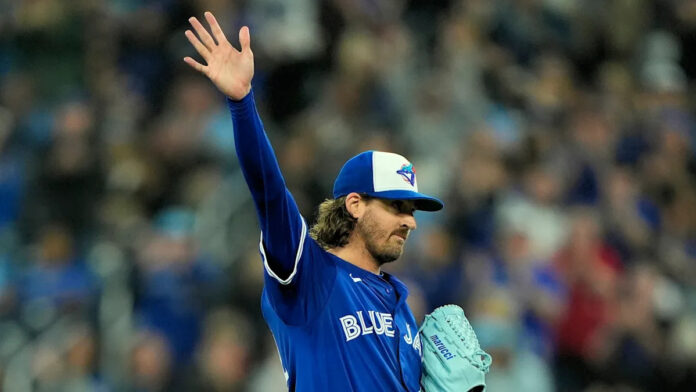
Starting Pitcher Spotlight: Jacob deGrom, Rangers, and Kevin Gausman, Blue Jays
You know these guys, so I’m not introducing you to a player who is performing at a higher level than normal, but deGrom and Gausman both achieved major career milestones that are worth shouting out. For deGrom, he threw seven scoreless innings on Sunday and became the second-fastest pitcher (in terms of innings) in baseball to reach 1,900 strikeouts.
Injuries have limited deGrom to under 93 innings in four of the last five full seasons, so we sometimes forget just how dominant he was in the first six years of his career. His career ERA of 2.57 is the second-best career ERA for a starting pitcher since 1949, trailing only Clayton Kershaw (2.53). deGrom also has a 5.37 strikeout-to-walk ratio, which is the best of any pitcher ever. Even at 38 years old, deGrom is sitting averaging 97.4mph on his fastball and regularly touching 100 mph. Who knows how much longer he can keep pitching like this, but hopefully w
Advertisement
As for Gausman, his outing on Monday was not a good one, but it did see him reach 2,000 career strikeouts, joining only five other active pitchers (only one of whom is currently healthy).
Additionally, Gausman reached that milestone while posting a 9.18 career K/9. There are only nine players with higher K/9 who also have 2,000 or more career strikeouts: Chris Sale, Randy Johnson, Max Scherzer, Yu Darvish, Gerrit Cole, Pedro Martínez, Clayton Kershaw, Nolan Ryan, and Sandy Koufax. That’s not a bad list to be on.
Relief Pitcher Spotlight: Bryan Baker, Rays
Heading into Wednesday’s games, Bryan Baker sits fourth in baseball with 11 saves, just one behind the three pitchers who are tied for the league lead. That’s probably not a situation anybody saw coming. Baker had two good seasons for Baltimore in 2022 and 2023, but he posted a 5.01 ERA in 23.1 innings in 2024 and a 3.52 ERA in 38.1 innings last season before Baltimore traded him to the Rays. This also wasn’t a situation where the Rays instantly helped him find success. He finished last season with a 4.75 ERA in 30.1 innings for the Rays.
Advertisement
He likely wasn’t even on the radar as a potential saves option this season with the Rays having Griffin Jax, Edwin Uceta, and Garrett Cleavinger. Yet, Uceta and Cleavinger both got hurt, and Jax imploded to start the season, so Baker had an opportunity and ran with it. A big change the Rays made this season was to essentially scrap Baker’s slider, going from 25% usage in 2025 to 6% usage this season. That allowed him to up his changeup usage from 28% to 45%. Baker will use the changeup 38% of the time to righties, but because it has such a dramatic downward fade, he has a 16.7% swinging strike rate and just a 20% Ideal Contact Rate allowed on that pitch to righties. His fastball is also 97 mph with elite vert at nearly 19 inches. He’s getting it up in the zone far more this season and looks like the best arm in the Rays bullpen by a considerable margin.
Individual Stat Leaders (4/13 – 5/13)
Hits
-
Otto Lopez – SS, Marlins: 37 hits (.343 batting average)
-
Josh Jung – 3B, Rangers: 37 hits (.349 batting average)
Home Runs
Advertisement
Steals
-
Nasim Nunez – 2B, Nationals: 10 steals
-
Jose Caballero – SS, Yankees: 8 steals
-
Konnor Griffin – SS, Pirates: 8 steals
Strikeouts (K-BB%)
-
Chris Sale, Braves: 27.5% K-BB%
Saves
-
Bryan Baker, Rays: 9 saves
-
Riley O’Brien, Cardinals: 8 saves
-
Andres Munoz, Mariners: 7 saves
Disclaimer : This story is auto aggregated by a computer programme and has not been created or edited by DOWNTHENEWS. Publisher: Sports.yahoo.com