
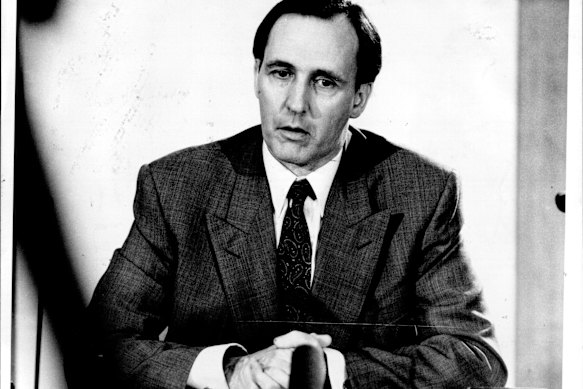

Paul Keating has described his most important declaration about the state of the economy as a weighty truth lifted from his shoulders – but it may not have happened but for a woman washing some heavy pots.
May 14 marks the 40th anniversary of Keating’s famous “banana republic” declaration, a turning point in Australian economic history that many analysts argue shifted the public’s understanding of the financial challenges facing the country.
At a time when US President Donald Trump garners headlines for social media posts about the Pope being soft on crime, Keating’s commentary today may seem almost quaint.
But the then treasurer, in a few choice comments, upended commodity markets, the Hawke government and the economic commentariat.
In Melbourne’s eastern suburbs for a breakfast event, Keating did a radio interview with the Sydney-based John Laws, who at the time was one of the nation’s most important broadcasters.
Pushed on the state of the country, and new figures revealing the nation’s current account deficit – when the value of a nation’s imports of goods, services and investments exceeds its exports – was 6 per cent of GDP, Keating declared that without policy change “Australia would end up a third-rate economy, a banana republic”.
His comments, alongside warnings about the state of the current account deficit, the speed at which the economy could grow, and interest ratings, had an immediate impact measured in a near 5¢ drop in the value of the Australian dollar against the US dollar.
It created political havoc for then-prime minister Bob Hawke, travelling in Japan at the time, who had to argue the pair were aligned in their views on the strengths of the economy.
More importantly, it was a rallying cry used by proponents of reform – led by Keating.
Reflecting on that one radio interview, Keating described it as a near-religious moment.
“The remark, made under inhospitable circumstances and time pressure, burst from me like a truth fountain – something I was not particularly intent on saying via a radio interview, but which, as the thread of the argument went, the logic of it compelled its delivery,” he told this masthead.
“And in the saying of it, the truth of it lifted a weight off me.
“From that moment, the century-long cast of Australian economic policy changed.”
But it was a heavenly revelation born in a hellish situation.
“I took the call on a wall phone in the kitchen of [a] wedding venue which had just serviced a very large complement of people for breakfast,” he said.
“An older lady generating lots of noise was emptying and washing a collection of large metal pots and plates from the breakfast but was obviously annoyed by my presence on the phone at the end of her bench. She looked askance at me, daggers really, and kept up the clanging as I spoke to Laws.”
This week, as Treasurer Jim Chalmers delivered a budget that has spending at 26.8 per cent GDP, Keating paid tribute to several key ministers who helped slice government expenditure by tens of billions of dollars.
He said people such as Peter Walsh, Brian Howe, Ralph Willis and John Dawkins, many of whom sat on the expenditure review committee, were instrumental in driving spending down to levels that no subsequent government has ever achieved.
According to Keating, his commentary in that interview and the actions taken by the Hawke government delivered an enviable economic outcome.
“The changes set Australia up for 30 years of low inflationary growth – the income surge which has since made Australia one of the wealthiest countries in the world,” he said.
Independent economist Chris Richardson, who was working at Treasury at the time, said Keating’s comments were aimed at a community that had effectively adopted a “she’ll be right, mate” approach with no agitation for reform.
“Business people didn’t think we could change. People thought we couldn’t change. The public service said we couldn’t change,” he said.
“Australians have for a long time thought things are okay, it doesn’t have to change. But Keating showed the place had to change.
“I don’t think [now] is as bad as it was in the early parts of the 1980s, but it’s a similar story. We’ve left a lot of crap just stay in place.”
Productivity Commission chair Danielle Woods said while the world had changed over the past 40 years, the message at the heart of the “banana republic” comment remained.
“We need to boost our dynamism and productivity or risk our living standards continuing to flatline. Serious policy reforms helped do that through the 1980s and 1990s, and they can again,” she said.
“The challenge for government is not to lose sight of the prize and to push through to delivering and delivering well.”
Cut through the noise of federal politics with news, views and expert analysis. Subscribers can sign up to our weekly Inside Politics newsletter.
 Shane Wright is a senior economics correspondent for The Sydney Morning Herald and The Age.Connect via X or email.
From our partners
Disclaimer : This story is auto aggregated by a computer programme and has not been created or edited by DOWNTHENEWS. Publisher: www.smh.com.au


