
Updated ,first published
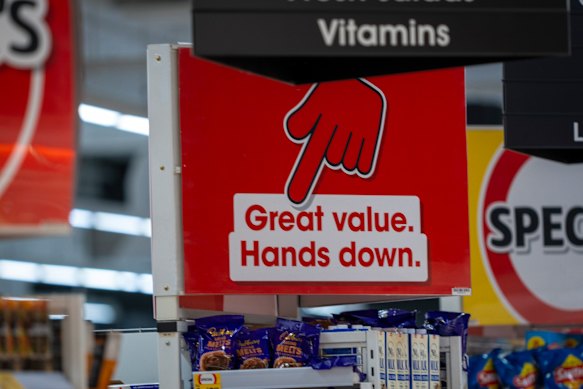
Coles could be on the hook for hundreds of millions of dollars in fines and compensation costs for spruiking fake discounts to more than 10 million shoppers, after the Federal Court ruled the supermarket giant misled Australians for years through its “Down Down” program.
Federal Court Justice Michael O’Bryan upheld allegations from the Australian Competition and Consumer Commission (ACCC) that Coles’ discounts were only a reduction from increased prices that were available for too short a period for customers to believe they were genuine.
Coles’ shares had fallen 2.4 per cent on Wednesday afternoon, as the supermarket considers whether to appeal and the regulator looks towards “substantial” penalties.
The decision took many in the sector off guard. One supermarket industry source not authorised to speak publicly said they were surprised by O’Bryan’s decision to ultimately side with the ACCC given the tenor of his questioning during the hearings.
The ACCC had argued that Coles artificially jacked up prices for hundreds of products for a brief period so they could say their new prices were a reduction on its previous one, when in fact the “Down Down” price was higher than just a few weeks before.
Coles defended the claims, arguing their discounts were genuine specials to help customers and sales after prices rose because of inflation.
O’Bryan found that Coles increased prices because suppliers wanted that to happen. “Coles increased the prices in a commercially justifiable manner,” O’Bryan said in a summary of his judgment.
But he said that they needed to be sold for 12 weeks at the higher price before customers would consider the discounts genuine. Most of Coles’ products were at the higher price for just four weeks. As a result, he found Coles had misled customers.
“The relevant products were not sold at the ‘was’ price stated on the ticket for a reasonable period, and, as a consequence, the discount represented on the tickets was not genuine,” O’Bryan said.
“In offering the sample products on those ‘Down Down’ tickets, Coles engaged in conduct in trade or commerce that was misleading, in contravention of … the Australian Consumer Law, and made a misleading representation with respect to the price of the sample products.”
Highest penalties for breaches of the Australian Consumer Law
- Phoenix Institute of Australia: $438 million. For unconscionable conduct, after students were misled into thinking the vocational courses they were enrolling in were free.
- Australian Institute of Professional Education: $153 million. For unconscionable conduct, as well misleading or deceptive conduct, when enrolling consumers into online diploma courses that were promoted as “free” but incurred VET FEE‑HELP debts.
- Volkswagen: $125 million. For making false representations about compliance with Australia’s diesel emissions standards.
O’Bryan’s judgment comes ahead of his ruling in separate, but very similar proceedings against Woolworths by the ACCC, which he is also presiding over.
At the height of public fury about inflation in late 2024, the consumer watchdog lobbed legal bombshells at Coles and Woolworths by accusing them of the fake discounts on products that were the same price or even higher than before.
Coles said it was reviewing the judgment. “The court found that all price increases resulted from supplier cost price increases and were, therefore, commercially justifiable,” Coles said in a statement to the stockmarket.
In a later statement to media, Coles insisted: “Our priority has always been – and will continue to be – delivering value to our customers.
“This case highlights the importance of clarity for both retailers and customers alike. And the need for clear, practical guidance on minimum price establishment periods to ensure the retail industry can avoid unnecessary litigation in future,” Coles said.
Assistant Minister for Competition Andrew Leigh said the decision was “an important win for shoppers, and a tribute to the ACCC’s patient, rigorous enforcement of consumer law”.
Hefty penalty expected
ACCC chair Gina Cass-Gottlieb said she was “happy” with the outcome and that the regulator would be pursuing a major penalty against Coles, which made $1.1 billion in profit last financial year.
“The ACCC will seek a substantial penalty, reflecting the importance of accurate pricing for consumers and also because it is very important that a penalty is not just able to be dismissed as a cost of doing business, and that it becomes at a level that is a significant deterrent for such conduct,” Cass-Gottlieb said.
“The ACCC brought this case in the public interest because we considered that Coles’ pricing practices within its ‘Down Down’ program made it harder for customers to identify genuine value for money while shopping for household essentials,” she said.
While Cass-Gottlieb would not speculate on the potential penalties given the ongoing deliberations over the parallel case against Woolworths, others say Coles will cop a severe financial hit over the matter.
In addition to penalties for breaking consumer law, which have previously run into the hundreds of millions of dollars in other cases, Coles could have to pay damages, including from a class action case linked to the ACCC’s proceedings.
Former ACCC chair Allan Fels said Coles’ penalties could easily exceed $100 million, and the financial penalties needed to be in the hundreds of millions to act as a deterrent.
“The repercussions for Coles now will be very big, I’d expect the fines to be very high, in the hundreds of millions of dollars in penalties,” he predicted.
While O’Bryan found Coles had misled consumers, his judgment also said that if Coles had offered the products for sale at the “was” price for a longer period before the “Down Down” price, it would not have been misleading. He said this “raises the question whether consumers were harmed by the conduct.”
Rod Sims, who preceded Cass-Gottlieb at the ACCC, said the decision sets a precedent well beyond supermarkets and across Australian retail broadly.
“This is a big win for consumers because it means that if you’re telling customers they’re getting a discount, there’s got to be a real basis for saying that. It raises the bar for calling something a discount, you can’t just be flippant about it,” Sims said.
Beyond court-ordered penalties, Coles could also face hefty compensation payouts.
Gregory Mackey, special counsel at Gerard Malouf & Partners which brought the attached class action against Coles, said that pending any appeals, the next step would be calculating damages and compensation.
Mackey said the class action represents an estimated 10 million customers, given an “opt-out” system with a deadline that passed last year. The lawyers plan to call experts before hearings to determine payout request, but Mackey expects it will be at least another year before that process proceeds.
“Because of its loyalty program, Coles has a very good record of who bought these items and for how much. Normally we’d have no idea how to calculate this, but for a portion of these sales they have records which they can show the courts,” he said. Non-members could produce receipts or credit card statements as proof of purchase and a right to damages.
Mackey said the damages and compensation proceedings would “likely become a philosophical argument about what consumers actually lost here”.
“We’ve done surveys which found people wait until a product is on special, because they trusted Coles, and then they bought in bulk. They may not have bought it at all,” he said.
The consumer watchdog alleged Coles misled shoppers in relation to “Down Down” pricing across 245 products when filing the initial legal action.
But for the two-week hearing, the parties agreed to focus on a small number of products sold between January 2021 and May 2023, including 2 litre bottles of Coca-Cola, Colgate toothpaste, 900 gram tins of Karicare baby formula, Rexona deodorant, Lurpak butter and a box of Arnott’s Shapes.
The Business Briefing newsletter delivers major stories, exclusive coverage and expert opinion. Sign up to get it every weekday morning.
 Elias Visontay is a National Consumer Affairs Reporter at The Sydney Morning Herald and The Age.Connect via email.
From our partners
Disclaimer : This story is auto aggregated by a computer programme and has not been created or edited by DOWNTHENEWS. Publisher: www.smh.com.au