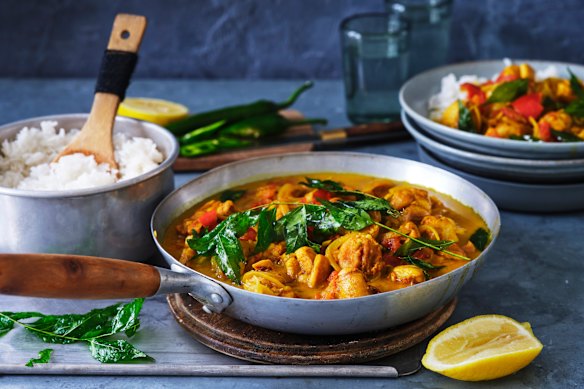
Cookbook writer Sarina Kamini shares tips to take your chicken curries from ho-hum to wow-yum, and proves you can whip up a good one in just 20 minutes.
Sarina Kamini
Chicken is Australia’s most cooked meat. And chicken curry is India’s best-loved export. Put the two together and you get a meal good enough to bring back the family dinner.
Across India’s regions, the iterations are vast. But no matter the variation – from Kashmir’s kokur rogan josh to Tamil Nadu’s Chicken Chettinad – what they all have in common is a dedicated approach to maximising deliciousness.
Here are some quick tips to take your chicken curry efforts from ho-hum to wow-yum.
Introducing … the curry cut
Forget skinless and boneless. The chicken “curry cut” is the cut-to-order gold standard among Indian butchers. The curry cut means chopping the chicken into pieces, keeping the skin and bone intact. So a leg might be cut into three horizontally, while the thigh might be quartered.
The best recipes from Australia’s leading chefs straight to your inbox.
The reason for the curry cut is twofold. One, it eliminates waste: the whole chicken is chopped up for use. And two, you’re getting maximum flavour and cooking convenience: the pieces are small enough to cook quickly, and with the skin and the bone retained, all the texture and taste of the bird funnels into the dish.
Introducing your own butcher to the “curry cut” means your curry is off to a much better start. If you’re a supermarket meat buyer, invest in a heavy cleaver and keep your fingers out of blade range.
Start using mustard oil
Use mustard oil once, and I can guarantee it will be the start of a life-long love affair with this, the king of Indian fats. Mustard oil is made from pressed mustard seeds. Once impossible to find in Australia, it’s since become a regular on major supermarket shelves right by the pickles and the pappadum. Mustard oil’s superpower is that its intense wasabi-like aroma penetrates the chicken meat, while its heavy viscosity ensures any spice used will really stick.
I use mustard oil for every chicken dish I make, from cacciatore to my dad’s famous Kashmiri chicken curry. Start your curry with two tablespoons of mustard oil for 700 grams of chicken, browning the meat on high heat until the outside is a little caramelised. Add your spices, then the tomato or coconut milk base, and step into a new world of flavour.
How to make a 20-minute chicken curry
Yes, it’s possible. This is a combination of stir-fry and high-heat cooking, Indian-style. Start with the curry cut, mustard oil and a heavy-based wok or pot. Add a few tablespoons of mustard oil and set to very high heat. Once it reaches smoking point, toss in your chicken pieces with some salt and a little whole spice – a cinnamon stick, a few bay leaves and some cloves, if you have them handy.
Continue to cook over high heat for a few minutes before adding 1 teaspoon of chilli powder stirred through 3 to 4 tablespoons of water, deglazing the vessel and taking a little heat out of the cook.
Toss in some diced tomato, add the masala (see below), and cook for a minute or two, until the aroma develops and the spices are no longer raw. Return your browned curry-cut chicken to the pan and cook for 20 minutes or until cooked
through. You can finish the dish by stirring through some fresh spinach or cooked peas. Serve with white rice.
The masala
In this context, masala means a collection of spices used together. With a recipe like this, where time and convenience are factors, there’s no need to stage the spicing. Everything can go in at once, at the beginning of the cook. The key is to heat the mustard oil, then toss in chopped tomatoes, yoghurt or coconut milk as a curry base before adding the spices – the liquid addition protects them from burning in the oil.
Masala ingredients
- 1 tsp fine pink salt
- 2 tsp cumin seed
- 1 tsp chilli powder
- ½ tsp turmeric powder
- 1 tsp ginger powder
- 2 tsp fennel powder
- 2 tsp amchur (dried green mango powder), optional
Combine the spices in a katori or small bowl and keep it within reach by the stovetop so you can add it to the pan once you’ve browned the chicken.
From our partners
Disclaimer : This story is auto aggregated by a computer programme and has not been created or edited by DOWNTHENEWS. Publisher: www.smh.com.au