Updated ,first published
THEATRE
Steel Magnolias
Theatre Royal, May 14, until May 30
Reviewed by KATE PRENDERGAST
★★★★
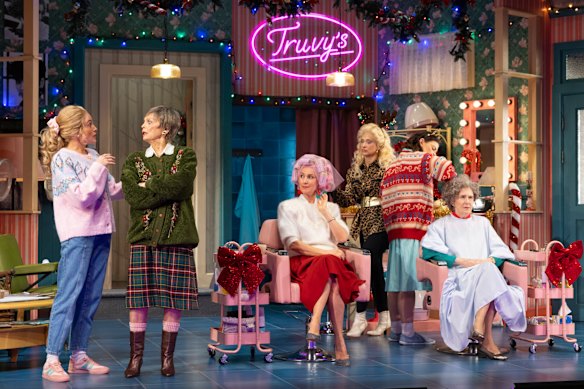
What a cosy privilege it is to be invited into the pink-and-turquoise haven of Truvy’s home salon. Here, in this secret, sacred world of curlers and fixing spray, where men’s voices can only intrude over the phone (which can be put down) or radio (which can be turned off), six lively Southern women let their hair down by doing their enormous ’80s hair up. Their seeming trivialities, vanity and gossip are given a warm treatment, proven over the course of four scenes in two acts to be part of a loving ritual of laughter, solace and strength.
Louisiana-born Robert Harling’s play, first performed off Broadway in 1987, has a touching origin story – one that would be remiss to share here for the unfamiliar. Suffice to say, Steel Magnolias sprang from Harling’s close relationship with his sister, his memories of the chatter of the women in his life, and his wish to preserve their radiant spirit. He certainly achieved more than he’d hoped with a subsequent film adaptation starring, among others, Dolly Parton and Julia Roberts, and a play that has since charmed audiences the world over. Some in Sydney may remember Nicole Kidman’s stage debut as Roberts’ counterpart in 1988, or Jacki Weaver as Dolly’s in 2009.
This production is elevated by its own luminously entertaining cast. Under Lee Lewis’ spry direction, you come to cherish every one of Magnolias’ idiosyncratic characters, all sporting honeyed Southern accents and distinctive get-ups, too. Mandy Bishop gives a winning performance as all-welcoming salon doyenne Truvy; Lisa McCune holds a nervous, poignant key as mother M’Lynn; Jessica Redmayne is a darling, defiantly sunny young Shelby. Debra Lawrance and Lotte Beckett have delicious comic moments, one as wealthy widow Clairee spreading later-life wings, the other as newcomer Annelle, a born-again Christian who’s escaped a no-good ex. Belinda Giblin is hilarious as the cantankerous, fashion-averse Ouiser – the odd one in overalls we couldn’t do without.
The plot? Well, first, Shelby is getting married. Then, against her doctor’s advice given her serious diabetes, she’s having a baby. (Her mother frets.) Then Shelby has the baby. In terms of what’s going on, as measured by dramatic action – not much. We don’t even see Shelby getting married, or pregnant, or with a baby boy. She escapes reduction as “wife” or “mother”.
But dramatic action is not the point. There’s some tragedy here, but it isn’t Greek. The point is the dialogue; where “idle chatter” is at once an art form in comic repartee and an elixir; where everything that is hard to talk about can be safely shared; where the light touch is a salve to real pain. Simone Romaniuk’s gorgeous set – patterned wallpaper, pink swivel chairs – is like a character in itself, suffused in a golden hour light.
Sweetly sentimental, Steel Magnolias is a romanticised yet heartwarming portrait of female friendship in a unique gathering place, where rosy pearls of homespun wisdom glimmer among the nail polish and helmet dryers. It’s much better than the film, by the way. Get Dad to take your mum.
MUSIC
The Waterboys
State Theatre, May 14, Until May 15
Reviewed by GEORGE PALATHINGAL
★★★½
For a man whose band peaked, commercially at least, about 40 years ago, Mike Scott has to be commended for his dogged resilience and determination to always look forward.
It’s hard to say whether the devoted Waterboys fans back him on the latter point especially. On the one hand, they all seemed to leave happy on this night, with an encore of (an actually slightly underwhelming) The Whole of the Moon ringing in their ears, but they weren’t always patient during the show.
They were largely respectful and appreciative of the Scotsman’s post-’80s material, for sure, but restless heckles for those big old pop-rock-folk favourites came even before he’d got to the show’s centrepiece: a run through songs from The Waterboys’ curiosity of an album from last year, Life, Death and Dennis Hopper.
Perhaps Scott read the room; perhaps he learnt from what one could surmise was a similar response at the Perth shows earlier this week. Either way, he stayed true to his word of playing just “five or six” songs from the pretty good recent album – a rock’n’roll-country-gospel kind of biography of the great American actor, Hopper – rather than the eight or more he went with in Perth and elsewhere around the world.
Scott still knows his way around a hot guitar riff and a quality tune, though, so whether he was blasting through fiery new songs such as this year’s Don’t Even Have to Say His Name (about a certain, uh, divisive American leader) or tearing through peak-period classic Be My Enemy, the show was always entertaining. It certainly didn’t hurt that one of his keyboard players, a likeable livewire known as “Brother” Paul Brown, wasn’t afraid of hamming it up and grabbing the attention.
But some of the little things, usually when it came to the big songs, irked. While Fisherman’s Blues had many out of their seats and dancing in the aisles, the fact that Brown was trying to emulate the original’s glorious fiddle parts on a (gulp) keytar wasn’t ideal. Likewise the fact that The Whole of the Moon ambled along and threatened to explode, frustratingly without doing so.
A bit of a mixed bag, then – but at least not in the way you might have expected.
MUSIC
Audrey Hobert
Enmore Theatre, May 13
Reviewed by NADIA RUSSELL
★★★★
If you knew that Audrey Hobert’s initial musical breakthrough was co-writing for her friend and singer Gracie Abrams, you’d think her sound might be similar – yet it couldn’t be more different.
Hobert is quirky and weird and has that girl-next-door vibe but her storytelling in a 45-minute set is like no other – there’s no elaborate on-stage production, just her band, some lights and herself and yet somehow she transports the crowd to her own coming-of-age, sitcom-esque setting in New York, with influences of Friends and Sex and the City sprinkled throughout in her songs.
Right out the gate, she sings I like to touch people wearing Groucho glasses and playing a banjo to the enthusiastic crowd, mostly made up of teens and young adults wearing plastic tiaras and pigtails. The opening is frenetic – Hobert changes outfits several times in three numbers in between moments of black where sound effects take over to tell the story, with car sounds leading into Drive and spoken words that push the show along.
During her third number Wet Hair she performs a rambling, endearing monologue about her experience growing up an outsider only to have now transformed into a shining star, and shining she is.
Hobert’s stage presence is unmatched. Her band fades into the background as she runs around energetically. There’s rarely a slow moment to be found throughout the show. Her vocals never falter though – her voice is crisp and strong even as she runs around. She’s also a consummate professional and it’s hard to believe this is a tour for her debut album.
The upbeat Thirst Trap is an immediate crowd pleaser, but it’s Hobert’s favourite song to perform – Phoebe – that has all the girls in the crowd screaming “I think I’ve got a f—ed-up face,” in catharsis.
The 45-minute set is great if you’re trying to have an early night and understandable given her small discography, but despite the energy she brought it did feel a little underwhelming. But she plays the entirety of her album, and Sue Me twice during the encore. Not a single second of the 45 minutes is wasted, and the energy among the audience says that it was absolutely worth it.
THEATRE
The Happiest Man on Earth
Playhouse, Sydney Opera House, until May 17
Reviewed by HARRIET CUNNINGHAM
★★½
Eddie Jaku’s story came to the attention of the world when, in his 90s, he finally began sharing memories that he had spent a lifetime trying to forget. Going from happy schoolboy to pariah, overnight, in 1932. Coming of age on Kristallnacht. Surviving Buchenwald. Surviving Auschwitz. Surviving the Death March. Just.
Now Eddie’s bestselling memoir, The Happiest Man on Earth, has been adapted for the stage by US writer Mark St Germain. It is a well-crafted monologue, a blow-by-blow account of Eddie’s life in Nazi Europe, framed by an appeal from the older Eddie to put family first, second and last, with the crucial reminder, ‘We are all family.’
The Happiest Man on Earth takes us from his Australian backyard, complete with Hills Hoist, to pre-war Leipzig, across borders to Belgium, through wartime France to Dunkirk and Lyon, then back to Germany and on, into German-occupied Poland, before making a home in Sydney.
The action-packed journey is brought to life with an array of props of the kind you might find in your grandfather’s backyard. Old tyres become a factory floor, and a ladder helps Eddie hide his greatest friend, while stepping stones in the lawn become points on Eddie’s journey. The events of 1933-1945 drive the drama, and it feels like a missed opportunity that the rest of Eddie’s life, including his lifelong advocacy for peace and kindness, becomes something of an afterthought.
Anton Berezin, as Eddie, sustains the role and a German accent with heroic focus across 80 minutes of non-stop storytelling. It is, however, a tough fight, particularly with technical issues on opening night. The constant stage business – climbing up and down the ladder, in and out of the shed, on the porch, off the porch, with bucket, without bucket – is not always successful, asking Berezin to act out the story with makeshift literalism, rather than letting the words speak for themselves.
The lighting (Finnegan Comte-Harvey), while quietly atmospheric for the main part, picks out Berezin’s forehead mic with distracting clarity at one point. The underscore (Sam Weiss) is subtle but when Eddie uses a handkerchief to wipe his brow that pesky mic upstages the action with a rasp of feedback. One moment of genuine theatrical impact is when Eddie strips off his top layers (costumes and staging by Jacob Battista) and stands before us, his striped business shirt transformed into a concentration camp uniform.
The Happiest Man on Earth is presented by the Shalom Collective, a bundle of Sydney-based non-profit organisations using cultural experiences to facilitate intergenerational storytelling. It’s a brilliant concept: in spite of first night frustrations, the shared experience of sitting in a full theatre, bearing witness as a community, is powerful and moving. Eddie died aged 101 in 2021, but his story lives on. The standing ovation greeting Berezin’s curtain call was both sincere and well-deserved.
THEATRE
ROMEO AND JULIE
KXT on Broadway, May 13
Until May 23
Reviewed by JOHN SHAND
★★★★
No, that’s not a typo in the title: this is Welsh playwright Gary Owen’s contemporary take on star-crossed lovers, now set in Cardiff rather than Verona. His Romeo – called Romy (rhymes with “foamy”) – and Julie also have problematic parents, but there’s no feud. What thwarts this pair’s love is Julie’s having a chance to study physics at Cambridge, while Romy, well, he’s illiterate and a single dad courtesy of the last teen he got pregnant.
Claudia Barrie’s Mad March Hare production is exceptionally well cast and performed, and she’s found two new-generation gems to play the leads. Estelle Davis is luminous in portraying everything from Julie’s incisive intelligence to her exquisite revulsion when drinking rough red. Alex Kirwan captures perfectly Romy’s boyish wonderment being fast-tracked into manhood by the ceaseless demands of his new baby, Niamh (pronounced “Neeve”).
Geita Goarin’s simple set on the traverse stage has a multipurpose rostrum, a daybed, and two “clotheslines”, on which hang what could be torn nappies or the shredded sheets of love (very occasionally obscuring one’s view).
Barrie, herself, plays Barb, Romy’s hard-nosed, hard-drinking mum, who’s done with child-raising, but while soiled nappies are entirely Romy’s business, the part of her heart that hasn’t been ransacked by booze is happy to share her two-room flat with her son and granddaughter.
Christopher Stollery (whom, coincidentally, I first encountered playing Mercutio in Romeo and Juliet some 33 years ago) is Julie’s gruff father, Col, who wouldn’t be averse to solving the Romy problem with his fists. Linda Nicholls-Gidley not only plays Kath, Julie’s step-mum, she’s also the accent and dialect coach, and has highly successfully landed all five actors on the same page of lilting Cardiff Welsh, with bouncy, dieresis-creating vowel extensions, whereby “school” becomes “sku-ell”.
Every character’s heart is laid bare, however much they want to swaddle it up like little Niamh’s body, and everyone’s likeable, however grossly flawed. “You be kind to my boy when you’ve had enough of him,” Barb tells Julie, and part of the play’s sophistication is the acknowledgement of different forms of intelligence, so Romy’s moral intelligence can match Julie’s IQ. He teaches her how to be a mother, and she begins to teach him to read.
But few people get their lives right, and then only with some wrenching decisions along the way, and you see the potential doom of Romy and Julie’s affair looming on the horizon some way out. As with his Iphigenia in Splott, however, Owen has another problem with his ending. In Iphigenia, he concluded by spelling out themes already expounded by the play. Here, he lets sinewy reality start to froth towards soapiness, which is only exacerbated by sound designer Josh Anderson giving us a swelling, Hollywood-style underscore in the final scene. This story, these characters and these compelling performances deserved better.
CLASSICAL
From Prague to Tasmania: Baroque Without Borders
Utzon Room, Sydney Opera House, May 10
Reviewed by PETER McCALLUM
★★★★½
When I first encountered early 17th century music several decades ago, I confess I found much of it more interesting than successful. No sooner would a section begin with sweet polyphony, a plaintive recitative or a spirited dance than it would stop and head off in a totally different direction as though eager to sample all the new possibilities that early baroque basso continuo technique offered, yet without developing any one of them in any depth. While that partly reflects my anachronistic perspective at the time, there is no doubt that the sophistication of performers playing this music has progressed in leaps and bounds since.
Enter CzechMate, an expert quartet put together by Australian-born historical bassoonist Jane Gower, with Swedish harpsichordist Lars Ulrik Mortensen, Czech baroque violinist Helena Zemanová and Melbourne-born violinist Julia Fredersdorff in a superb program of Italian, German and Austrian early baroque instrumental works.
Combining a persuasive sense of rhythmic freedom, accent and melodic direction with exquisitely coloured tonal focus, they created a stylish inner musical narrative in which the music’s hyperactive volatility was, as Shakespeare put it, no more troubling than a dream.
In Dario Castello’s Sonata 9, the violins played lines of silvery luminescence, Mortensen drew elegantly nuanced accents from the harpsichord, while Gower, playing the dulcian, an early bassoon-like instrument fashioned from a single piece of cherrywood, supplied richly textured lines with the subtly fuzzy finish of brown velvet. In Sonata Seconda by Giovanni Battista Fontana, Zemanová’s tone combined singing sweetness with bold expressive projection, not to mention impeccable intonation.
Mortensen played Toccata VII by Michelangelo Rossi as though his fingers were in direct contact with the harpsichord strings, shaping the articulation with the intimate expressiveness of a clavichord. In 2 Ricercares by Diego Ortiz, Gower mined the expressive range of her noble instrument further, and gave emphatic resonance to its splendidly low bass in Dario Castello’s Sonata 10. Francesco Turini’s Sonata 19 mixed serene polyphonic textures of radiantly clear string tone with brief eruptive moments of furious activity.
Moving to German music, Johann Balthasar Erben’s Sonata ut-re-mi was structured around mellifluous imitation, while in Philipp Friedrich Buchner’s Sonata 8, Fredersdorf adorned the flowing lines with suave ornamentation. As though to summarise, and even parody what had gone before, Johann Heinrich Schmelzer’s Polnische Sackpfeifen mixed gracious contrapuntal passages with heavy dances, folk-like hijinks and bagpipe drones, ending not with a thump, but an enigmatic question, left hanging.
The Booklist is a weekly newsletter for book lovers from Jason Steger. Get it delivered every Friday.
 Nadia Russell is a social media producer at The Sydney Morning Herald.
 John Shand has written about music and theatre since 1981 in more than 30 publications, including for Fairfax Media since 1993. He is also a playwright, author, poet, librettist, drummer and winner of the 2017 Walkley Arts Journalism AwardConnect via X.
From our partners
Disclaimer : This story is auto aggregated by a computer programme and has not been created or edited by DOWNTHENEWS. Publisher: www.smh.com.au